

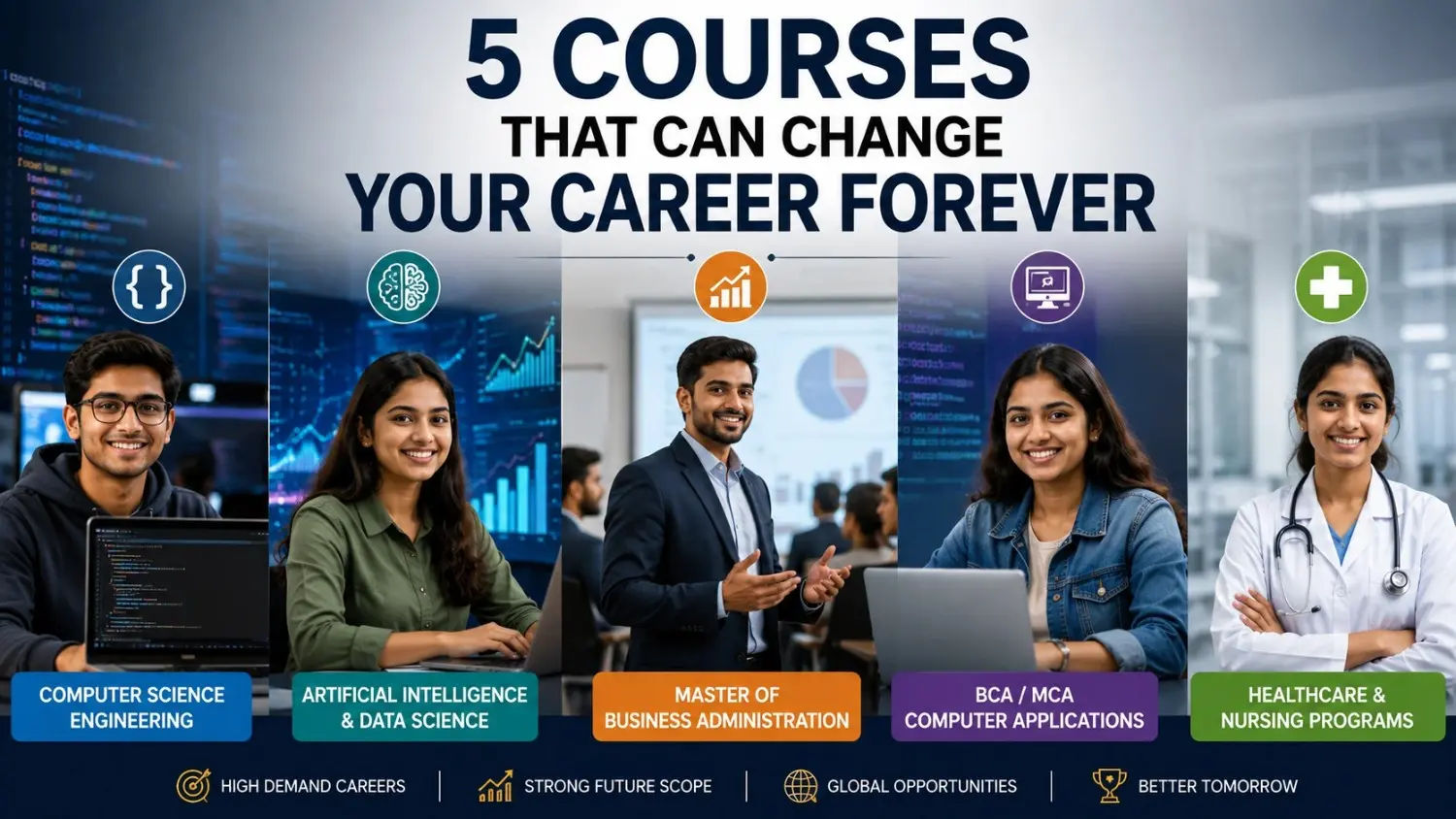
5 Courses That Can Change Your Career Forever
Choosing a course is often treated as a simple academic decision. In reality, it can influence the skills you develop, the industries you enter, the people you meet, and the opportunities available to you years later.
But there is a problem: students today have more choices than ever.
Technology, artificial intelligence, healthcare, business, cybersecurity, data, and digital transformation are creating new career paths while changing traditional ones. So, instead of asking only “Which course is popular?”, a better question is:
“Which course can give me skills that remain valuable as the job market changes?”
This guide explores five courses with strong long-term potential and explains who should consider them, what careers they can lead to, and how to make the most of them.
Quick Answer: Which Courses Can Change Your Career?
Five strong options are:
- B.Tech in Computer Science and Engineering
- Artificial Intelligence & Data Science
- MBA
- BCA/MCA
- Healthcare and Nursing Programs
These courses are not automatically right for everyone. Your interests, academic background, financial situation, location, skills, and career goals should influence your final decision.
1. B.Tech in Computer Science Engineering
Computer Science Engineering remains one of the most versatile choices for students interested in technology.
A B.Tech in CSE can provide a foundation in programming, algorithms, databases, computer networks, software engineering, and emerging technologies.
Career Opportunities
A graduate can potentially move into roles such as:
- Software Developer
- Full-Stack Developer
- Cloud Engineer
- DevOps Engineer
- Data Engineer
- Cybersecurity Professional
- AI/ML Engineer
- Systems Analyst
The biggest advantage is flexibility. You do not necessarily have to stay in one technology throughout your career.
A student might begin as a software developer and later move into cloud computing, cybersecurity, product management, artificial intelligence, or entrepreneurship.
Who Should Choose CSE?
CSE may suit you if you:
- Enjoy computers and technology
- Like solving problems
- Are comfortable learning continuously
- Have an interest in programming
- Want access to international technology careers
One thing many beginners miss is that the degree alone is not enough. Projects, internships, communication skills, coding ability, and practical experience can make a major difference.
2. Artificial Intelligence & Data Science
If you are looking for a career connected to one of the biggest technological shifts of this decade, AI and Data Science deserve serious attention.
Organisations across industries increasingly rely on data to make decisions, while AI is being integrated into software, finance, healthcare, manufacturing, marketing, education, and other sectors.
What Do You Learn?
Depending on the program, students may study:
- Python
- Statistics
- Machine Learning
- Data Analytics
- Deep Learning
- Databases
- Natural Language Processing
- Data Visualization
- Artificial Intelligence
Career Options
Possible career paths include:
- Data Analyst
- Data Scientist
- Machine Learning Engineer
- AI Engineer
- Business Intelligence Analyst
- Data Engineer
- AI Product Specialist
This field can be highly rewarding, but it is not a shortcut to a high salary.
You need mathematical thinking, programming fundamentals, analytical ability, and the willingness to work with complex problems.
A Smart Beginner Approach
Do not try to learn every AI technology at once.
Start with Python → statistics → SQL → data analysis → machine learning, then specialise.
That structured approach is usually more effective than jumping directly into advanced AI tools.
3. MBA — Master of Business Administration
Not every successful career is built around coding.
Businesses need people who can understand markets, manage teams, analyze financial decisions, develop strategies, communicate with customers, and lead organizations.
That is where an MBA can become valuable.
Popular MBA Specialisations
Students can explore areas such as:
| Marketing | Brand Management, Digital Marketing, Sales |
| Finance | Financial Analysis, Banking, Investment |
| HR | Recruitment, Talent Management |
| Business Analytics | Data-driven Business Decisions |
| Operations | Supply Chain, Operations Management |
| International Business | Global Business & Trade |
An MBA can be particularly useful when combined with previous technical or professional knowledge.
For example, a BCA graduate may move toward technology management, while an engineering graduate could specialize in operations, finance, marketing, or product management.
Who Should Consider an MBA?
MBA may suit students and professionals who enjoy:
- Leadership
- Business strategy
- Communication
- Decision-making
- Management
- Entrepreneurship
If you are comparing business-oriented degrees, our guide on BBA vs BCA career options can also help clarify which undergraduate direction fits different interests.
4. BCA / MCA — Computer Applications
You do not necessarily need a traditional engineering degree to build a career in technology.
BCA offers an undergraduate route into computer applications and IT, while MCA can provide advanced technical education after graduation.
Students can study areas such as:
- Programming
- Web Development
- Database Management
- Software Engineering
- Cloud Computing
- Networking
- Cybersecurity
- Artificial Intelligence
Possible Career Paths
BCA/MCA graduates can work toward roles such as:
- Software Developer
- Web Developer
- Application Developer
- System Analyst
- Technical Consultant
- Full-Stack Developer
- IT Support Specialist
The important part is specialisation.
A student who completes BCA but never develops practical technical skills may struggle against candidates with strong portfolios.
On the other hand, someone who builds projects, completes internships, learns modern development tools, and develops communication skills can create a much stronger profile.
Students already considering what to do after BCA can explore this detailed postgraduate courses after BCA guide.
5. Healthcare and Nursing Programs
Technology gets enormous attention, but healthcare remains one of the most important career sectors worldwide.
Healthcare programs can lead to careers where professional knowledge, practical skills, responsibility, and human interaction all matter.
Depending on your eligibility and country, options may include:
- Nursing
- MBBS
- Pharmacy
- Physiotherapy
- Public Health
- Medical Laboratory Sciences
- Healthcare Management
Why Healthcare Can Be a Strong Career Choice
Healthcare professionals are needed across hospitals, clinics, rehabilitation centers, laboratories, community health organizations, and other healthcare settings.
Nursing, in particular, can offer career opportunities in different countries, although international practice generally requires meeting the destination country's licensing, registration, language, and qualification requirements.
For international students exploring education pathways, Vidya Udbhav's Study in India guide for international students provides additional context.
What Makes a Course “Career-Changing”?
A course becomes career-changing when it does more than provide a certificate.
Look for a program that develops:
- Practical skills
- Industry knowledge
- Problem-solving ability
- Communication
- Professional networks
- Internship opportunities
- Adaptability
- A pathway to specialization
A degree can open the door. Your skills and experience determine what happens after you enter.
How to Choose the Right Course
Here is a simple five-step method.
Step 1: Understand Yourself
Ask:
What subjects do I genuinely enjoy?
Interest does not mean you need to love every subject. But if you strongly dislike the core work involved in a career, staying motivated for several years can become difficult.
Step 2: Identify Your Strengths
Are you better at:
- Mathematics and logic?
- Communication?
- Creativity?
- Leadership?
- Scientific thinking?
- Technology?
- Working with people?
Your strengths can help narrow your choices.
Step 3: Research Career Outcomes
Do not look only at course names.
Research:
- Job roles
- Required skills
- Internship opportunities
- Industry demand
- Higher education options
- International opportunities
- Typical career progression
Vidya Udbhav's research on courses with strong placement opportunities can help students compare career-oriented programs.
Step 4: Compare Colleges, Not Just Courses
The same course can provide very different experiences at different institutions.
Check:
- Curriculum
- Faculty
- Laboratories
- Industry exposure
- Internships
- Placement record
- Alumni outcomes
- Fees
- Location
- Student support
Step 5: Think Beyond Your First Job
Your first job is only the beginning.
Ask yourself:
“Where can this course take me after five or ten years?”
That question often produces a better decision than simply comparing starting salaries.
Beginner Strategy vs Advanced Strategy
For Beginners
Start with three things:
- Understand your career interests.
- Shortlist three relevant courses.
- Compare colleges and career outcomes.
Do not select a course because everyone around you is choosing it.
For Advanced Career Seekers
If you already have a degree or work experience, consider combining your existing knowledge with a high-demand specialisation.
For example:
Technology + Management = Tech Management
Healthcare + Management = Healthcare Management
Business + Analytics = Business Analytics
Programming + AI = AI Engineering
This combination approach can create differentiated career profiles.
Common Mistakes to Avoid
Choosing Only Because of Salary
High salary numbers can be attractive, but they do not guarantee career satisfaction.
Following Friends
Your friend's strengths and goals may be completely different from yours.
Ignoring Skills
A degree without practical skills can become a weak career investment.
Choosing a College Without Research
Check curriculum, faculty, placements, fees, and student outcomes before making a decision.
Ignoring Future Learning
Industries change. Your learning should not stop when your course ends.
Future Trends Students Should Watch
The next generation of careers will increasingly reward people who can combine technical knowledge with human skills.
Important areas to watch include:
- Artificial Intelligence
- Data Analytics
- Cybersecurity
- Cloud Computing
- Healthcare Technology
- Automation
- Digital Business
- Sustainable Technology
- Business Analytics
- Human-AI collaboration
This does not mean every student should choose AI or technology.
Instead, understand how technology is changing your chosen industry and develop skills accordingly.
Expert Tips for a Better Career Decision
Before paying your admission fee, answer these questions:
- What job roles can this course lead to?
- What skills will I actually learn?
- Does the curriculum match current industry needs?
- What internships are available?
- What are my higher-study options?
- Can this qualification support international opportunities?
- What is the total cost?
- What happens if I change my career direction later?
If you cannot answer these questions, research more before committing.
Final Advice
There is no single course that can guarantee a successful career.
A course can give you knowledge, exposure, qualifications, and opportunities—but your results depend on how you use them.
If you love technology, consider CSE or AI/Data Science.
If you see yourself leading businesses, consider an MBA.
If you want an accessible pathway into IT, BCA/MCA can be worth exploring.
If you are passionate about helping people through science and healthcare, healthcare and nursing programs can provide meaningful career pathways.
The smartest choice is not necessarily the course with the highest salary. It is the course that sits at the intersection of your interests, strengths, market demand, and long-term goals.
Conclusion
The right education can change more than your job title. It can change your confidence, professional network, earning potential, knowledge, and the opportunities available to you.
The five courses discussed here—B.Tech. CSE, AI & Data Science, MBA, BCA/MCA, and Healthcare/Nursing—represent different career directions with strong potential.
But remember: the best course is not the best course for everyone. It is the best course for you.
Take time to understand your strengths, research career outcomes, compare institutions, and build practical skills alongside your education.
That is how a course becomes more than a qualification—it becomes the foundation of a career.
Frequently Asked Questions
1. Which course can change your career the most?
There is no universal answer. CSE, AI & Data Science, MBA, BCA/MCA, and healthcare programs can all create strong career opportunities depending on a student's interests and goals.
2. Which course has the best future scope?
Technology, AI, data, healthcare, cybersecurity, and business analytics are among the areas with strong long-term relevance. However, future scope varies by country and industry.
3. Which course is best after 12th for a high-paying career?
Students can consider CSE, AI/Data Science, BCA, BBA, healthcare, and other professional programs. The right choice depends on eligibility, skills, interests, and career goals.
4. Is BCA a good career option?
Yes. BCA can provide a pathway into IT and software careers. Students can strengthen their prospects through programming, projects, internships, certifications, and further education such as MCA.
5. Is an MBA still valuable?
Yes, particularly for students and professionals targeting management, strategy, finance, marketing, operations, entrepreneurship, or business leadership roles. The value depends heavily on the institution, specialisation, experience, and skills.
6. Is AI and Data Science a good career choice?
It can be an excellent choice for students interested in mathematics, programming, statistics, technology, and analytical problem-solving. Continuous learning is especially important in this field.
7. Which course is best for international career opportunities?
Technology, healthcare, engineering, data, and certain business careers can provide international opportunities. However, licensing, immigration, qualification recognition, and local employment requirements differ by country.
8. Should I choose a course based on salary?
Salary should be one factor, not the only factor. Consider interest, skills, career progression, job demand, education cost, work environment, and long-term opportunities before deciding.