

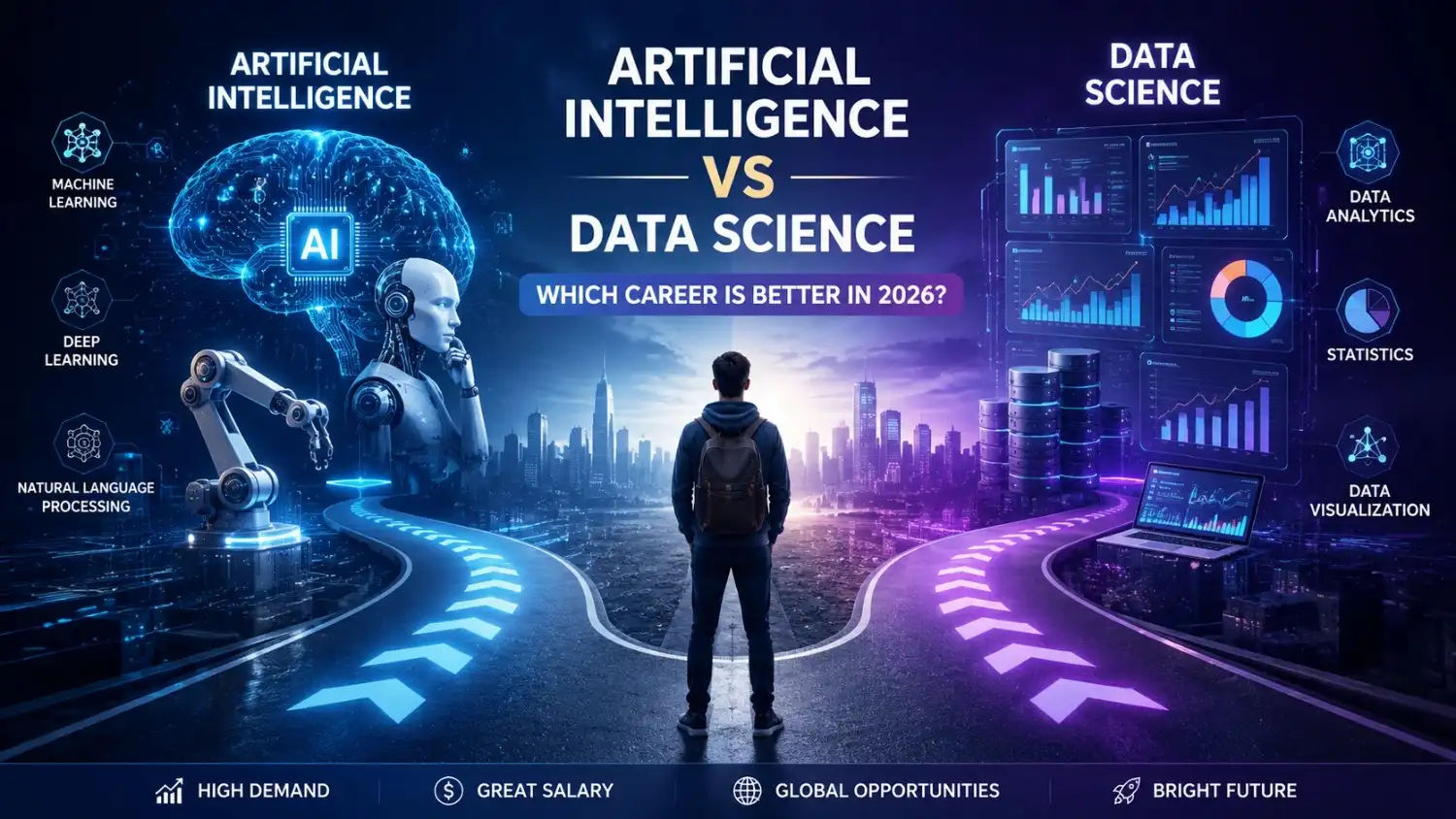
Artificial Intelligence vs Data Science: Which Career Is Better in 2026?
Artificial Intelligence (AI) and Data Science have become two of the fastest-growing career fields in the world. From healthcare and finance to education and entertainment, organizations are investing heavily in intelligent technologies and data-driven decision-making.
If you're wondering which career offers better opportunities in 2026, you're not alone. Many students and professionals face the same question before choosing a degree or certification.
The answer is not simply "AI is better" or "Data Science is better." It depends on your interests, technical skills, and long-term career goals.
If you're still exploring career options, our career planning guide at Vidya Udbhav can help you understand different technology programs and future-ready career paths.
Quick Answer
| Primary Focus | Building intelligent systems | Extracting insights from data |
| Main Skills | Machine Learning, Deep Learning, NLP | Statistics, Analytics, Visualization |
| Coding Level | High | Moderate to High |
| Mathematics | Advanced | Strong Statistics |
| Demand in 2026 | Extremely High | Very High |
| Best For | Problem solvers and innovators | Analytical thinkers |
| Career Growth | Excellent | Excellent |
What Is Artificial Intelligence?
Artificial Intelligence is the field of computer science that enables machines to perform tasks that typically require human intelligence. These include learning, reasoning, language understanding, image recognition, and decision-making.
AI combines several technologies, including:
- Machine Learning
- Deep Learning
- Natural Language Processing (NLP)
- Computer Vision
- Robotics
Popular AI applications include virtual assistants, autonomous vehicles, fraud detection, recommendation systems, and healthcare diagnostics.
What Is Data Science?
Data Science focuses on collecting, cleaning, analyzing, and interpreting data to solve business problems.
A Data Scientist transforms raw information into valuable insights that help organizations make informed decisions.
The field combines:
- Statistics
- Programming
- Data Visualization
- Machine Learning
- Business Intelligence
Companies rely on Data Science to improve customer experiences, predict market trends, optimize operations, and reduce costs.
Artificial Intelligence vs Data Science: Key Differences
| Goal | Build intelligent systems | Analyze and interpret data |
| Output | Smart automation | Business insights |
| Core Technologies | AI, ML, Deep Learning | Analytics, Statistics, ML |
| Programming | Python, C++, Java | Python, R, SQL |
| Mathematics | Linear Algebra, Calculus | Statistics, Probability |
| Industries | Robotics, Healthcare, Finance | Every data-driven industry |
Skills Required for Each Career
Artificial Intelligence
Successful AI professionals usually develop skills such as:
- Python Programming
- Machine Learning
- Deep Learning
- Neural Networks
- NLP
- TensorFlow
- PyTorch
- Computer Vision
- Mathematics
- Algorithm Design
Data Science
Data Scientists often specialize in:
- Python
- SQL
- R Programming
- Statistics
- Data Visualization
- Tableau
- Power BI
- Excel
- Machine Learning
- Business Analytics
One thing many beginners miss is that both careers require continuous learning because technology evolves rapidly.
Career Opportunities in 2026
Artificial Intelligence Jobs
Popular AI roles include:
- AI Engineer
- Machine Learning Engineer
- Robotics Engineer
- NLP Engineer
- Computer Vision Engineer
- AI Research Scientist
- AI Product Manager
Data Science Jobs
Leading Data Science positions include:
- Data Scientist
- Data Analyst
- Business Intelligence Analyst
- Data Engineer
- Analytics Consultant
- Quantitative Analyst
- Machine Learning Analyst
Technology companies, healthcare organizations, banks, manufacturing firms, retail businesses, and government agencies continue hiring professionals in both domains.
Salary Comparison
While salaries vary by country, experience, and company size, the overall trend remains strong.
| Entry Level | High | High |
| Mid-Level | Very High | Very High |
| Senior Level | Excellent | Excellent |
AI specialists often earn slightly higher salaries because advanced AI expertise is relatively scarce. However, experienced Data Scientists also receive highly competitive compensation packages.
Which Career Is Easier for Beginners?
This becomes more important when you're selecting your first technology specialization.
Choose Artificial Intelligence if you:
- Enjoy mathematics
- Love solving complex problems
- Want to build intelligent applications
- Are interested in robotics or automation
- Enjoy programming challenges
Choose Data Science if you:
- Like analyzing information
- Enjoy statistics
- Want business-focused roles
- Prefer working with dashboards and reports
- Love discovering patterns from data
Benefits of Choosing Artificial Intelligence
- Exceptional career growth
- High global demand
- Competitive salaries
- Opportunities in cutting-edge industries
- Innovation-driven work
- International career prospects
Benefits of Choosing Data Science
- Applicable across almost every industry
- Strong job stability
- Flexible career options
- Business impact
- Excellent remote work opportunities
- Easier transition into management roles
Challenges to Consider
Artificial Intelligence
- Steeper learning curve
- Advanced mathematics
- Continuous model optimization
- Rapid technological changes
Data Science
- Managing large datasets
- Data quality issues
- Business communication
- Interpreting complex findings
Understanding these challenges early helps you prepare more effectively.
Step-by-Step Roadmap
For Artificial Intelligence
- Learn Python.
- Build strong mathematics fundamentals.
- Study Machine Learning.
- Learn Deep Learning.
- Work on AI projects.
- Create a professional portfolio.
- Apply for internships.
- Continue learning advanced AI topics.
For Data Science
- Learn Python and SQL.
- Understand statistics.
- Practice data cleaning.
- Learn visualization tools.
- Build analytics projects.
- Explore Machine Learning basics.
- Participate in competitions.
- Develop business problem-solving skills.
For additional preparation, explore the student success roadmap and placement preparation strategies available on Vidya Udbhav.
Recommended Learning Tools
Beginner-Friendly
- Python
- Google Colab
- Jupyter Notebook
Free Options
- Kaggle
- GitHub
- VS Code
Premium Options
- Tableau
- Power BI
- AWS
- Microsoft Azure
Real-World Example
Imagine an online shopping company.
A Data Scientist studies customer purchasing behavior to identify buying patterns.
An AI Engineer uses those insights to build a recommendation system that automatically suggests products customers are most likely to purchase.
Both professionals address different aspects of the same business problem, making these careers complementary rather than competitive.
Common Mistakes to Avoid
Here is where many people make mistakes.
- Choosing a career based only on salary
- Ignoring mathematics fundamentals
- Learning too many tools without mastering basics
- Skipping real-world projects
- Not building a portfolio
- Avoiding internships
- Neglecting communication skills
Expert Tips
Industry professionals often recommend:
- Focus on strong programming fundamentals.
- Build practical projects instead of collecting certificates.
- Learn Git and version control.
- Participate in hackathons.
- Stay updated with research and emerging technologies.
- Network through professional communities.
- Keep improving your problem-solving abilities.
Future Trends Beyond 2026
The future looks promising for both careers.
Emerging areas include:
- Generative AI
- AI Ethics
- Explainable AI
- Edge AI
- Healthcare Analytics
- Predictive Analytics
- Autonomous Systems
- AI Cybersecurity
- Real-Time Data Intelligence
Professionals who combine AI with Data Science skills are expected to enjoy the strongest career prospects over the next decade.
Final Advice
If your passion lies in building intelligent systems and pushing technological boundaries, Artificial Intelligence is an excellent choice.
If you enjoy discovering insights, solving business problems, and working with data, Data Science offers tremendous opportunities.
Rather than asking which field is "better," ask which aligns better with your strengths and interests. Both careers are expected to remain among the world's most in-demand technology professions in 2026 and beyond.
For personalized admission guidance, career counseling, and technology course selection, explore the career planning guide, internship preparation resources, and related education content on Vidya Udbhav.
Frequently Asked Questions (FAQs)
1. Which is better in 2026: Artificial Intelligence or Data Science?
Both fields offer outstanding opportunities. AI is ideal for building intelligent systems, while Data Science focuses on extracting insights from data.
2. Does Artificial Intelligence pay more than Data Science?
In many cases, experienced AI professionals earn slightly higher salaries, although skilled Data Scientists are also highly compensated.
3. Can a Data Scientist become an AI Engineer?
Yes. Many professionals transition into AI after gaining experience in Machine Learning and advanced programming.
4. Which field requires more mathematics?
Artificial Intelligence generally requires stronger knowledge of linear algebra, calculus, and optimization, while Data Science emphasizes statistics and probability.
5. Is Python enough for AI and Data Science?
Python is the most widely used programming language in both fields, but learning SQL, statistics, and relevant frameworks significantly improves career prospects.