

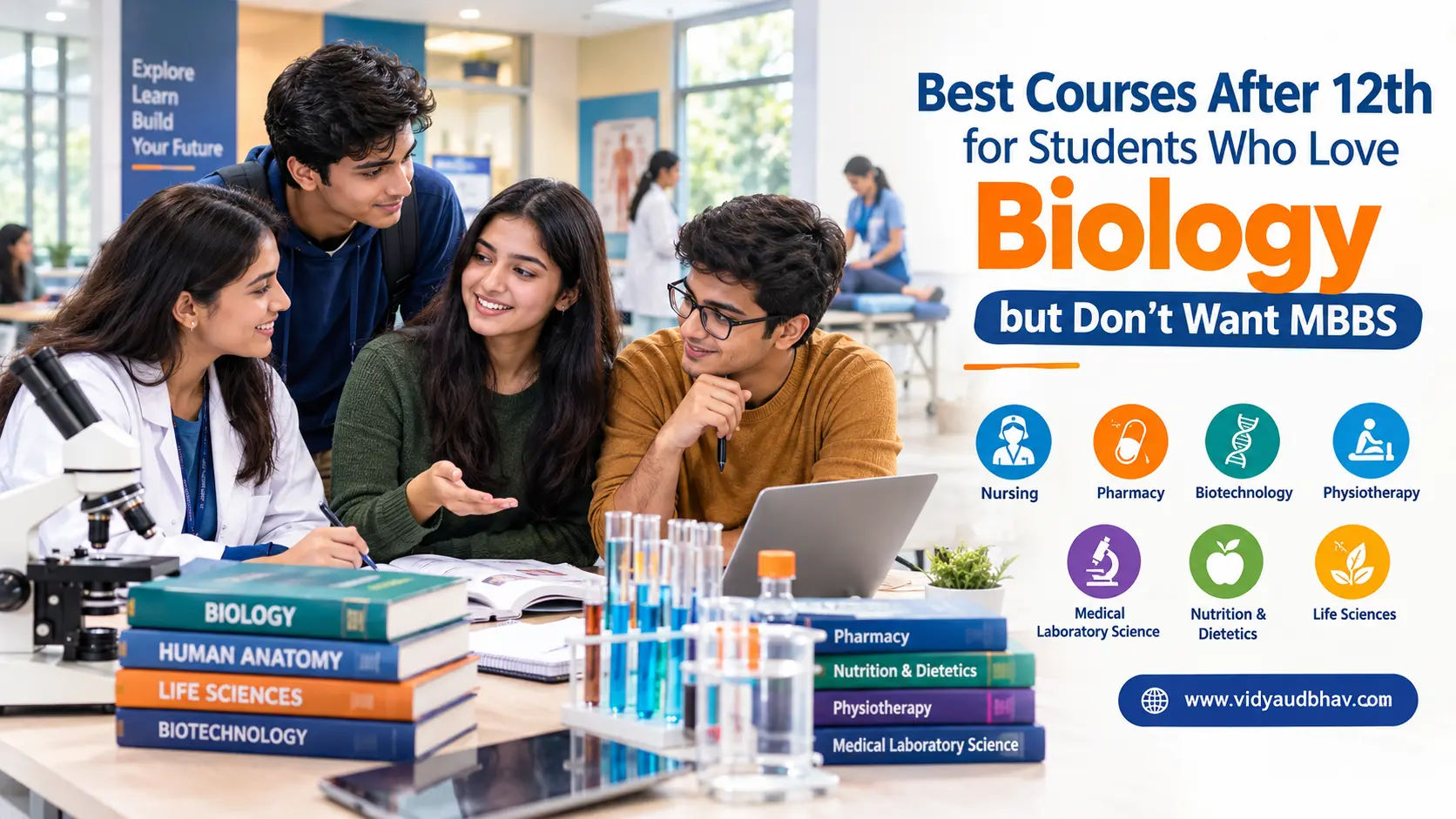
Choosing Biology after Class 12 does not mean your only serious career option is MBBS. If you enjoy understanding the human body, diseases, living organisms, health, genetics, or the environment but don't want to become a doctor, many other academic and professional paths are worth exploring.
https://vidyaudbhav.com/blogs/what-is-generative-ai-and-how-students-build-career
https://vidyaudbhav.com/blogs/why-course-curriculum-matters-more-than-course-name
In fact, modern healthcare and life sciences include careers in nursing, pharmacy, physiotherapy, biotechnology, medical laboratory science, nutrition, psychology, public health, research, and several emerging fields.
If you are confused about what to do after 12th, start by looking beyond the traditional “doctor or nothing” mindset. A broader career planning approach can help you compare courses according to your interests, abilities, preferred work environment, and long-term goals.
Quick Answer: What Are the Best Biology Courses After 12th Without MBBS?
Some of the strongest options include:
- B.Sc. Nursing
- B.Pharm
- BPT / Physiotherapy
- Biotechnology
- Medical Laboratory Technology
- Radiology and Medical Imaging
- Nutrition and Dietetics
- Psychology
- Public Health
- Microbiology
- Biochemistry
- Environmental Science
- Biomedical Science
- Genetics and Molecular Biology
The best course depends on whether you prefer patient care, laboratory work, research, medicines, technology, nutrition, psychology, or environmental science.
For a wider comparison of career paths, students can also explore Vidya Udbhav's career planning guide.
Why Choose Biology If You Don't Want to Become a Doctor?
Biology is much broader than medicine.
The subject develops an understanding of cells, organisms, genetics, anatomy, physiology, ecosystems, and life processes. These concepts are useful across healthcare, pharmaceuticals, biotechnology, research, agriculture, environmental science, and public health.
One thing many students miss is that liking Biology does not automatically mean liking clinical medicine.
You may enjoy studying the human body but dislike hospital environments. You may love genetics but prefer laboratory research. Or perhaps you enjoy helping patients but don't want the responsibilities associated with being a doctor.
That difference matters when choosing a course.
Best Courses After 12th for Biology Students Without MBBS
1. B.Sc. Nursing
B.Sc. Nursing is one of the most direct alternatives for students interested in healthcare and patient care.
Nursing combines biological knowledge with clinical training, patient communication, healthcare procedures, and practical experience.
Suitable for students who:
- Enjoy working directly with patients.
- Want a healthcare career.
- Have good communication skills.
- Can remain calm in demanding situations
- Prefer practical learning
Nursing can also offer opportunities in hospitals, community healthcare, specialised care, education, administration, and international healthcare markets.
2. Bachelor of Pharmacy (B.Pharm)
If you are interested in medicines, chemistry, drug development, and how treatments work, pharmacy may be a better fit than clinical medicine.
Students study areas such as pharmacology, pharmaceutical chemistry, pharmaceutics, and drug-related sciences.
Career possibilities can include:
- Pharmacist
- Clinical research professional
- Pharmaceutical industry roles
- Quality control
- Drug safety
- Regulatory affairs
- Medical information
Pharmacy is particularly interesting for students who enjoy the science behind medicines rather than direct diagnosis and surgery.
3. Bachelor of Physiotherapy
Physiotherapy is another healthcare-focused option for Biology students.
Instead of primarily treating illness through medicines, physiotherapists help people improve movement, physical function, rehabilitation, and recovery.
A physiotherapy career may suit someone who enjoys:
- Human anatomy
- Exercise and movement
- Rehabilitation
- Sports injuries
- Patient interaction
- Practical healthcare
It can lead to work in hospitals, rehabilitation centres, sports environments, clinics, and wellness settings.
4. Biotechnology
If your interest in Biology is more scientific than clinical, biotechnology deserves serious consideration.
Biotechnology combines biology with laboratory science and technology. Depending on the specialisation, students may explore genetics, molecular biology, microbiology, bioinformatics, agriculture, pharmaceuticals, or industrial biotechnology.
Potential career areas include:
- Biotechnology research
- Laboratory science
- Pharmaceutical research
- Genetic analysis
- Food biotechnology
- Agricultural biotechnology
- Research and development
This is a strong option for students who enjoy asking “How does this work?” rather than simply wanting to work with patients.
5. Medical Laboratory Technology
Medical laboratory professionals play an important role in healthcare by examining biological samples and supporting disease diagnosis.
Students interested in laboratory work can explore areas such as:
- Blood testing
- Microbiology
- Pathology
- Biochemistry
- Clinical laboratory procedures
This path is suitable for students who prefer a scientific and laboratory-based healthcare environment rather than continuous patient interaction.
6. Radiology and Medical Imaging
Medical imaging combines healthcare with technology.
Depending on the program and country, students can pursue education related to diagnostic imaging, radiography, or medical imaging technologies.
It may appeal to Biology students who are interested in:
- Anatomy
- Healthcare technology
- Diagnostic procedures
- Imaging equipment
- Hospital environments
This is an example of how modern healthcare increasingly combines biological knowledge with technology.
7. Nutrition and Dietetics
If you are interested in food, health, metabolism, fitness, and preventive wellness, nutrition can be an attractive career direction.
Nutrition-related studies can cover:
- Human nutrition
- Metabolism
- Food science
- Diet planning
- Public health nutrition
- Lifestyle-related health
Career opportunities can exist in healthcare, wellness, sports, food industries, community programs, and private practice, depending on local professional regulations.
8. Psychology
Psychology can be a surprising choice for Biology students.
The field explores human behaviour, cognition, emotions, development, and mental processes. Students who enjoy understanding how the human mind works may find psychology more engaging than conventional medical courses.
However, students should distinguish between an undergraduate psychology degree and regulated clinical professions. Requirements for becoming a licensed practitioner vary by country.
9. Microbiology and Biochemistry
If you enjoy laboratory science, microorganisms, cells, chemicals, and biological processes, consider pure science degrees.
Microbiology focuses on microorganisms such as bacteria, fungi, and other microscopic life.
Biochemistry examines the chemical processes occurring within living organisms.
Both can provide foundations for higher education and careers in research, laboratories, pharmaceuticals, food science, biotechnology, and related industries.
10. Public Health and Environmental Science
Not every Biology career involves hospitals.
Public health focuses on improving health at the population level, while environmental science examines relationships between organisms, ecosystems, pollution, resources, and environmental conditions.
These areas can be particularly relevant to students interested in:
- Health awareness
- Disease prevention
- Sustainability
- Climate and ecosystems
- Community health
- Environmental protection
Biology Courses: Which One Should You Choose?
| B.Sc. Nursing | Patient care | Healthcare & nursing | Hospitals/clinics |
| B.Pharm | Medicines | Pharmaceutical science | Pharmacies/industry |
| Physiotherapy | Rehabilitation | Anatomy & movement | Clinics/hospitals |
| Biotechnology | Research | Genetics & molecular biology | Laboratories |
| Medical Lab Technology | Diagnostics | Laboratory science | Diagnostic labs |
| Radiology/Imaging | Healthcare technology | Medical imaging | Hospitals/imaging centres |
| Nutrition | Food & wellness | Human nutrition | Healthcare/wellness |
| Psychology | Human behaviour | Mind & behaviour | Education/healthcare/research |
| Microbiology | Laboratory science | Microorganisms | Labs/research |
| Biochemistry | Biological chemistry | Cells & chemical processes | Research/labs |
Course names, eligibility requirements, licensing rules, and professional scopes can differ considerably between countries and institutions. Always check the specific university and professional regulations before applying.
How to Choose the Right Biology Course After 12th
Here is what actually works: don't choose a course simply because someone says it has a good salary.
Step 1: Identify What You Like About Biology
Ask yourself:
- Do I like the human body?
- Do I enjoy laboratory experiments?
- Am I interested in medicines?
- Do I like helping patients?
- Do I enjoy genetics and research?
- Am I interested in food and nutrition?
- Do I care about environmental issues?
Your answers can quickly narrow the field.
Step 2: Decide Your Preferred Work Style
Imagine your future working day.
Would you rather:
Work with patients?
Consider nursing or physiotherapy.
Consider nursing or physiotherapy.
Work with medicines?
Explore pharmacy.
Explore pharmacy.
Work in laboratories?
Consider biotechnology, microbiology, biochemistry, or medical laboratory science.
Consider biotechnology, microbiology, biochemistry, or medical laboratory science.
Work with technology?
Explore medical imaging and other healthcare technology fields.
Explore medical imaging and other healthcare technology fields.
Study behaviour and people?
Psychology may be worth exploring.
Psychology may be worth exploring.
Step 3: Research the Actual Career, Not Just the Course
Before applying, investigate:
- Course duration
- Eligibility
- Practical training
- Internship opportunities
- Licensing requirements
- Job roles
- Higher-study options
- Career growth
- International recognition
This prevents a common mistake: choosing a degree because the course name sounds attractive without understanding what professionals actually do.
Benefits of Choosing a Non-MBBS Biology Career
Choosing an alternative biology career can offer several advantages.
More Career Variety
You can enter healthcare, pharmaceuticals, biotechnology, research, nutrition, environmental science, diagnostics, or other related industries.
Different Work Environments
Not every Biology graduate has to work in a hospital. Laboratories, research organisations, pharmaceutical companies, universities, wellness organisations, and environmental projects are also possible directions.
Opportunities for Specialisation
Many fields become more valuable when you specialise through postgraduate education, certifications, research experience, or practical training.
Potential International Mobility
Healthcare and life-science careers exist across many countries, although professional licensing and qualification recognition must always be checked locally.
Challenges You Should Know About
Alternative does not mean easy.
Some Biology-related careers require postgraduate education before reaching specialized roles. Certain healthcare professions also involve licensing examinations, clinical placements, or regulated practice.
Research-oriented careers can require patience because progression may depend on advanced degrees, publications, technical expertise, and experience.
Another important point: salary should not be your only selection factor. Income can vary significantly according to country, specialisation, employer, experience, and professional registration.
Vidya Udbhav's analysis of trending courses and career opportunities also highlights healthcare, biotechnology, pharmacy, physiotherapy, and related fields among areas students are exploring.
A Simple Beginner Strategy
If you are still completely confused, use this three-column exercise.
Column 1 — What I Enjoy
Write the Biology topics you genuinely enjoy.
Column 2 — How I Want to Work
Choose between patient-facing, laboratory, research, technology, office, field, or mixed environments.
Column 3 — My Career Goal
Decide whether you want employment, research, entrepreneurship, international opportunities, or further education.
Now compare courses against all three columns.
A course that matches your interest + working style + career objective is usually a stronger choice than one selected only because it is popular.
Common Mistakes to Avoid
Choosing a Course Because Friends Are Choosing It
Your friend's strengths and career goals may be completely different from yours.
Assuming MBBS Is the Only Respectable Biology Career
Healthcare depends on thousands of professionals beyond doctors.
Looking Only at Starting Salary
A lower starting salary does not automatically mean poor long-term potential.
Ignoring Practical Training
For healthcare and laboratory careers, practical exposure can be just as important as classroom knowledge.
Selecting a College Before Selecting a Career
First decide what you want to study. Then compare institutions offering that program.
Following Social Media Career Trends Blindly
A viral career is not necessarily the right career for you.
Expert Tips for Biology Students
One thing many beginners miss is that skills can make your degree more useful.
For example, a biotechnology student can develop data analysis or bioinformatics skills. A psychology student can strengthen research and communication skills. A nutrition student can learn evidence-based communication and digital content skills.
The combination of degree + practical skills + experience can make a student more competitive.
Internships, research projects, volunteering, laboratory exposure, communication skills, and relevant certifications can all strengthen your profile.
Future Trends in Biology Careers
Biology is becoming increasingly connected with technology.
Fields such as biotechnology, genomics, bioinformatics, personalised medicine, healthcare technology, public health analytics, and environmental science are developing rapidly.
Artificial intelligence is also changing how researchers and healthcare organisations analyse information.
This does not mean every Biology student needs to become a programmer. It does mean that students who are comfortable learning new technologies may have an advantage as life sciences evolve.
Which Biology Course Is Best Without MBBS?
There is no single best course for every student.
Choose Nursing if you want direct patient care.
Choose Pharmacy if medicines and pharmaceutical science interest you.
Choose Physiotherapy if rehabilitation and movement appeal to you.
Choose Biotechnology, Microbiology, or Biochemistry if you prefer laboratory science and research.
Choose Medical Laboratory Technology if diagnostics interest you.
Choose Nutrition if food, health, and wellness are your main interests.
Choose Psychology if human behaviour fascinates you.
Choose Environmental Science or Public Health if you want to work beyond individual patient care.
The right decision is the one that matches your interests, strengths, preferred working environment, and long-term goals.
Final Advice for Students
If you love Biology but don't want MBBS, don't assume that you have chosen the wrong stream.
You have a much wider set of possibilities than you may realize.
Start by identifying what you actually enjoy about Biology, then compare courses based on curriculum, practical exposure, career roles, future study options, and professional requirements.
And if you are still unsure, don't make the decision under pressure. Structured career counselling can help you compare options objectively instead of choosing based on marks, relatives, friends, or social media trends.
Vidya Udbhav provides career guidance and course-selection support for students exploring their next academic step. You can also explore its broader career guidance resources before making your decision.
FAQs
1. What are the best courses after 12th Biology without MBBS?
Popular options include B.Sc. Nursing, B.Pharm, Physiotherapy, Biotechnology, Medical Laboratory Technology, Nutrition, Psychology, Microbiology, Biochemistry, Public Health, and Environmental Science.
2. Can Biology students have a good career without becoming doctors?
Yes. Healthcare, pharmaceuticals, biotechnology, diagnostics, research, nutrition, psychology, public health, and environmental science offer different career opportunities.
3. Which Biology course is best for laboratory work?
Biotechnology, Microbiology, Biochemistry, Medical Laboratory Technology, and related life-science programs are worth exploring if you prefer laboratory-based work.
4. Which course is best for Biology students who like helping people?
Nursing, Physiotherapy, Psychology, Nutrition, and several public-health-related programs may suit students who enjoy working directly with people.
5. Is B.Pharm a good alternative to MBBS?
B.Pharm can be a strong alternative for students interested in medicines, pharmaceutical science, drug development, quality control, and related areas rather than clinical medicine.
6. Can Biology students study biotechnology after 12th?
In many education systems, Biology students can pursue biotechnology-related undergraduate programs. However, specific subject combinations and eligibility requirements depend on the university and country.
7. Which Biology course has the best career scope?
There is no universal answer. Career scope depends on specialisation, skills, location, experience, professional regulations, and market demand. Students should compare the complete career pathway rather than choosing based only on salary.
8. Should I choose a Biology course based only on salary?
No. Salary is only one factor. Interest, aptitude, work environment, education duration, career progression, practical training, and long-term goals should also influence the decision.