

Introduction
Choosing the right course has never been more important. As technology evolves, industries transform, and global economies shift, the skills employers seek today may look very different tomorrow. That is why selecting a course based on future job market trends can give you a significant advantage.
Whether you are a student planning your first career, a graduate looking to specialize, or a professional considering a career change, understanding where the job market is heading helps you make informed decisions.
If you are also exploring career planning resources, the career guidance section on Vidya Udbhav offers valuable insights for students preparing for competitive industries.
What Are Future Job Market Trends?
Future job market trends refer to the industries, skills, and professions expected to experience sustained growth over the coming years due to technological innovation, demographic changes, globalization, and economic development.
Quick Answer
Future-proof careers are those expected to remain in high demand because they solve real-world problems, adapt to technological change, and require specialized expertise.
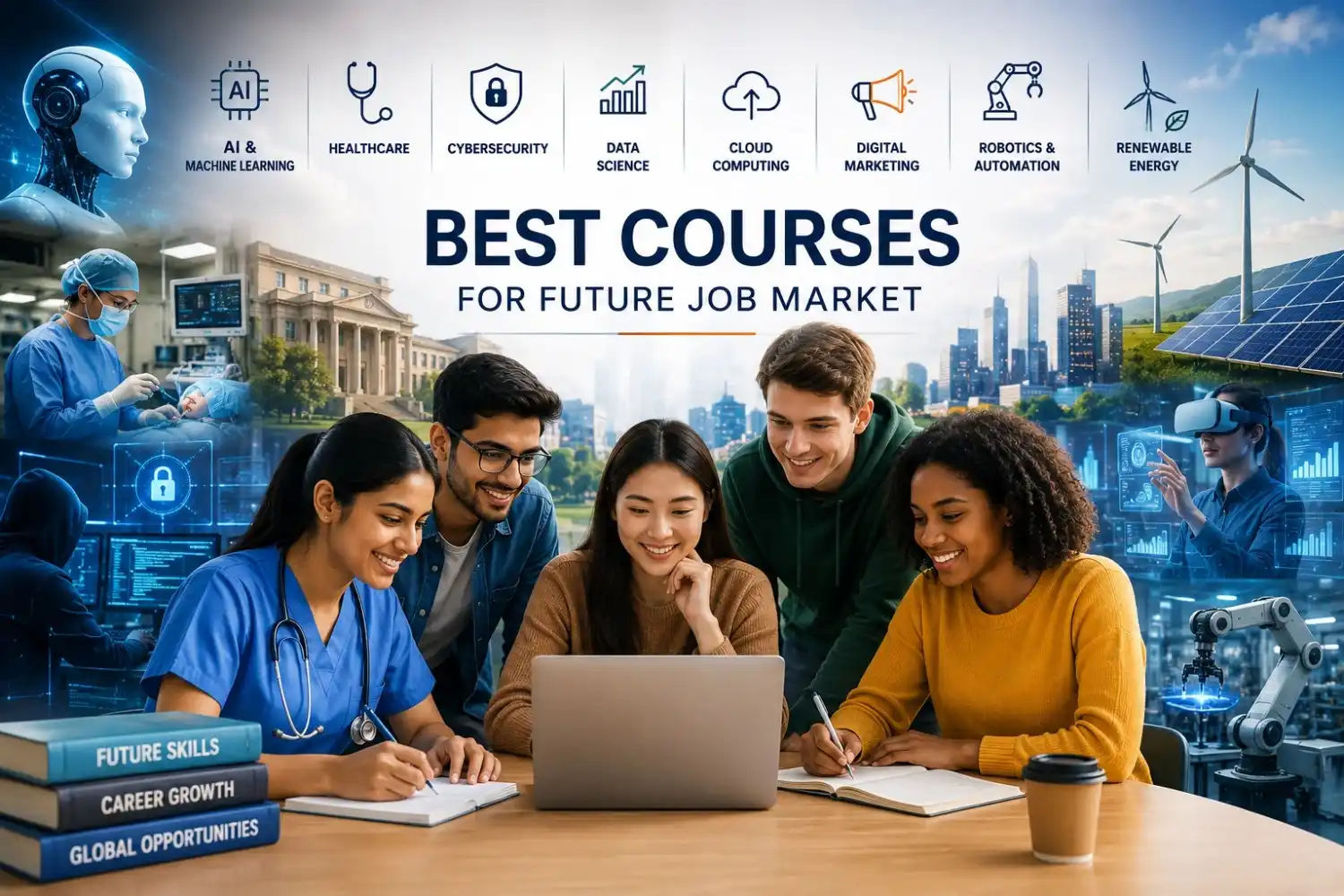
Some of the fastest-growing industries include:
- Healthcare
- Artificial Intelligence
- Cybersecurity
- Data Science
- Renewable Energy
- Digital Marketing
- Cloud Computing
- Biotechnology
- Robotics
- Financial Technology
Why Choosing the Right Course Matters
The right course does much more than provide a certificate.
It helps you:
- Develop industry-relevant skills
- Improve employability
- Increase earning potential
- Stay competitive
- Adapt to changing technologies.
- Build long-term career security.
One thing many beginners miss is that employers increasingly hire based on practical skills rather than degrees alone.
Best Courses Based on Future Job Market Trends
1. Artificial Intelligence and Machine Learning
Artificial Intelligence is transforming almost every industry, from healthcare to finance.
Career Opportunities:
- AI Engineer
- Machine Learning Engineer
- NLP Specialist
- Computer Vision Engineer
- AI Consultant
Key Skills:
- Python
- Deep Learning
- Neural Networks
- Data Analysis
- Automation
2. Data Science and Analytics
Organizations generate enormous amounts of data every day.
Professionals who can analyze and interpret this information are becoming increasingly valuable.
Career Roles:
- Data Scientist
- Business Analyst
- Data Engineer
- BI Analyst
- Data Consultant
3. Cybersecurity
As businesses move online, cyber threats continue to increase.
Cybersecurity professionals protect organizations from attacks and data breaches.
Popular Roles:
- Security Analyst
- Ethical Hacker
- Security Consultant
- SOC Analyst
- Information Security Manager
4. Healthcare and Allied Health Sciences
Healthcare remains one of the most stable industries worldwide.
Courses in:
- Nursing
- Medical Laboratory Technology
- Dialysis Technology
- Radiology
- Operation Theatre Technology
- Physiotherapy
- Public Health
Continue to offer excellent career opportunities.
Students interested in healthcare careers can also explore the healthcare career guidance resources available on Vidya Udbhav.
5. Digital Marketing
Every business now requires an online presence.
Digital marketing professionals help companies reach customers through multiple digital channels.
Skills Include:
- SEO
- Content Marketing
- Social Media Marketing
- Google Ads
- Email Marketing
- Analytics
6. Cloud Computing
Businesses increasingly rely on cloud infrastructure.
Cloud professionals are needed to manage applications, security, and data storage.
Popular Platforms:
- AWS
- Microsoft Azure
- Google Cloud
7. Software Development
Software engineers continue to be among the highest-paid professionals worldwide.
Specializations include:
- Full Stack Development
- Mobile App Development
- Backend Engineering
- Frontend Development
- DevOps
8. Renewable Energy
Governments and industries are investing heavily in sustainable energy solutions.
Growing Careers:
- Solar Engineer
- Wind Energy Specialist
- Sustainability Consultant
- Environmental Engineer
9. Financial Technology (FinTech)
Digital payments and online banking continue to expand globally.
Career Paths:
- FinTech Analyst
- Blockchain Developer
- Risk Analyst
- Financial Data Analyst
10. Robotics and Automation
Automation is changing manufacturing, logistics, healthcare, and agriculture.
Professionals with robotics expertise will continue to see increasing demand.
Comparison Table
| Artificial Intelligence | Very High | Excellent | Excellent | Tech Enthusiasts |
| Data Science | Very High | Excellent | Excellent | Analytical Thinkers |
| Cybersecurity | Very High | Excellent | Excellent | Problem Solvers |
| Healthcare | High | High | Excellent | Patient-Centered Individuals |
| Digital Marketing | High | High | High | Creative Professionals |
| Cloud Computing | Very High | Excellent | Excellent | IT Professionals |
| Software Development | Very High | Excellent | Excellent | Programmers |
| Renewable Energy | High | High | Excellent | Environmental Enthusiasts |
| FinTech | High | High | High | Finance Professionals |
| Robotics | High | Excellent | Excellent | Engineers |
How to Choose the Right Course
You might be wondering which course is best for you.
Here is what actually works:
Step 1
Identify your interests.
Step 2
Evaluate your strengths.
Step 3
Research industry demand.
Step 4
Check future salary potential.
Step 5
Understand required skills.
Step 6
Gain practical experience through internships and projects.
Students can also benefit from the student success roadmap available at Vidya Udbhav as they plan their educational journey.
Benefits of Future-Focused Courses
Choosing a future-oriented course provides several long-term advantages.
- Better job security
- Higher salaries
- Global career opportunities
- Faster career growth
- Continuous learning opportunities
- Better work flexibility
- Strong international demand
Common Challenges
Despite the opportunities, students often face challenges such as:
- Choosing among too many options
- Lack of career guidance
- Rapidly changing technology
- Skill gaps
- Financial constraints
Fortunately, proper planning and continuous learning help overcome these obstacles.
Practical Solutions
Here is where many people make mistakes.
Instead of choosing a course solely based on popularity, evaluate:
- Industry demand
- Personal interests
- Skill requirements
- Career growth
- Practical training opportunities
Combining technical expertise with communication and problem-solving skills creates stronger career prospects.
Real-Life Example
Imagine two graduates entering the workforce.
One completes a general course with limited practical exposure.
The other studies cybersecurity while earning industry certifications and completing internships.
Although both hold degrees, the second candidate is more likely to secure interviews because employers value practical skills alongside academic knowledge.
Beginner Strategy
If you are just starting, focus on:
- Building strong fundamentals
- Learning industry software
- Completing online projects
- Developing communication skills
- Creating a professional portfolio
Consistency matters more than learning everything at once.
Advanced Strategy
Professionals looking to advance should consider:
- Specialized certifications
- Industry networking
- Leadership training
- Continuous skill upgrades
- Cross-functional expertise
This approach helps professionals remain competitive in rapidly evolving industries.
Common Mistakes to Avoid
- Choosing courses based only on salary
- Ignoring future industry demand
- Skipping internships
- Neglecting soft skills
- Avoiding continuous learning
- Failing to build a professional network
Expert Tips
Career experts generally recommend:
- Learn practical skills alongside theory.
- Build a strong portfolio.
- Stay updated with industry trends.
- Participate in internships.
- Earn recognized certifications.
- Develop communication and teamwork skills.
Best Practices
For long-term career success:
- Learn continuously.
- Stay adaptable.
- Embrace technology.
- Focus on problem-solving.
- Build professional relationships.
- Practice lifelong learning.
Future Trends
Over the next decade, several trends are expected to shape employment worldwide.
These include:
- AI-powered workplaces
- Personalized healthcare
- Automation
- Green energy
- Remote work
- Digital transformation
- Smart manufacturing
- Precision medicine
- Sustainable technologies
- Human-AI collaboration
Professionals who continuously update their skills will be best positioned to benefit from these changes.
Actionable Final Advice
Before enrolling in any course:
- Research market demand.
- Compare career outcomes.
- Identify required skills.
- Speak with professionals.
- Gain hands-on experience.
- Continue learning throughout your career.
Remember, the best course is not simply the most popular one—it is the one that aligns with your strengths while preparing you for tomorrow's opportunities.
For additional educational resources, career planning articles, and professional guidance, explore the placement preparation strategies and career planning guide available on Vidya Udbhav.
Conclusion
The future belongs to professionals who are willing to learn, adapt, and embrace change. Courses in artificial intelligence, healthcare, cybersecurity, cloud computing, data science, renewable energy, and digital marketing are expected to remain among the strongest career choices over the coming years.
Rather than following trends blindly, invest in a course that matches your interests, develops valuable skills, and prepares you for long-term success. With the right education and a commitment to continuous improvement, you can build a rewarding and resilient career in an ever-changing global job market.
Frequently Asked Questions
1. Which course has the highest demand in the future?
Artificial Intelligence, Data Science, Cybersecurity, Healthcare, and Cloud Computing are among the fastest-growing fields.
2. Which course offers the highest salary?
AI, Data Science, Cybersecurity, and Cloud Computing typically offer strong earning potential depending on experience and location.
3. Are healthcare courses still a good career choice?
Yes. Healthcare continues to experience global demand due to aging populations and expanding medical services.
4. How do I choose the best future-proof course?
Consider your interests, strengths, market demand, salary potential, and opportunities for practical learning.
5. Is continuous learning necessary after completing a course?
Absolutely. Industries evolve quickly, and updating your skills regularly helps you remain competitive in the job market.