

Introduction
Studying abroad is no longer limited to students who want to earn a degree from a famous university. For many students, it is a way to gain international exposure, develop practical skills, build a global network, and prepare for careers that cross national boundaries.
But there is one decision that can make the entire experience more valuable: choosing the right course to study abroad.
You might be wondering whether Computer Science, Business, Engineering, Healthcare, Finance, or another field would offer the strongest career opportunities. The answer depends on your academic background, interests, budget, destination, and long-term career plans.
If you are still unsure about your direction, a structured career planning guide can help you compare your interests and strengths before selecting a course.
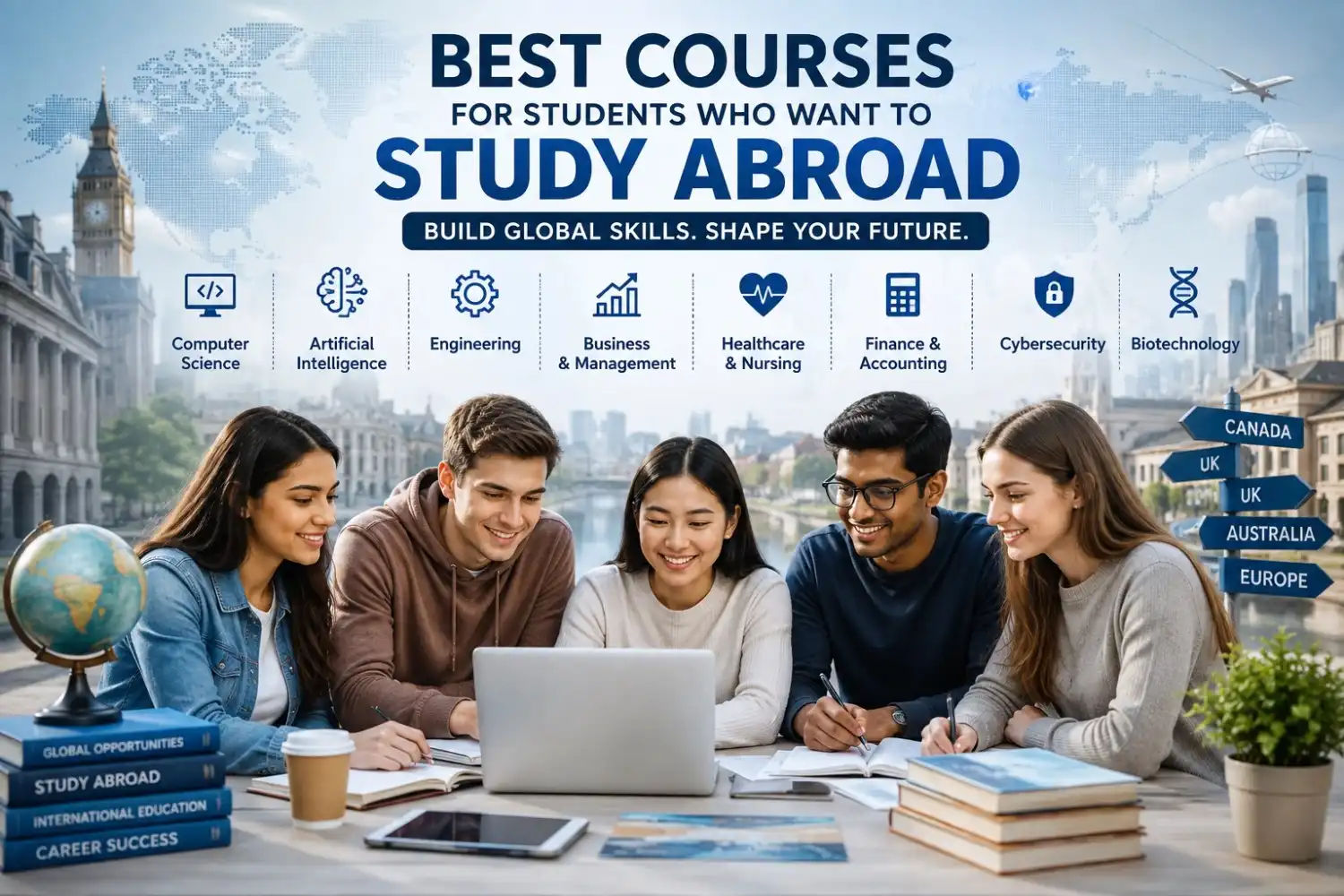
Quick Answer: What Are the Best Courses to Study Abroad?
Some of the most popular and career-focused courses for international students include:
- Computer Science and Information Technology
- Artificial Intelligence and Data Science
- Engineering
- Business and Management
- Finance and Accounting
- Healthcare and Nursing
- Biotechnology and Life Sciences
- Cybersecurity
- Hospitality and Tourism
- Design and Creative Technology
The "best" course is not necessarily the one with the highest salary. It is the course that combines your ability, interest, career demand, affordability, and future opportunities.
1. Computer Science and Information Technology
Computer Science remains one of the strongest choices for students interested in global technology careers.
Popular areas include:
- Software engineering
- Cloud computing
- Information technology
- Software development
- Computer systems
- Web technologies
The biggest advantage is flexibility. A computer science graduate can work across industries such as banking, healthcare, retail, education, manufacturing, and technology.
Students considering technology careers can also compare engineering pathways through resources such as this B.Tech CSE college guide.
2. Artificial Intelligence and Data Science
AI and data-driven decision-making are changing how companies operate.
Students interested in mathematics, programming, statistics, and problem-solving can explore:
- Artificial Intelligence
- Machine Learning
- Data Science
- Business Analytics
- Data Analytics
- Computational Science
These courses can be particularly attractive for students who want careers involving technology and research.
One thing many beginners miss is that an AI or Data Science degree should not be selected simply because "AI is trending." Strong mathematical foundations, programming ability, and genuine interest in analytical work matter.
3. Engineering
Engineering remains a broad international career pathway because it covers multiple industries.
Popular specializations include:
| Computer Science | Technology and software |
| Mechanical Engineering | Manufacturing and machines |
| Electrical Engineering | Energy, electronics and systems |
| Civil Engineering | Construction and infrastructure |
| Chemical Engineering | Manufacturing and industrial processes |
| Environmental Engineering | Sustainability and environmental systems |
Before choosing a specialization, compare curriculum, laboratory facilities, internships, accreditation, and employment opportunities rather than focusing only on university rankings.
4. Business and Management
Business degrees are popular among students who want careers in management, consulting, entrepreneurship, marketing, or operations.
Common options include:
- Business Administration
- International Business
- Marketing
- Entrepreneurship
- Business Analytics
- Supply Chain Management
- Management
An undergraduate business degree can provide a broad foundation, while an MBA or specialized master's degree may be appropriate later in a student's career.
5. Finance and Accounting
Students who enjoy numbers, economics, financial decision-making, and business strategy can consider finance-related programs.
Potential study areas include:
- Finance
- Accounting
- Economics
- Investment Management
- Financial Analytics
- Banking
A useful strategy is to combine academic study with practical skills such as financial modelling, analytics, communication, and professional certifications where appropriate.
6. Healthcare and Nursing
Healthcare is another important field for international students, particularly those interested in long-term professional careers.
Courses can include:
- Nursing
- Public Health
- Pharmacy
- Healthcare Management
- Biotechnology
- Biomedical Sciences
- Physiotherapy
However, healthcare requires additional attention to professional licensing, registration, language requirements, and country-specific regulations.
So before paying an application fee, always check whether the qualification can lead to professional practice in your intended destination.
7. Biotechnology and Life Sciences
Biotechnology is suitable for students interested in biology, medicine, genetics, research, pharmaceuticals, and laboratory science.
Potential specializations include:
- Molecular Biology
- Genetics
- Biotechnology
- Biomedical Science
- Pharmaceutical Science
- Bioinformatics
This field can be a good choice for students who are comfortable with laboratory-based learning and research.
8. Cybersecurity
As businesses become increasingly dependent on digital infrastructure, cybersecurity has become an important academic and professional field.
Students can study:
- Cybersecurity
- Network Security
- Information Assurance
- Digital Forensics
- Security Engineering
The field suits students who enjoy logical thinking, technology, investigation, and problem-solving.
9. Hospitality and Tourism
Not every international career is technology-focused.
Hospitality and tourism can be attractive for students who enjoy communication, customer service, travel, event management, and international environments.
Relevant courses include:
- Hotel Management
- Hospitality Management
- Tourism Management
- Event Management
- Culinary Arts
Practical training and internships can be particularly valuable in this field.
How to Choose the Right Course for Studying Abroad
Here is where many students make mistakes. They select a course first and investigate everything else later.
Instead, follow this process:
Step 1: Understand Your Strengths
Ask yourself:
- Which subjects do I enjoy?
- What type of work interests me?
- Am I analytical, creative, technical, or people-oriented?
- What skills do I already have?
Step 2: Define Your Career Goal
Do not simply say, "I want to work abroad."
Identify the type of career you want.
For example:
Programming → Computer Science → Software Career
Biology → Biotechnology → Research/Healthcare
Business → Management → Corporate/Entrepreneurial Career
Step 3: Compare Countries
Consider:
- Tuition fees
- Living expenses
- Course duration
- Language
- Admission requirements
- Internship opportunities
- Post-study work rules
- Professional licensing
Step 4: Compare Universities
Look beyond rankings.
Evaluate:
- Curriculum
- Faculty
- Industry connections
- Internship opportunities
- Research facilities
- Student support
- Total cost
- Graduate outcomes
This approach is consistent with the broader principle of choosing education based on career fit, budget, and long-term goals rather than advertisements alone.
Benefits of Choosing the Right Course Abroad
A well-matched course can provide:
- International academic exposure
- Practical learning
- Professional networking
- Industry experience
- Cross-cultural communication
- Access to specialized programs
- Broader career opportunities
But studying abroad is a major investment, so students should evaluate return on investment rather than assuming an overseas degree automatically guarantees employment.
Challenges Students Should Expect
Studying abroad can also involve challenges such as:
- High education costs
- Homesickness
- Cultural adjustment
- Academic pressure
- Language barriers
- Visa requirements
- Competitive admissions
- Different teaching styles
The solution is preparation. Research the destination, understand the course requirements, prepare financially, and build relevant skills before leaving home.
Beginner Strategy: Start 12–18 Months Early
A simple timeline can make the process much easier.
12–18 months before:
Research courses, countries, universities, and costs.
Research courses, countries, universities, and costs.
9–12 months before:
Prepare academic documents and language tests if required.
Prepare academic documents and language tests if required.
6–9 months before:
Shortlist universities and submit applications.
Shortlist universities and submit applications.
3–6 months before:
Review offers, funding, accommodation, and visa requirements.
Review offers, funding, accommodation, and visa requirements.
Before departure:
Prepare finances, documents, insurance, accommodation, and travel arrangements.
Prepare finances, documents, insurance, accommodation, and travel arrangements.
Students can also use a student success roadmap to organize academic and career decisions systematically.
Tools and Platforms Students Can Use
For planning and preparation, useful options include:
Beginner-friendly/free:
Google Sheets, Canva, LinkedIn, university comparison spreadsheets
Google Sheets, Canva, LinkedIn, university comparison spreadsheets
Learning:
Coursera, edX, Khan Academy
Coursera, edX, Khan Academy
Professional networking:
LinkedIn
Premium/structured preparation:
Professional test-preparation platforms and paid career counselling services
Professional test-preparation platforms and paid career counselling services
The tool matters less than how consistently you use it.
Advanced Strategy: Build Your Profile Before Applying
A strong application is more than marks.
Try to build evidence of your interests through:
- Internships
- Academic projects
- Research work
- Competitions
- Certifications
- Volunteering
- Leadership activities
- Relevant portfolios
For technology students, projects can be especially useful. For business students, internships and competitions may demonstrate practical exposure.
This aligns with the broader profile-building approach recommended for students seeking stronger academic and professional outcomes.
Common Mistakes to Avoid
Choosing a Course Because Friends Choose It
Your friend's career path may not suit your strengths.
Selecting a University Only for Ranking
A lower-ranked institution with a better course fit can sometimes be more suitable.
Ignoring Total Cost
Calculate tuition, accommodation, food, transportation, insurance, and other expenses.
Assuming Every Degree Leads to a Job
Employability depends on skills, experience, location, industry demand, and individual performance.
Ignoring Licensing Requirements
This is particularly important for healthcare and other regulated professions.
Waiting Until the Final Year
Internships, projects, language preparation, and profile development take time.
What Is the Best Course for You?
There is no universal winner.
| Loves coding and technology | Computer Science, AI, Data Science |
| Strong in mathematics | Data Science, Finance, Engineering |
| Interested in business | Management, Finance, International Business |
| Interested in healthcare | Nursing, Public Health, Biomedical Science |
| Loves biology and research | Biotechnology, Life Sciences |
| Interested in digital security | Cybersecurity |
| Loves travel and people | Hospitality, Tourism |
| Creative and technology-oriented | Design, UX/UI, Creative Technology |
The right decision starts with career fit, not simply the popularity of a course.
Future Trends in International Education
The international education landscape is becoming increasingly skills-focused.
Students are likely to see continued growth in areas such as:
- Artificial Intelligence
- Data Analytics
- Cybersecurity
- Renewable Energy
- Healthcare
- Biotechnology
- Sustainable Engineering
- FinTech
- Business Analytics
- Digital Technologies
At the same time, employers continue to value communication, adaptability, teamwork, and practical experience alongside technical qualifications.
Final Advice for Students Planning to Study Abroad
If you want to study abroad, don't start by asking, "Which country is best?"
Start with:
"Which career is right for me?"
Then work backward:
Career → Course → Country → University → Budget → Application
That simple sequence can prevent expensive mistakes.
Students who are still comparing career paths can also explore career guidance and educational counselling resources before making a final decision.
Conclusion
The best courses for students who want to study abroad include technology, AI, data science, engineering, business, finance, healthcare, biotechnology, cybersecurity, hospitality, and several other specialized fields.
However, popularity alone should never determine your choice.
Your academic background, interests, skills, financial situation, preferred country, career objectives, and long-term opportunities all matter.
A good international education decision is not about finding the "perfect" course. It is about finding the right combination of course, university, destination, affordability, and career opportunity for you.
Frequently Asked Questions
1. What are the best courses for students who want to study abroad?
Computer Science, AI, Data Science, Engineering, Business, Finance, Healthcare, Biotechnology, Cybersecurity, and Hospitality are among the popular options.
2. Which course is best for an international career?
Technology, healthcare, engineering, business, and specialized analytical fields can provide international career pathways, but opportunities depend on the destination and profession.
3. What is the best course to study abroad after 12th?
Students can consider bachelor's programs in Computer Science, Engineering, Business, Healthcare, Biotechnology, Design, Hospitality, and other fields based on their stream and interests.
4. Is studying abroad worth the cost?
It can be worthwhile when the course, university, destination, career opportunities, and total cost are carefully evaluated.
5. Should I choose the country or course first?
Choose your career direction and course first, then compare countries and universities that offer strong programs in that field.
6. Do all foreign degrees guarantee jobs?
No. A degree does not automatically guarantee employment. Skills, internships, academic performance, networking, work authorization, and industry demand also matter.
7. How early should I start planning to study abroad?
Ideally, begin researching around 12–18 months before your intended intake so you have enough time for course selection, applications, tests, finances, and documentation.