

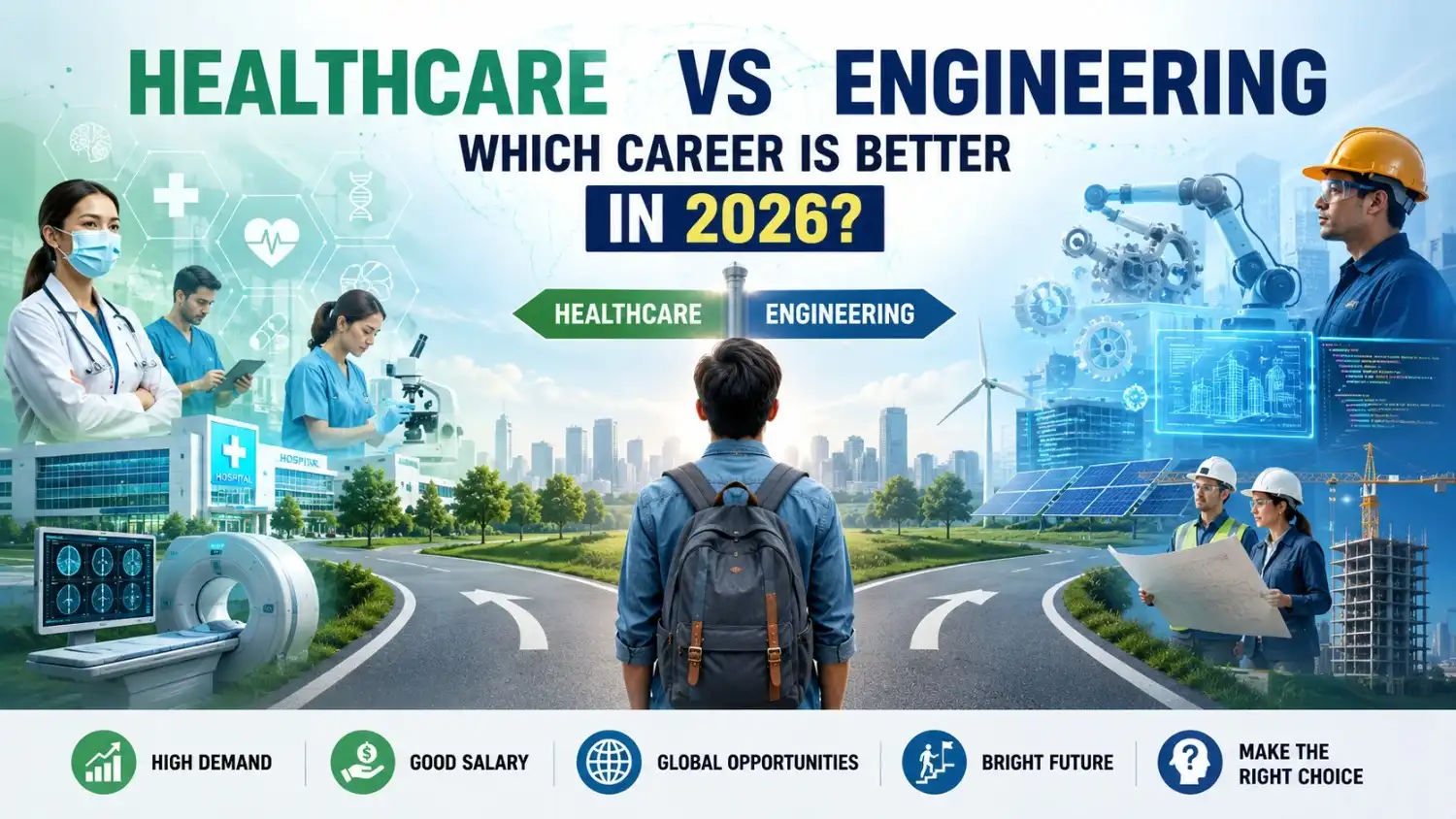
Introduction
Choosing between healthcare and engineering is one of the biggest career decisions students face today. Both fields offer excellent career opportunities, global demand, attractive salaries, and long-term growth. However, the "better" career depends on your interests, skills, career goals, and the future job market.
With rapid technological advancements, artificial intelligence, digital healthcare, renewable energy, and automation reshaping industries, students entering college in 2026 have more opportunities than ever before.
If you're unsure which path to choose, this guide will help you compare healthcare and engineering across key factors—from salary and job security to work-life balance and future trends.
For more career guidance, explore Vidya Udbhav and related resources, including the career planning guide, admission guidance, and student success roadmap.
What Is Healthcare?
Healthcare focuses on preventing, diagnosing, treating, and managing illnesses while improving people's quality of life.
Professionals in healthcare work directly or indirectly to improve patient health through clinical care, diagnostics, research, technology, and healthcare management.
Popular Healthcare Careers
- Nursing
- Medicine
- Physiotherapy
- Pharmacy
- Medical Laboratory Technology
- Dialysis Technology
- Radiology
- Occupational Therapy
- Healthcare Administration
- Public Health
What Is Engineering?
Engineering applies mathematics, science, and technology to solve real-world problems through innovation and design.
Engineers build infrastructure, develop software, create machines, improve manufacturing processes, and design technologies that power modern life.
Popular Engineering Fields
- Computer Science Engineering
- Artificial Intelligence
- Mechanical Engineering
- Civil Engineering
- Electrical Engineering
- Electronics Engineering
- Biomedical Engineering
- Aerospace Engineering
- Robotics Engineering
- Data Engineering
Healthcare vs Engineering: Quick Comparison
| Primary Focus | Patient care and medical services | Technology, innovation, design |
| Education Duration | 3–8 years depending on specialization | 4 years (Bachelor's), higher for specialization |
| Global Demand | Extremely High | Very High |
| Salary Growth | Excellent | Excellent |
| Job Security | Very High | High |
| Work Environment | Hospitals, clinics, laboratories | Offices, industries, research labs, remote work |
| Career Flexibility | Growing | Extremely Flexible |
| AI Impact | Supports professionals | Automates repetitive work |
| International Opportunities | Outstanding | Outstanding |
Why Healthcare Is Growing Rapidly in 2026
Healthcare has become one of the world's fastest-growing industries due to aging populations, chronic diseases, medical innovation, and increasing access to healthcare services.
Some of the biggest growth drivers include:
- Telemedicine
- Digital health platforms
- AI-assisted diagnosis
- Personalized medicine
- Elderly care
- Mental health services
- Medical technology
- Healthcare data analytics
Countries worldwide continue to experience shortages of healthcare professionals, creating excellent employment opportunities.
Why Engineering Continues to Thrive
Engineering remains one of the strongest career choices because nearly every industry depends on engineers.
Today's engineering careers extend beyond traditional manufacturing into:
- Artificial Intelligence
- Machine Learning
- Robotics
- Cloud Computing
- Cybersecurity
- Renewable Energy
- Smart Infrastructure
- Internet of Things (IoT)
As technology evolves, engineers continue to solve increasingly complex global challenges.
Step-by-Step Guide to Choosing the Right Career
Step 1: Identify Your Interests
Ask yourself:
- Do you enjoy helping people directly?
- Do you enjoy solving technical problems?
- Are biology and chemistry your strengths?
- Or do mathematics and physics excite you more?
Your natural interests often predict long-term career satisfaction.
Step 2: Understand Your Personality
Healthcare may suit you if you are:
- Compassionate
- Patient
- Calm under pressure
- Good communicator
- Service-oriented
Engineering may be ideal if you are:
- Analytical
- Curious
- Creative
- Logical thinker
- Enjoy building solutions
Step 3: Consider Future Demand
You might be wondering which industry offers better job security.
Here is what actually works:
Healthcare demand rarely declines because people always need medical care.
Engineering demand shifts with technology, meaning continuous learning is essential.
Step 4: Evaluate Education Costs and Duration
Healthcare programs can require longer education depending on specialization.
Engineering generally offers quicker entry into the workforce after graduation, although advanced roles may require postgraduate study.
Salary Comparison in 2026
Salary varies significantly by country, specialization, experience, and employer.
Healthcare
High-paying careers include:
- Doctors
- Surgeons
- Dentists
- Pharmacists
- Nurse Practitioners
- Healthcare Managers
Engineering
Top-paying engineering careers include:
- AI Engineers
- Software Engineers
- Data Engineers
- Robotics Engineers
- Cloud Architects
- Petroleum Engineers
Rather than comparing average salaries alone, focus on long-term earning potential and career growth.
Benefits of Choosing Healthcare
Healthcare offers several advantages:
- Excellent global demand
- High job stability
- Meaningful work
- Opportunities to improve lives
- International career mobility
- Strong professional respect
- Continuous learning opportunities
One thing many beginners miss is that healthcare careers extend far beyond becoming a doctor.
Benefits of Choosing Engineering
Engineering provides numerous benefits as well.
- Diverse career paths
- Innovation-driven work
- High salaries
- Remote work opportunities
- Entrepreneurship potential
- Fast career progression
- Technology-focused future
Engineers often have greater flexibility to switch industries throughout their careers.
Common Challenges
Healthcare Challenges
- Long working hours
- Emotional stress
- Continuous licensing requirements
- Shift work
- Patient responsibilities
Engineering Challenges
- Rapid technology changes
- Continuous skill upgrades
- Competitive hiring
- Project deadlines
- Industry disruptions
Practical Solutions for Career Success
Whether you choose healthcare or engineering, these strategies increase your chances of success.
- Develop communication skills.
- Learn digital tools.
- Build professional networks.
- Gain internship experience.
- Continue learning through certifications.
- Improve problem-solving abilities.
You can also explore the internship preparation resources and placement preparation strategies available on Vidya Udbhav.
Real-Life Career Scenarios
Scenario 1
A student passionate about biology chooses Medical Laboratory Technology.
Within a few years, they specialize in molecular diagnostics and work in advanced laboratories supporting disease detection.
Scenario 2
Another student loves programming and mathematics.
They pursue Computer Science Engineering and later specialize in Artificial Intelligence, developing healthcare software that improves patient diagnosis.
Both careers positively impact society in different ways.
Useful Tools for Students
Free Tools
- Google Scholar
- Coursera
- Khan Academy
Beginner-Friendly Platforms
- Canva
- Notion
- Trello
Premium Learning Platforms
- Udemy
- edX
- Pluralsight
These tools can help students build technical knowledge, organize learning, and develop career-ready skills.
Beginner Strategy
If you're still uncertain, consider these steps:
- Take career aptitude assessments.
- Attend career counseling sessions.
- Speak with professionals in both industries.
- Participate in internships or job shadowing.
- Research future industry trends.
This becomes more important when selecting a career that aligns with your long-term goals rather than short-term salary expectations.
Advanced Strategy
Students aiming for global careers should consider combining healthcare and engineering.
Emerging interdisciplinary fields include:
- Biomedical Engineering
- Health Informatics
- Medical Robotics
- Bioinformatics
- AI in Healthcare
- Medical Imaging Technology
These hybrid careers are expected to experience substantial growth over the coming decade.
Mistakes to Avoid
Here is where many people make mistakes.
- Choosing based only on salary.
- Following friends instead of personal interests.
- Ignoring future industry trends.
- Underestimating required skills.
- Avoiding internships.
- Neglecting communication and soft skills.
Career satisfaction depends on much more than income.
Expert Tips
Industry professionals often recommend:
- Focus on lifelong learning.
- Build practical experience early.
- Develop digital literacy.
- Improve teamwork and leadership.
- Stay informed about emerging technologies.
Success comes from consistent skill development rather than choosing the "perfect" profession.
Best Practices
To remain competitive:
- Earn industry-recognized certifications.
- Participate in research projects.
- Build a strong professional portfolio.
- Network with experts.
- Keep learning throughout your career.
Future Trends
Looking beyond 2026, both industries are expected to expand significantly.
Healthcare Trends
- Precision medicine
- AI-assisted healthcare
- Remote patient monitoring
- Robotics in surgery
- Personalized treatment
Engineering Trends
- Artificial Intelligence
- Green Engineering
- Quantum Computing
- Smart Cities
- Sustainable Infrastructure
- Autonomous Systems
Students who embrace innovation will enjoy the greatest career opportunities.
Final Advice
Instead of asking, "Which career is better?" ask yourself:
Which career matches my strengths, interests, and long-term vision?
Healthcare is ideal for individuals passionate about improving lives through patient care and medical science.
Engineering is perfect for problem-solvers who enjoy designing technologies that shape the future.
Both careers offer outstanding opportunities in 2026 and beyond. Your success will depend more on your commitment to learning, adaptability, and practical experience than the title of your profession.
For additional career insights, admission guidance, and educational resources, explore Vidya Udbhav and related content such as the career planning guide, student success roadmap, and placement preparation strategies.
Frequently Asked Questions (FAQs)
1. Which career has better job security: healthcare or engineering?
Healthcare generally offers stronger long-term job security because medical services remain essential regardless of economic conditions.
2. Is engineering better than healthcare for higher salaries?
Both fields offer excellent earning potential. Salary depends more on specialization, experience, location, and skills than the industry itself.
3. Can engineering students work in healthcare?
Yes. Biomedical Engineering, Health Informatics, Medical Devices, AI in Healthcare, and Medical Imaging are excellent interdisciplinary options.
4. Which career is better for working abroad?
Both healthcare and engineering provide strong international opportunities. Demand varies by country and specialization.
5. Which field is expected to grow faster after 2026?
Healthcare is expected to experience sustained growth due to aging populations and increased healthcare needs, while engineering will continue expanding through AI, automation, renewable energy, and digital transformation.