

Choosing a Bachelor of Technology (B.Tech) degree is an exciting step toward a career in engineering, technology, and innovation. One of the first questions students ask after completing Class 12 is, "How many subjects are there in B.Tech?"
The answer is not as straightforward as a single number because the total subjects depend on your engineering branch, university curriculum, elective choices, and credit structure. However, most universities follow a similar framework that combines core engineering subjects, laboratory work, projects, electives, internships, and skill development courses.
If you're planning to pursue engineering in 2026, this guide explains everything you need to know—from the number of subjects and semester-wise syllabus to practical training, career opportunities, and expert tips for succeeding in B.Tech.
For more engineering admission guidance, explore the B.Tech admission guide on www.vidyaudbhav.com. You can also find helpful resources on the career planning guide, engineering college selection, and student success roadmap.
Quick Answer: How Many Subjects Are There in B.Tech?
Most B.Tech programs include:
| Core Theory Subjects | 40–50 |
| Laboratory Subjects | 10–15 |
| Elective Subjects | 6–10 |
| Projects | 2–4 |
| Internship/Industrial Training | 1–2 |
| Skill Development Courses | 4–8 |
Total subjects throughout the degree: Approximately 55–75, depending on the university and specialization.
Understanding the B.Tech Course Structure
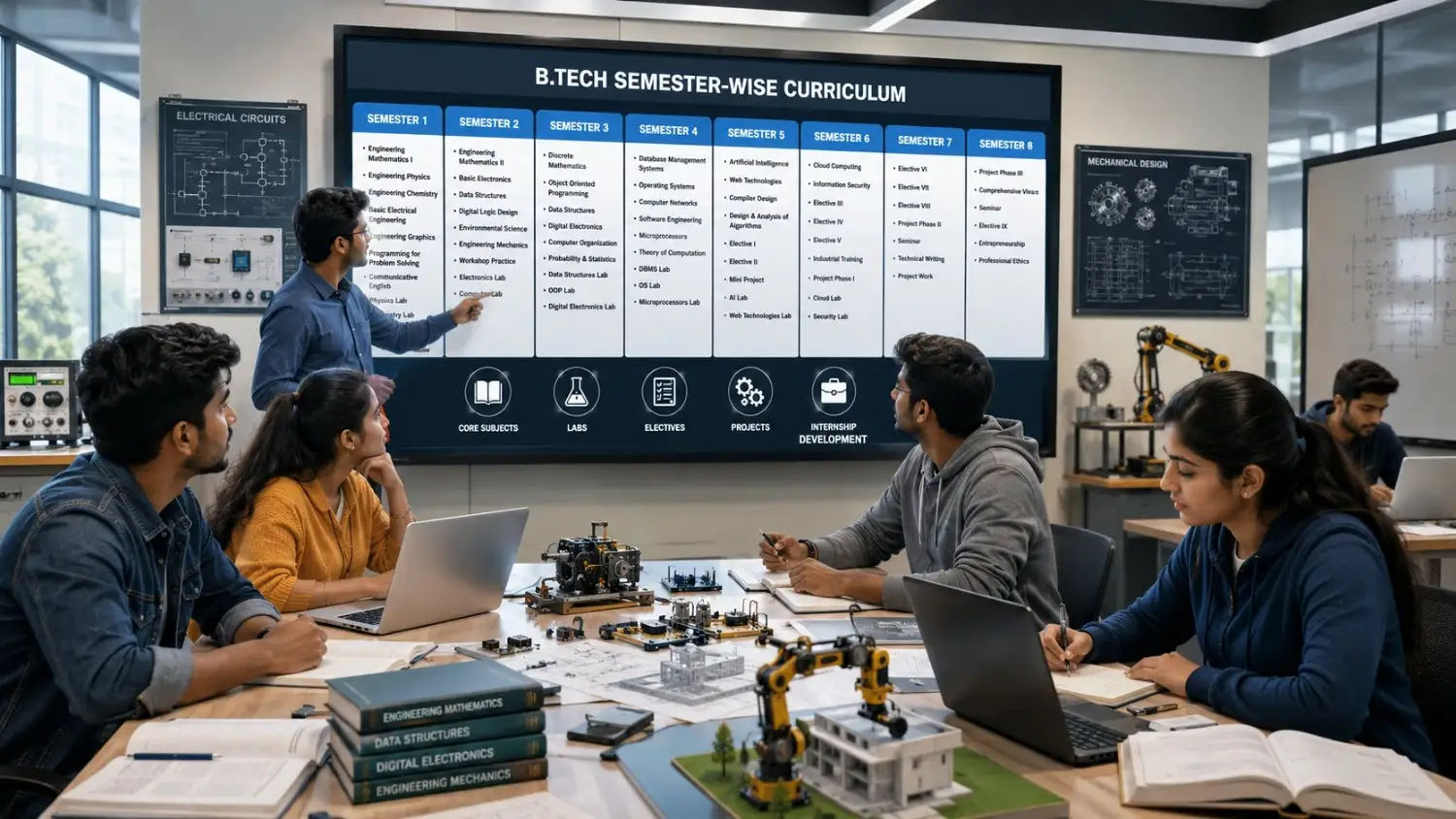
B.Tech is a four-year undergraduate engineering program divided into eight semesters.
Each semester usually contains:
- 5–7 theory subjects
- 1–3 laboratory courses
- Assignments
- Internal assessments
- Practical examinations
- Mini projects
- Major project (final year)
One thing many beginners miss is that engineering is not just about classroom learning. Practical exposure, coding, design, research, teamwork, and internships are equally important parts of the curriculum.
Semester-Wise B.Tech Subject List
Although subjects vary across branches like Computer Science, Mechanical, Civil, Electronics, Electrical, Artificial Intelligence, and Information Technology, the overall structure remains similar.
First Year (Semester 1 & 2)
The first year focuses on building a strong engineering foundation.
Typical subjects include:
- Engineering Mathematics I
- Engineering Mathematics II
- Engineering Physics
- Engineering Chemistry
- Basic Electrical Engineering
- Basic Electronics
- Programming Fundamentals
- Engineering Graphics
- Environmental Science
- English Communication Skills
Laboratories may include:
- Physics Lab
- Chemistry Lab
- Programming Lab
- Electrical Lab
- Workshop Practice
Second Year (Semester 3 & 4)
Now students begin studying branch-specific subjects.
Examples include:
Computer Science
- Data Structures
- Object-Oriented Programming
- Database Management Systems
- Digital Electronics
- Discrete Mathematics
- Computer Organization
Mechanical Engineering
- Thermodynamics
- Manufacturing Technology
- Fluid Mechanics
- Strength of Materials
- Machine Drawing
Civil Engineering
- Surveying
- Structural Analysis
- Building Materials
- Geotechnical Engineering
- Concrete Technology
Practical labs continue alongside theory classes.
Third Year (Semester 5 & 6)
This stage introduces advanced concepts.
Depending on the branch, subjects may include:
- Operating Systems
- Computer Networks
- Software Engineering
- Artificial Intelligence
- Machine Design
- Power Systems
- Structural Engineering
- VLSI Design
- Control Systems
- Heat Transfer
Students also begin:
- Mini Projects
- Research Assignments
- Industrial Visits
- Internship Preparation
Now, let us understand why this stage becomes more important. Employers often evaluate the technical knowledge developed during the third year while selecting interns.
Final Year (Semester 7 & 8)
The final year emphasizes industry readiness.
Common components include:
- Major Project
- Professional Electives
- Open Electives
- Industrial Internship
- Seminar Presentation
- Entrepreneurship
- Innovation & Research
Many universities also encourage students to work on real-world industry projects in collaboration with companies.
Core Subjects vs Elective Subjects
Understanding this difference helps students choose the right specialization.
| Mandatory | Optional |
| Fixed by university | Selected by students |
| Fundamental engineering concepts | Specialized topics |
| Required for graduation | Based on career interests |
Examples of electives include:
- Artificial Intelligence
- Cyber Security
- Cloud Computing
- Robotics
- Data Science
- Internet of Things
- Renewable Energy
- Blockchain Technology
Practical Subjects in B.Tech
Engineering education focuses heavily on practical learning.
Students perform experiments in laboratories related to their specialization.
Examples include:
- Programming Lab
- CAD Lab
- Machine Shop
- Electronics Lab
- Networking Lab
- Civil Engineering Lab
- Electrical Machines Lab
Practical sessions improve technical understanding and problem-solving abilities.
Internship and Industrial Training
Almost every engineering college now requires students to complete industrial training.
Internships help students:
- Gain real industry exposure.
- Improve technical skills
- Build professional networks
- Strengthen resumes
- Increase placement opportunities
Many students secure full-time job offers through internships before graduation.
For placement preparation, the placement preparation strategies available on www.vidyaudbhav.com can be valuable resources.
How Many Exams Are Conducted in B.Tech?
Each semester generally includes:
- Internal Tests
- Mid-Semester Exams
- Assignments
- Laboratory Assessments
- Viva Voce
- End Semester Examination
- Project Evaluation
Performance is usually measured using a Credit-Based Grading System (CBGS).
Skills You Learn During B.Tech
Besides technical knowledge, students develop essential professional skills.
These include:
- Analytical thinking
- Problem solving
- Coding
- Research methodology
- Communication
- Team collaboration
- Leadership
- Project management
- Technical documentation
- Presentation skills
These competencies are highly valued across industries worldwide.
Popular B.Tech Specializations
Students can choose from several engineering branches based on their interests.
Popular options include:
- Computer Science Engineering
- Artificial Intelligence
- Data Science
- Information Technology
- Mechanical Engineering
- Civil Engineering
- Electrical Engineering
- Electronics & Communication Engineering
- Chemical Engineering
- Biotechnology Engineering
- Aerospace Engineering
- Automobile Engineering
- Robotics Engineering
Each specialization includes unique subjects after the first year.
Common Challenges Faced by B.Tech Students
Engineering can be demanding.
Here are some common challenges:
- Heavy academic workload
- Complex mathematics
- Programming difficulties
- Time management
- Practical assignments
- Project deadlines
- Placement preparation
The good news is that these challenges become manageable with consistent study habits and hands-on practice.
Beginner Strategy for Success
If you're starting B.Tech in 2026, follow these simple strategies:
- Attend lectures regularly.
- Revise topics every week.
- Practice numerical problems daily.
- Build practical projects.
- Improve coding skills early.
- Participate in technical events.
- Complete internships during vacations.
- Learn industry-relevant software.
- Develop communication skills.
- Prepare for placements from the third year.
Advanced Strategy for Better Career Growth
Students aiming for top companies should also:
- Earn professional certifications.
- Contribute to open-source projects.
- Publish research papers.
- Participate in hackathons.
- Build a strong portfolio.
- Maintain a high CGPA.
- Network with industry professionals.
Real-world experience often creates a stronger impression than grades alone.
Mistakes to Avoid During B.Tech
Here is where many people make mistakes:
- Ignoring practical knowledge
- Studying only before exams
- Avoiding internships
- Not improving communication skills.
- Skipping projects
- Choosing electives without career planning
- Neglecting resume building
Avoiding these mistakes can significantly improve your academic and professional journey.
Future Trends in Engineering Education (2026 and Beyond)
Engineering education is evolving rapidly.
High-demand areas include:
- Artificial Intelligence
- Machine Learning
- Robotics
- Sustainable Engineering
- Cyber Security
- Data Science
- Electric Vehicles
- Smart Manufacturing
- Cloud Computing
- Internet of Things
Students who combine traditional engineering with emerging technologies will have a competitive advantage.
Expert Tips
Experienced educators recommend:
- Focus on concepts instead of memorization.
- Learn by building projects.
- Practice coding consistently.
- Read technical documentation.
- Join engineering communities.
- Keep up with industry developments.
- Develop both technical and soft skills.
A balanced approach prepares students for higher studies as well as employment.
Final Advice
The number of subjects in B.Tech may seem overwhelming initially, but the curriculum is designed to develop your technical expertise gradually. Every semester introduces new concepts that build upon previous knowledge, preparing you for real-world engineering challenges.
Whether your goal is campus placement, higher education, entrepreneurship, or research, a strong understanding of your B.Tech syllabus will help you plan your learning journey effectively.
For additional guidance, explore the engineering college selection, career planning guide, student success roadmap, and internship preparation resources available on www.vidyaudbhav.com.
Frequently Asked Questions (FAQs)
1. How many subjects are there in B.Tech in total?
Most universities offer approximately 55 to 75 subjects, including theory, practicals, electives, projects, and internships.
2. Does every B.Tech branch have the same subjects?
No. The first year is largely common, but branch-specific subjects differ from the second year onward.
3. Is mathematics compulsory in B.Tech?
Yes. Engineering Mathematics is a core subject in most B.Tech. programs, especially during the first two years.
4. Are practical labs mandatory in B.Tech?
Yes. Laboratory courses are an essential part of engineering education and carry academic credits.
5. How many semesters are there in B.Tech?
A standard B.Tech program consists of 8 semesters completed over four years.
6. Is an internship compulsory for B.Tech students?
Most universities require at least one industrial internship or practical training before graduation.
7. Which B.Tech specialization has the most coding subjects?
Computer Science Engineering, Information Technology, Artificial Intelligence, and Data Science generally include the highest number of programming-related subjects.