

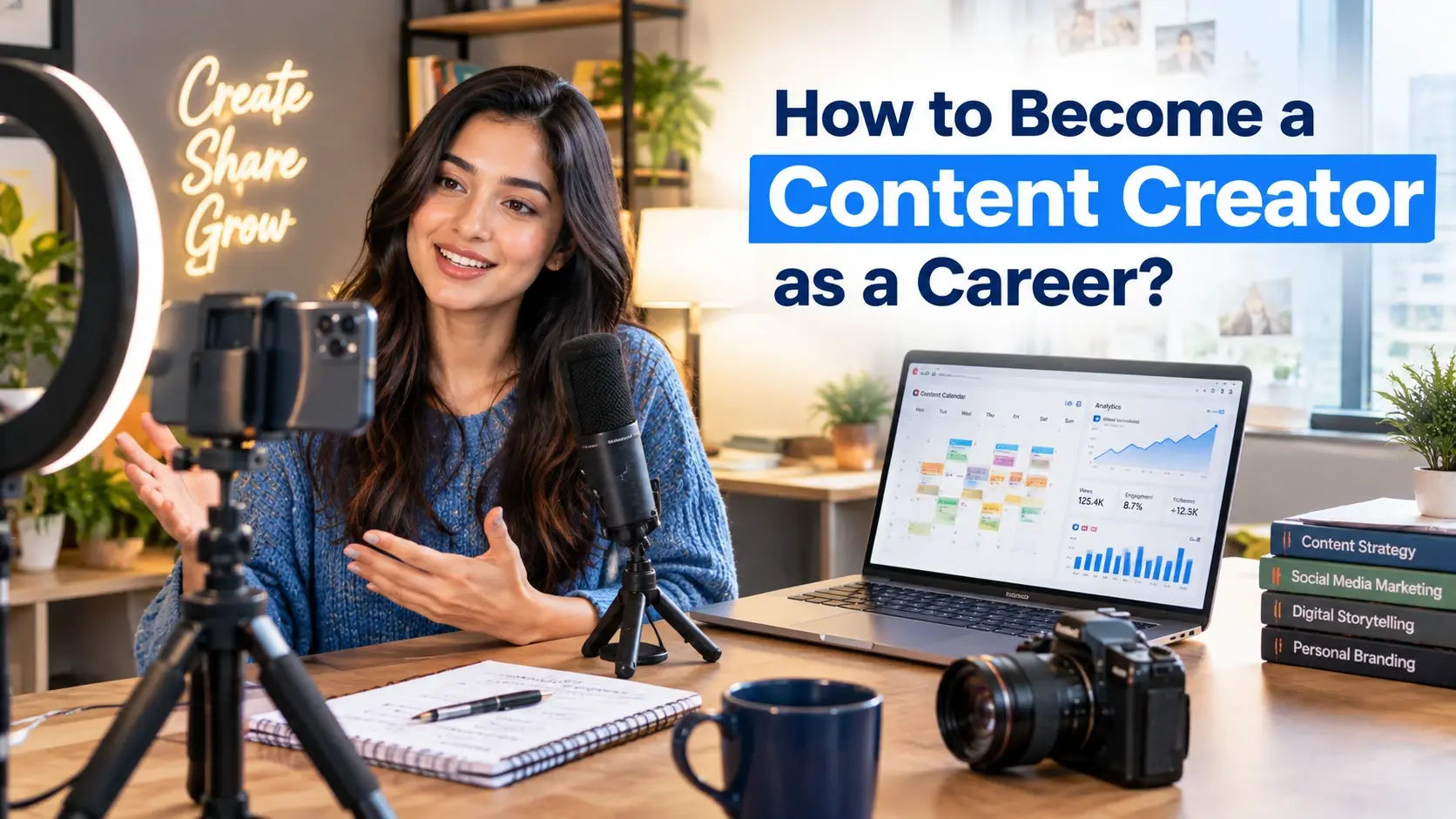
Becoming a content creator is no longer limited to people who want to become influencers. Today, content creation can involve video production, social media, photography, podcasting, blogging, graphic design, storytelling, education, brand communication, and digital marketing.
That makes content creation an increasingly flexible career option for students, graduates, freelancers, and professionals who enjoy creativity and communication.
https://vidyaudbhav.com/blogs/can-i-become-a-software-developer-after-bcom
https://vidyaudbhav.com/blogs/how-to-become-data-analyst-without-engineering-degree
But there is an important difference between creating content occasionally and building a content creator career. A career requires skills, consistency, audience understanding, portfolio development, platform knowledge, and eventually a sustainable way to earn.
If you are exploring creative careers, it is also useful to understand how your interests and existing abilities can influence your broader career direction. Vidya Udbhav's career planning resources can help you compare different career paths before committing to one.
What Does a Content Creator Do?
A content creator develops useful, entertaining, educational, or engaging material for a specific audience.
Depending on the niche, a creator might produce:
- Short-form videos
- YouTube videos
- Instagram Reels
- Blog articles
- Podcasts
- Newsletters
- Photography
- Educational content
- Product reviews
- Tutorials
- Social media posts
- Graphic designs
- Livestreams
A professional content creator usually does much more than press “publish.” Research, scripting, shooting, editing, thumbnail design, SEO, analytics, community management, and content planning can all become part of the job.
Is Content Creation a Good Career?
Content creation can become a career, but it should not be treated as an instant-income opportunity.
The industry includes several career models:
| Personal Creator | Build an audience around your personality or expertise | Individuals |
| Brand Creator | Produce content for companies | Creative professionals |
| Freelance Creator | Work with multiple clients | Freelancers |
| Educator | Create courses, tutorials, or educational media | Teachers and experts |
| Creator-Entrepreneur | Build products or services around an audience | Business-minded creators |
| Content Specialist | Work within a company's marketing team | Job seekers |
This variety is one of the biggest advantages of the field. You do not necessarily need millions of followers to make content creation part of your professional life.
What Skills Do You Need to Become a Content Creator?
You do not need to master everything on day one. Start with a core skill and gradually expand.
1. Communication
Good creators know how to explain an idea clearly.
You need to understand how to write captions, structure stories, speak naturally, create hooks, and communicate information without making it unnecessarily complicated.
2. Video and Photo Skills
Basic production skills are extremely valuable.
Learn:
- Framing
- Lighting
- Composition
- Camera basics
- Audio recording
- Video editing
- Thumbnail creation
You can begin with a smartphone. Expensive equipment is not a requirement for learning the fundamentals.
3. Writing and Storytelling
Even video creators need writing skills.
A strong Reel may require a script. A YouTube video needs structure. A social post needs a clear message.
Storytelling helps transform information into something people remember.
4. Social Media Knowledge
Each platform has different audience behavior.
You should understand concepts such as:
- Content formats
- Audience retention
- Engagement
- Posting consistency
- Hashtags and keywords
- Platform analytics
- Community interaction
Do not simply copy the same content everywhere. Adapt the idea to the platform.
5. Research Skills
Professional creators research before creating.
Look at audience questions, competing content, search trends, comments, frequently asked questions, and gaps in existing information.
One thing many beginners miss is that good content starts with understanding what people actually need.
6. Analytics
Views alone do not tell the complete story.
Track metrics such as:
- Watch time
- Retention
- Saves
- Shares
- Comments
- Click-through rate
- Follower growth
- Conversion rate
Analytics help you understand which topics and formats deserve more attention.
How to Become a Content Creator Step by Step
Step 1: Choose a Niche
Do not start with “I will create everything.”
Choose a broad area that you can consistently talk about.
Examples include:
- Technology
- Education
- Fitness
- Fashion
- Gaming
- Travel
- Food
- Personal finance
- Career guidance
- Beauty
- Business
- Photography
- Digital marketing
Your niche can become more specific later.
For example, “technology” could become “AI tools for students.”
Step 2: Define Your Audience
Ask yourself:
Who am I creating for?
A student audience has different interests from business owners or working professionals.
Define their age group, problems, interests, knowledge level, and goals.
This makes content planning much easier.
Step 3: Select One Main Platform
You can eventually publish across several platforms, but beginners often benefit from mastering one first.
For example:
- YouTube → Long-form video and educational content
- Instagram → Reels, visual content, personal branding
- TikTok → Short-form entertainment and educational videos
- LinkedIn → Professional and industry content
- Blogs → Search-driven educational content
- Podcasts → Conversations and long-form audio
Choose based on your strengths and where your target audience spends time.
Step 4: Build a Content Portfolio
Do not wait for a brand to hire you.
Create your own sample work.
A beginner portfolio could contain:
- 5 short videos
- 3 educational posts
- 2 edited videos
- 3 thumbnail designs
- 2 written articles
- 1 content calendar
- 1 sample brand campaign
This gives potential employers and clients something concrete to evaluate.
Step 5: Create Consistently
Consistency does not mean posting every day regardless of quality.
A realistic schedule might be:
- 3 short videos per week
- 1 long-form video per week
- 2 written posts per week
The right schedule depends on your available time.
The goal is to build a repeatable production system rather than burn out after two weeks.
Step 6: Learn From Analytics
After publishing enough content, look for patterns.
Which topics get more watch time?
Which opening lines make people continue watching?
Which posts receive saves or shares?
Which videos bring new followers?
Here is what actually works: use your audience's behavior to improve your next piece of content.
How Do Content Creators Make Money?
Content creators can build income through several routes.
Common options include:
- Brand partnerships
- Freelance content creation
- YouTube monetization
- Affiliate marketing
- Sponsored content
- Digital products
- Online courses
- Memberships
- Consulting
- UGC creation
- Photography or video services
- Social media management
Income varies significantly by niche, audience, platform, location, experience, business model, and consistency.
That is why beginners should avoid choosing content creation solely because they see another creator earning money online.
Content Creator vs Influencer
These terms are often used interchangeably, but they are not identical.
A content creator focuses primarily on producing content.
An influencer generally focuses on influencing audience decisions, opinions, or purchasing behavior through an established personal brand.
One person can be both.
For example, a technology creator may produce smartphone tutorials while also partnering with technology brands.
Tools Content Creators Can Use
You do not need dozens of applications.
Beginner-Friendly Options
- Canva
- CapCut
- Adobe Express
- Google Docs
- YouTube Studio
Professional Options
- Adobe Premiere Pro
- Adobe Photoshop
- Adobe After Effects
- DaVinci Resolve
- Final Cut Pro
Research and Planning
- Google Trends
- YouTube Studio
- Notion
- Trello
- Google Analytics
The best tool is usually the one you can use efficiently rather than the one with the longest feature list.
Beginner Strategy: Start Small
If you are completely new, try this 30-day approach.
Week 1: Choose your niche, audience, platform, and content themes.
Week 2: Study successful content and create your first five pieces.
Week 3: Publish consistently and collect performance data.
Week 4: Identify your strongest topics, improve your production quality, and plan the next month.
Do not spend your first month obsessing over equipment.
Spend it learning.
Advanced Strategy: Build a Personal Brand
Once you have basic skills, start developing recognizable expertise.
Create recurring content series.
For example:
- “AI Tool of the Week”
- “Career Tip Tuesday”
- “One-Minute Marketing”
- “Beginner Design Lessons”
A repeatable series makes content planning easier and can help audiences understand what they can expect from you.
You should also develop a recognizable voice, visual identity, and point of view.
How Education Can Help a Content Creator Career
A specific degree is not always required to begin creating content. However, education can help develop complementary skills.
Useful academic areas may include:
- Mass Communication
- Journalism
- Marketing
- Digital Marketing
- Graphic Design
- Film and Media
- Business
- English
- Communication
Your educational choice should depend on the kind of work you ultimately want to do.
If you are still deciding between creative and other professional paths, explore Vidya Udbhav's career guidance based on interests and skills before selecting a course.
Common Mistakes to Avoid
Chasing Virality
One viral video does not automatically create a career.
Build a system that can produce useful content repeatedly.
Copying Other Creators
Study successful creators, but develop your own perspective.
Ignoring Audio
Poor audio can make otherwise good videos difficult to watch.
Focusing Only on Followers
A smaller, relevant audience can be more valuable than a large but disconnected one.
Buying Expensive Equipment Too Early
Learn production fundamentals before making major equipment investments.
Posting Without a Strategy
Random content makes it difficult to understand what your audience expects.
Ignoring Business Skills
Creators who want long-term sustainability should eventually understand pricing, contracts, client communication, budgeting, and personal branding.
The Role of AI in Content Creation
AI is increasingly becoming part of creator workflows.
It can assist with:
- Brainstorming
- Research organization
- Transcription
- Caption drafting
- Editing assistance
- Image generation
- Content repurposing
- Translation
- Idea development
Recent Adobe research found that creative AI is already deeply integrated into many creators' workflows, while creators also emphasized retaining human control over final creative decisions.
That distinction matters.
AI can speed up production, but your judgment, originality, experience, storytelling, and understanding of your audience remain important.
Future Trends in Content Creation
The creator profession is likely to become more multidisciplinary.
Future creators may increasingly combine:
- Content strategy
- AI literacy
- Video production
- SEO
- Community building
- Personal branding
- Data analysis
- Entrepreneurship
The traditional boundary between “creator,” “marketer,” “designer,” and “entrepreneur” is already becoming less clear.
For students thinking about future-proof careers, this is part of a broader shift toward combining formal education with practical, job-ready skills. Vidya Udbhav's guide to future jobs and international careers explores this wider career landscape.
Expert Tips for Building a Sustainable Creator Career
- Start with one clear audience.
- Build one strong skill before adding five more.
- Publish useful content consistently.
- Learn basic SEO and analytics.
- Create a professional portfolio.
- Study audience behavior instead of guessing.
- Keep improving your storytelling.
- Develop communication and business skills.
- Experiment with multiple income streams over time.
- Protect your credibility by checking facts before publishing.
Quick Career Roadmap
Beginner → Skill Development → Portfolio → Consistent Publishing → Audience Building → Analytics → Personal Brand → Monetization → Professional Creator Career
You do not have to complete every stage immediately.
The important part is progressing from one stage to the next.
Frequently Asked Questions
1. Can I become a content creator without a degree?
Yes. A degree is not necessarily required to start creating content. However, education in areas such as communication, marketing, media, design, or business can provide useful supporting knowledge.
2. What should I post as a beginner content creator?
Start with topics you understand or genuinely want to learn. Tutorials, educational posts, personal experiences, reviews, explanations, and problem-solving content are common starting points.
3. Which platform is best for content creators?
There is no universal best platform. YouTube, Instagram, TikTok, LinkedIn, blogs, and podcasts serve different audiences and content formats. Choose according to your niche and strengths.
4. How long does it take to become a successful content creator?
There is no fixed timeline. Results depend on content quality, consistency, niche, audience demand, platform, skills, and business strategy. Treat the early period as a learning and portfolio-building stage.
5. Can content creation become a full-time career?
Yes, but sustainable income usually requires more than audience growth. Creators may combine sponsorships, freelance services, platform revenue, products, courses, affiliate income, or other business models.
6. Do I need an expensive camera to start?
No. A smartphone, reasonable lighting, and clear audio can be enough to learn the fundamentals and build an initial portfolio.
7. Is content creation suitable for students?
It can be, particularly for students interested in communication, media, marketing, design, technology, education, or entrepreneurship. Students should balance content creation with their academic responsibilities.
Final Advice
If you want to become a content creator as a career, do not begin by asking, “How can I go viral?”
Start with better questions:
What can I teach, explain, entertain, or create?
Who needs this content?
Which skill can I develop that makes my work valuable?
How can I turn that skill into a professional portfolio?
Content creation rewards experimentation, but a career requires structure.
Start with one niche, one audience, one platform, and one useful skill. Create consistently, study your results, improve your craft, and gradually learn the business side of the profession.
Most importantly, give yourself time to develop.
A successful content career is rarely built from one viral post. It is built through hundreds of small improvements that eventually turn creativity into professional expertise.
For students who are still comparing different career possibilities, structured career planning and guidance can help connect personal interests, skills, education, and long-term goals before making an important decision.