

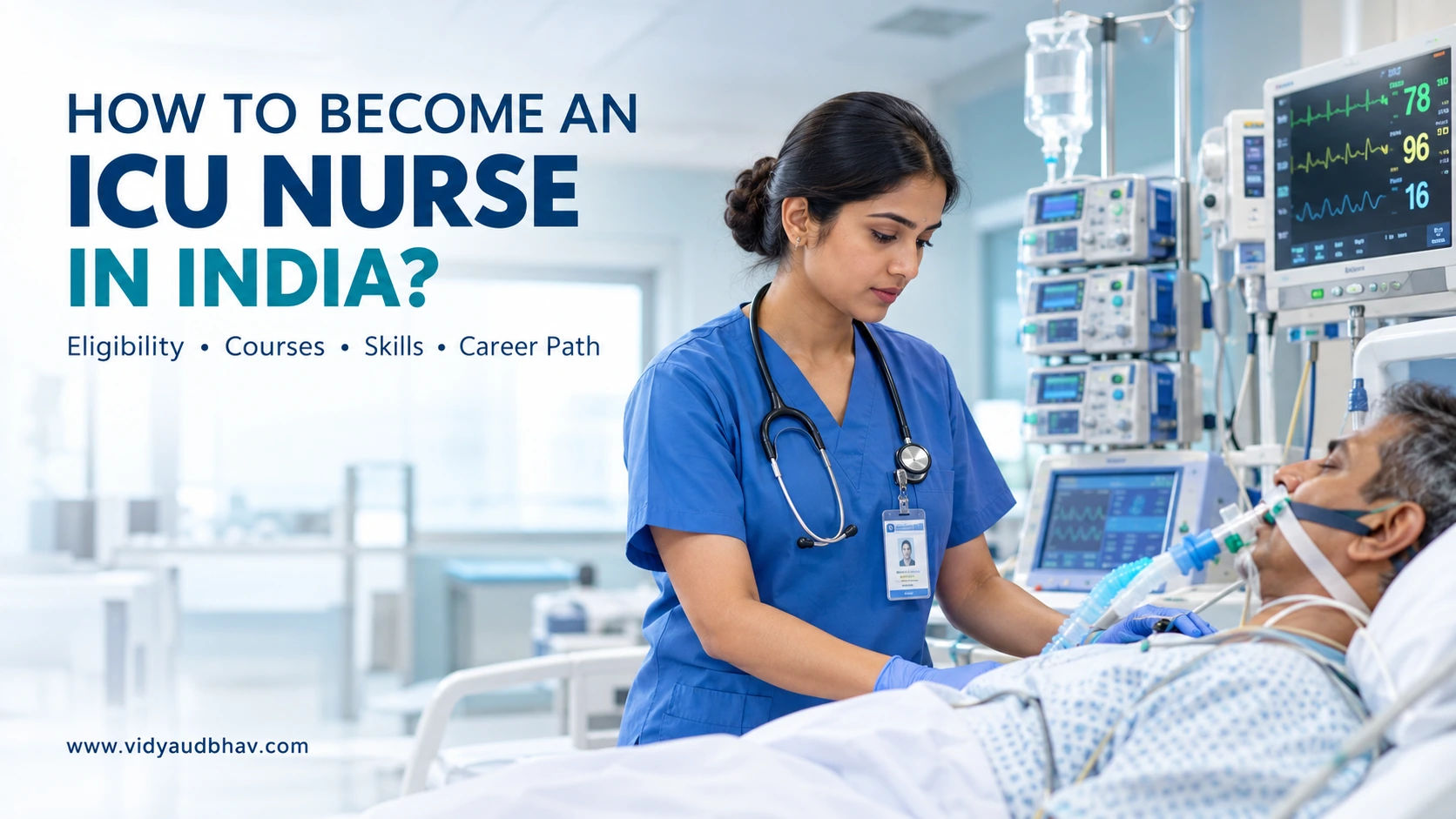
Becoming an ICU nurse is a rewarding career path for students who want to work in critical care and make a direct difference in patients' lives. Unlike general nursing, ICU nursing requires professionals to work with critically ill patients who may need continuous monitoring, ventilator support, emergency care, and complex medication management.
If you are wondering how to become an ICU nurse in India, the usual pathway starts with a recognised nursing qualification such as B.Sc Nursing or GNM, followed by clinical experience and specialised critical-care training.
https://vidyaudbhav.com/blogs/bsc-nursing-salary-in-india-freshers
https://vidyaudbhav.com/blogs/does-bba-have-maths
For students still comparing nursing pathways, the complete nursing course guide can help explain the major options available after school.
Quick Answer: How to Become an ICU Nurse in India
The basic roadmap is:
- Complete 10+2 with the required subjects.
- Pursue a recognised nursing qualification such as B.Sc Nursing or GNM.
- Complete clinical training and obtain the required nursing registration.
- Gain hospital experience, preferably in a critical-care environment.
- Develop ICU-specific clinical skills.
- Consider a Post Basic Diploma in Critical Care Nursing or another recognised specialisation.
- Apply for ICU nurse positions in hospitals and healthcare institutions.
- Continue learning through advanced certifications, training and higher education.
The Indian Nursing Council recognises B.Sc Nursing, GNM, Post Basic B.Sc Nursing, and specialised critical-care nursing programs within its nursing education framework. Its current program information lists a one-year Post Basic Diploma in Critical Care Nursing and a two-year Nurse Practitioner in Critical Care program.
What Does an ICU Nurse Do?
An ICU nurse, or intensive care unit nurse, provides specialised nursing care to patients with serious or life-threatening medical conditions.
A typical ICU nurse may be responsible for:
- Monitoring vital signs continuously
- Administering medicines and treatments
- Monitoring patients receiving ventilator support
- Maintaining accurate patient records
- Assisting doctors during emergency procedures
- Managing IV lines and other medical equipment
- Observing changes in a patient's condition
- Communicating with doctors and other healthcare professionals
- Supporting and educating patients' families
- Following infection-control and patient-safety protocols
ICU nursing requires much more than technical knowledge. Nurses must recognise changes in a patient's condition quickly and communicate them clearly to the clinical team.
Why Choose ICU Nursing as a Career?
ICU nursing can be demanding, but it offers opportunities to develop advanced clinical skills and build experience in complex healthcare environments.
1. Specialised Clinical Experience
Working in an ICU exposes nurses to critically ill patients and advanced hospital procedures. This can help build experience in areas such as emergency response, monitoring and critical-care equipment.
2. Career Opportunities
ICU nurses can work in:
- Government hospitals
- Private hospitals
- Multispecialty hospitals
- Medical colleges
- Trauma centres
- Cardiac-care units
- Emergency departments
- Critical-care facilities
3. Opportunities for Further Specialisation
Experienced nurses can pursue specialised education in critical care, emergency care, cardiothoracic nursing, oncology nursing and other areas.
4. International Career Potential
Nursing is also an internationally mobile profession. However, working abroad usually requires meeting the destination country's registration, licensing, language and immigration requirements.
What Qualification Is Required to Become an ICU Nurse in India?
There is no single educational route followed by every hospital. Requirements can vary depending on the employer and position.
Two common nursing pathways are B.Sc Nursing and GNM.
| GNM | Around 3 years | Nursing registration → hospital experience → ICU opportunity |
| B.Sc Nursing | 4 years | Nursing registration → hospital experience → ICU opportunity |
| Post Basic B.Sc Nursing | 2 years | GNM → degree upgrade → advanced career options |
| Post Basic Diploma in Critical Care Nursing | 1 year | Registered nurse → critical-care specialization |
| Nurse Practitioner in Critical Care | 2 years | Advanced critical-care specialization |
The Indian Nursing Council lists GNM as a recognised nursing program and B.Sc Nursing as a four-year program. It also lists Post Basic B.Sc Nursing as a two-year regular program and specialised critical-care qualifications.
Before enrolling, always verify the latest recognition status of the institution and program. The Indian Nursing Council publishes information about nursing institutions and recognised qualifications.
Step-by-Step Guide to Becoming an ICU Nurse
Step 1: Complete Your School Education
Students generally begin by completing 10+2 and meeting the eligibility requirements of their chosen nursing program.
For GNM, the Indian Nursing Council's eligibility information specifies 10+2 with English and a minimum qualifying percentage, while individual institutions may have additional requirements.
For B.Sc Nursing, eligibility should be checked with the specific college because admission requirements can differ.
Step 2: Choose a Recognised Nursing Course
Your first major decision is selecting between routes such as B.Sc Nursing and GNM.
If you are looking for a degree-based pathway with opportunities for higher studies, B.Sc Nursing may be worth considering.
If you want a diploma-based nursing route, GNM is another established pathway.
Do not select a college only because its advertisement promises placements. Check recognition, clinical exposure, hospital affiliations, faculty and training facilities.
Step 3: Complete Clinical Training
Nursing education involves both classroom learning and clinical practice.
This stage is particularly important for future ICU nurses because theoretical knowledge alone is not enough. You need experience applying nursing principles in real clinical environments.
Step 4: Obtain Nursing Registration
After completing the required nursing qualification, candidates need to follow the applicable registration process with the relevant State Nursing Council.
Registration requirements should be verified at the time of graduation because regulatory processes can change.
Step 5: Gain Hospital Experience
Many aspiring ICU nurses begin their careers as staff nurses and gradually move toward critical care.
Working in a hospital environment helps you develop:
- Patient assessment skills
- Medication safety
- Clinical communication
- Emergency response
- Documentation
- Infection-control practices
- Teamwork
Step 6: Develop ICU-Specific Skills
This is where many beginners underestimate the importance of practical training.
An ICU nurse should become comfortable with patient monitoring, emergency procedures, medical equipment, medication protocols and critical-care documentation.
The Indian Nursing Council's critical-care curriculum includes areas such as advanced health assessment, advanced pathophysiology, pharmacology and foundations of critical-care nursing practice.
Step 7: Consider Critical-Care Specialisation
After becoming a registered nurse, specialised education can strengthen your critical-care knowledge.
The Indian Nursing Council lists a Post Basic Diploma in Critical Care Nursing with a one-year duration. It also lists a Nurse Practitioner in Critical Care program with a two-year duration.
Eligibility for advanced programs can vary, so students should always check the current admission regulations before applying.
Skills Needed to Become a Successful ICU Nurse
Academic qualifications are only one part of ICU nursing.
Important skills include:
Clinical Observation
Small changes in a critically ill patient's condition can be significant. Strong observation and timely communication are essential.
Technical Skills
ICU nurses may work with monitoring systems, infusion pumps, ventilators and other critical-care equipment.
Communication
Clear communication with doctors, nurses, patients and families is essential, particularly during emergencies.
Teamwork
ICU care is highly collaborative. Nurses work closely with doctors, respiratory therapists, technicians and other healthcare professionals.
Emotional Control
ICU environments can be stressful. Nurses need professional composure while dealing with emergencies and difficult situations.
Where Can ICU Nurses Work?
After gaining appropriate qualifications and experience, ICU nurses may find opportunities in different healthcare settings.
Common workplaces include:
- Medical ICUs
- Surgical ICUs
- Cardiac ICUs
- Emergency and trauma units
- Neurosurgical ICUs
- Pediatric intensive care units
- Multispecialty hospitals
- Medical colleges
- Critical-care centres
Specialisation and experience can influence the type of ICU position a nurse can pursue.
ICU Nurse Salary in India
There is no single fixed salary for ICU nurses.
Pay can vary based on:
- Qualification
- Years of experience
- Hospital type
- City
- ICU specialization
- Shift responsibilities
- Additional certifications
- Employer
A fresher and an experienced critical-care nurse should therefore not expect identical compensation.
Instead of choosing nursing purely based on salary, students should evaluate the complete career pathway, including education cost, clinical exposure, specialization opportunities and long-term progression.
For broader information about nursing career pathways, explore the nursing courses and career guidance resources available through Vidya Udbhav.
Benefits and Challenges of ICU Nursing
| Specialized clinical experience | High-pressure environment |
| Multiple hospital career opportunities | Shift and night duties |
| Scope for specialization | Emotionally demanding cases |
| Advanced clinical learning | Long periods of standing |
| Potential international opportunities | Continuous learning required |
| Strong healthcare teamwork | Emergency situations |
One thing many beginners miss is that ICU nursing is not simply a higher-paying version of general nursing. It is a specialized clinical role requiring greater responsibility, technical awareness and continuous learning.
Tools and Learning Resources for Aspiring ICU Nurses
Students can use different resources during their education and professional development.
Beginner-Friendly Options
- Nursing textbooks
- Clinical procedure manuals
- Hospital training programs
- Simulation labs
- Nursing study apps
Professional Learning
- Critical-care nursing textbooks
- Clinical guidelines
- Simulation-based training
- Hospital workshops
- Continuing professional education
Advanced Options
- Post Basic Diploma in Critical Care Nursing
- Nurse Practitioner in Critical Care
- M.Sc Nursing
- Speciality nursing programs
The most useful resource is usually the one that combines theoretical knowledge with supervised clinical practice.
Beginner Strategy: How to Start After 12th
If you are currently in Class 12 and already know that you want to become an ICU nurse, do not worry about becoming a specialist immediately.
Follow a simple sequence:
12th → Nursing qualification → Registration → Clinical experience → ICU exposure → Critical-care specialization → Career progression
Start by researching recognised nursing colleges, admission requirements, clinical facilities and hospital affiliations.
You can also explore healthcare courses and career options if you are still comparing nursing with other healthcare careers.
Advanced Strategy for Existing Nurses
Already working as a nurse?
Your strategy can be different.
Focus on:
- Getting experience in a hospital with a functioning ICU.
- Improving critical-care knowledge.
- Learning how ICU equipment is used under proper supervision.
- Developing emergency-response skills.
- Pursuing recognised critical-care education where appropriate.
- Building strong clinical documentation and communication skills.
- Exploring leadership or advanced-practice pathways later.
The Indian Nursing Council's critical-care framework emphasizes specialized skills, professional accountability, communication, leadership and management of care for critically ill patients.
Common Mistakes to Avoid
Choosing a College Without Checking Recognition
A nursing college's marketing claims should never replace verification of its recognition and program status.
Focusing Only on Salary
Salary is important, but clinical exposure and specialization can have a major impact on long-term career development.
Ignoring Hospital Training
For ICU nursing, practical exposure is extremely important.
Avoiding Communication Skills
A technically capable nurse still needs to communicate clearly with the healthcare team and patient families.
Assuming Every ICU Job Has the Same Requirements
Hospitals can set different eligibility and experience requirements. Always read the job description carefully.
Expert Tips for Future ICU Nurses
Here is what actually works when preparing for this career:
- Choose a recognised nursing program.
- Prioritise strong clinical exposure.
- Learn patient assessment thoroughly.
- Treat documentation as a clinical skill.
- Build confidence in professional communication.
- Understand basic critical-care equipment before working independently.
- Never perform unfamiliar procedures without appropriate training and supervision.
- Keep updating your knowledge after graduation.
- Consider specialisation once you have a clear understanding of your career direction.
Future of ICU Nursing in India
Healthcare is becoming increasingly dependent on trained professionals who can manage complex patients safely.
Critical-care nursing is also becoming more specialised. The existence of dedicated critical-care programs, including Post Basic Diploma and Nurse Practitioner pathways, reflects the growing emphasis on specialised nursing education.
For students, this means the career path does not necessarily end with becoming a staff nurse. With appropriate education, experience and registration, nurses can explore clinical specialization, education, leadership, research and advanced-practice pathways.
Frequently Asked Questions
1. Can I become an ICU nurse after B.Sc Nursing?
Yes. B.Sc Nursing can provide the foundational nursing education needed to pursue hospital nursing roles, including ICU positions, subject to the employer's requirements and applicable registration rules.
2. Can GNM nurses become ICU nurses?
Yes. GNM is a recognised nursing pathway, and GNM-qualified nurses can pursue hospital employment and later develop critical-care expertise through experience and additional education. Specific ICU eligibility depends on the employer and program.
3. Is a critical-care course compulsory to become an ICU nurse?
Not necessarily for every ICU position. Requirements differ between hospitals. However, specialised critical-care education can provide structured knowledge and practical preparation for working with critically ill patients.
4. How long does it take to become an ICU nurse in India?
The timeline depends on the nursing pathway you choose. B.Sc Nursing is four years, while GNM is generally around three years under the current INC program information. Additional critical-care specialisation can add further study time.
5. What is the difference between a staff nurse and an ICU nurse?
A staff nurse may work across different hospital departments, whereas an ICU nurse works specifically with critically ill patients and requires familiarity with intensive monitoring, critical-care procedures and emergencies.
6. Can Indian ICU nurses work abroad?
Yes, Indian nurses can pursue international opportunities, but every country has its own licensing, qualification assessment, language and immigration requirements. International employment should therefore be planned country by country.
7. Is ICU nursing difficult?
ICU nursing can be demanding because patients may require continuous monitoring and urgent intervention. Strong training, clinical supervision, teamwork and continued learning can help nurses handle these responsibilities professionally.
Actionable Final Advice
If your goal is to become an ICU nurse, do not try to solve the entire career journey in one step.
First, choose the right nursing qualification. Then focus on clinical training, registration and hospital experience. Once you understand the realities of patient care, consider specialised critical-care education.
Most importantly, compare nursing colleges carefully before admission. Look beyond advertisements and check recognition, clinical exposure, faculty, hospital facilities and the actual curriculum.
For students who are still deciding between nursing pathways, career and course guidance from Vidya Udbhav can help you evaluate education options according to your academic background and career goals.
Conclusion
Learning how to become an ICU nurse in India is really about understanding the complete career pathway rather than looking for one short course.
A recognised nursing qualification is the foundation. Clinical experience builds confidence, while critical-care specialisation can help develop the advanced knowledge required in intensive-care environments.
If you are a student planning your healthcare career, start by researching the right nursing course and recognised institutions. If you are already a nurse, focus on clinical experience, critical-care skills and appropriate specialisation.
With the right education, practical training and commitment to continuous learning, ICU nursing can become a specialised and meaningful healthcare career.