

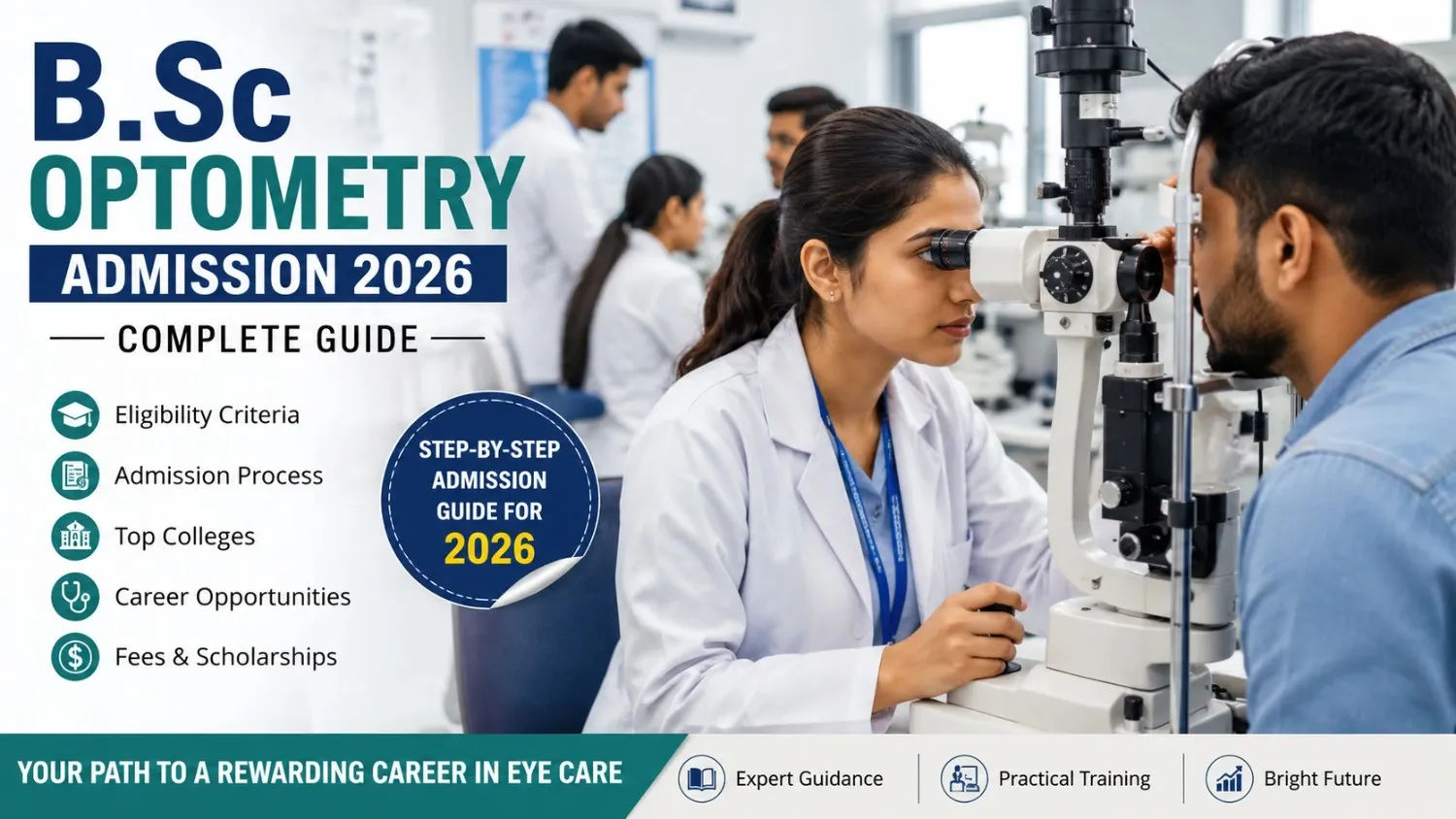
How to Get Admission in B.Sc Optometry? Complete Guide 2026
The healthcare industry is evolving rapidly, and eye care has become one of the most promising career sectors worldwide. With increasing screen time, rising rates of eye disorders, and growing awareness of vision health, the demand for qualified optometrists continues to rise.
If you are a student who has completed Class 12 and wants to build a rewarding healthcare career without pursuing an MBBS degree, a B.Sc. Optometry can be an excellent choice.
This comprehensive guide explains everything you need to know about B.Sc Optometry Admission 2026, including eligibility criteria, admission procedures, entrance exams, career opportunities, fees, and expert strategies to secure admission successfully.
For students exploring healthcare and professional career options, the career guidance resources available at Vidya Udbhav can also help in making informed academic decisions.
Quick Answer: How to Get Admission in B.Sc Optometry?
To get admission in B.Sc Optometry in 2026:
- Complete Class 12 with Physics, Chemistry, and Biology (or Mathematics, depending on the institution).
- Meet the minimum percentage requirement.
- Apply through merit-based admission or entrance examinations.
- Submit required documents.
- Attend counseling if applicable.
- Complete fee payment and admission formalities.
What is B.Sc Optometry?
B.Sc Optometry is a four-year undergraduate healthcare program focused on eye care, vision science, optical technology, and visual rehabilitation.
Students learn to:
- Examine eyesight
- Diagnose vision problems
- Prescribe corrective lenses
- Detect eye diseases
- Assist ophthalmologists
- Manage optical clinics
It combines medical science, technology, and patient care, making it one of the most practical allied healthcare programs available today.
Why Choose B.Sc Optometry in 2026?
The healthcare sector is witnessing a significant shortage of trained eye care professionals.
Major Reasons Students Choose Optometry
| Growing Demand | Increasing vision-related issues globally |
| Healthcare Career | Direct patient interaction |
| Multiple Career Paths | Clinical, academic, research, and corporate opportunities |
| International Scope | Demand exists in many countries |
| Stable Income | Consistent career growth |
| Higher Education Options | Master's and specialization opportunities |
One thing many students miss is that optometry professionals play a critical role in preventive healthcare. Early detection of eye diseases often prevents long-term complications.
Search Intent Behind B.Sc Optometry Admission
Most students searching for this topic want answers to:
- Can I do B.Sc Optometry after 12th?
- What are the eligibility requirements?
- Is NEET required?
- What is the admission process?
- Which colleges offer B.Sc Optometry?
- What is the career scope?
This guide addresses each of these questions in detail.
Eligibility Criteria for B.Sc Optometry Admission 2026
Before applying, students must understand the basic eligibility requirements.
Academic Qualification
Most institutions require:
- Class 12 or equivalent
- Recognized education board
- Science stream preferred
Required Subjects
Generally accepted subjects include:
- Physics
- Chemistry
- Biology
Some institutions also accept:
- Physics
- Chemistry
- Mathematics
Minimum Marks Requirement
Most colleges require:
- 45%–60% aggregate marks
- Reserved categories may receive relaxation.
Requirements can vary depending on the institution.
Is NEET Required for B.Sc Optometry?
This is one of the most frequently asked questions.
Short Answer
No.
Most B.Sc Optometry programs do not require NEET scores.
Admissions are usually based on:
- Class 12 marks
- Institution-level entrance exams
- State-level entrance examinations
- University admission processes
However, students should verify the latest admission rules of their preferred institution.
Admission Process for B.Sc Optometry 2026
Now, let us understand the complete admission process.
Step 1: Research Suitable Colleges
Begin by identifying institutions that offer:
- Modern laboratories
- Clinical exposure
- Internship opportunities
- Industry partnerships
- Experienced faculty
Students can explore healthcare career-planning resources through the student-focused educational guidance available at Vidya Udbhav.
Step 2: Check Eligibility
Review:
- Subject requirements
- Minimum marks
- Age criteria
- Entrance exam requirements
Step 3: Fill Application Form
Submit:
- Personal information
- Academic records
- Identity documents
- Photograph and signature
Step 4: Appear for Entrance Examination (If Applicable)
Some universities conduct admission tests.
These may assess:
- Biology
- Physics
- Chemistry
- Logical reasoning
- English proficiency
Step 5: Merit List and Counseling
Selected candidates are invited for:
- Counseling sessions
- Seat allocation
- Document verification
Step 6: Fee Payment
After seat allotment:
- Pay admission fees
- Confirm enrollment
- Complete registration
Important Documents Required
Keep the following documents ready:
- Class 10 Marksheet
- Class 12 Marksheet
- Transfer Certificate
- Character Certificate
- Migration Certificate (if applicable)
- Passport-size photographs
- Aadhaar Card or identity proof
- Category certificate (if applicable)
Organizing documents early prevents last-minute admission delays.
B.Sc Optometry Course Structure
The curriculum combines theory and practical learning.
Major Subjects Include
First Year
- Human Anatomy
- Physiology
- Biochemistry
- Visual Optics
Second Year
- Ocular Anatomy
- Optometric Instruments
- Contact Lens Technology
- Pathology
Third Year
- Clinical Optometry
- Binocular Vision
- Low Vision Care
- Community Optometry
Internship Training
The final phase usually includes clinical training and internships.
Students gain real-world experience by working with patients under professional supervision.
Skills Required to Become a Successful Optometrist
Academic knowledge alone is not enough.
Essential Skills
- Attention to detail
- Communication skills
- Problem-solving ability
- Patient management
- Analytical thinking
- Technical proficiency
- Empathy and professionalism
These skills significantly improve employability after graduation.
Career Scope After B.Sc Optometry
One reason optometry remains popular is its strong career potential.
Job Opportunities
Graduates can work as:
- Optometrist
- Clinical Optometrist
- Vision Therapist
- Contact Lens Specialist
- Refraction Expert
- Optical Consultant
- Eye Care Counselor
Employment Sectors
- Hospitals
- Eye care centers
- Optical retail chains
- Research institutes
- Healthcare organizations
- Educational institutions
Salary After B.Sc Optometry
Salary depends on:
- Skills
- Experience
- Location
- Organization
Average Career Progression
| Fresher | Junior Optometrist |
| 2–5 Years | Clinical Optometrist |
| 5–10 Years | Senior Specialist |
| 10+ Years | Consultant or Practice Owner |
Professionals who continuously upgrade their skills often achieve faster career growth.
Higher Education Options After B.Sc Optometry
Many graduates pursue advanced studies.
Popular Choices
- M.Sc Optometry
- Master of Public Health
- Vision Science Programs
- Clinical Research
- Healthcare Management
Higher education can open opportunities in research, teaching, and specialized clinical practice.
Common Challenges Students Face During Admission
Here is where many students make mistakes.
Challenge 1: Late Applications
Many students wait until deadlines approach.
Solution: Prepare applications early.
Challenge 2: Incomplete Documentation
Missing certificates can delay admissions.
Solution: Create a document checklist.
Challenge 3: Poor College Research
Students sometimes select institutions without evaluating facilities.
Solution: Compare curriculum, internships, and placement support.
Challenge 4: Ignoring Career Planning
Admission should align with long-term goals.
Students can benefit from structured career planning resources available through educational guidance platforms such as Vidya Udbhav.
Real-Life Example
Consider two students who complete Class 12 with similar marks.
Student A
- Applies early
- Researches colleges
- Prepares documents
- Attends counseling on time
Student B
- Delays applications
- Misses deadlines
- Lacks required documents
Student A secures admission in a preferred institution while Student B struggles to find available seats.
This example highlights why preparation matters.
Beginner Strategy for B.Sc Optometry Admission
If you are starting now, follow this roadmap:
Month 1
- Research colleges
- Understand eligibility
Month 2
- Collect documents
- Prepare entrance exam materials.
Month 3
- Submit applications
Month 4
- Attend counseling
- Verify admission status
This systematic approach reduces stress and improves admission success.
Advanced Strategy for Competitive Institutions
Students targeting highly sought-after institutions should:
- Maintain strong Class 12 scores.
- Prepare for entrance exams.
- Develop communication skills
- Gain healthcare exposure through volunteering.
- Participate in science-related activities.
These efforts strengthen academic profiles.
Best Practices for Successful Admission
Follow These Recommendations
- Start planning early
- Monitor admission notifications
- Keep multiple college options.
- Verify eligibility requirements carefully.
- Organize documents digitally and physically.
- Stay updated with admission schedules.
Consistency often matters more than complexity.
Expert Tips for Future Optometrists
Healthcare professionals recommend:
- Focus on science fundamentals.
- Develop patient communication skills.
- Learn basic healthcare ethics.
- Stay updated with eye care innovations.
- Pursue practical learning opportunities.
The most successful optometrists combine technical expertise with patient-centered care.
Future Trends in Optometry
The field is evolving rapidly.
Emerging Areas
- Digital eye strain management
- Pediatric vision care
- Tele-optometry
- Artificial intelligence in diagnostics
- Advanced contact lens technologies
- Vision rehabilitation
Students entering in 2026 will likely benefit from these growing opportunities.
Practical Admission Checklist
Before submitting applications, ensure you have:
✓ Completed Class 12
✓ Verified eligibility
✓ Prepared required documents
✓ Selected target institutions
✓ Submitted applications
✓ Tracked deadlines
✓ Prepared for counseling
✓ Arranged admission fees
This checklist helps avoid common admission errors.
Actionable Final Advice
If your goal is to enter the healthcare sector without pursuing a lengthy medical degree, B.Sc Optometry offers an excellent balance of professional growth, patient care, and career stability.
Start preparing as early as possible. Research institutions carefully, understand admission requirements, maintain strong academic performance, and stay organized throughout the application process.
Students seeking broader career planning, educational guidance, and academic decision-making support can also explore the student success resources available through Vidya Udbhav.
Conclusion
B.Sc Optometry Admission 2026 presents an exciting opportunity for students interested in healthcare, vision science, and patient care. With increasing demand for qualified eye care professionals worldwide, the course offers strong career prospects, practical learning experiences, and diverse employment opportunities.
By understanding eligibility requirements, preparing documents in advance, researching institutions carefully, and following a structured admission strategy, students can significantly improve their chances of securing admission in a quality optometry program.
The future of eye care is bright, and for motivated students, B.Sc Optometry can serve as the foundation of a successful and meaningful healthcare career.
Frequently Asked Questions (FAQs)
1. Can I do B.Sc Optometry after 12th?
Yes. Students who have completed Class 12 with Physics, Chemistry, and Biology or Mathematics can apply, depending on institutional requirements.
2. Is NEET compulsory for B.Sc Optometry admission?
No. Most institutions do not require NEET for B.Sc Optometry admission.
3. What is the duration of B.Sc Optometry?
The program generally lasts four years, including academic study and clinical internship training.
4. What are the career options after B.Sc Optometry?
Graduates can work as optometrists, vision therapists, contact lens specialists, optical consultants, and eye care professionals.
5. Is B.Sc Optometry a good career choice in 2026?
Yes. Growing awareness of eye health and increasing vision-related disorders are creating a strong demand for qualified optometrists.
6. What subjects are required for B.Sc Optometry?
Most institutions require Physics, Chemistry, and Biology. Some may also accept Mathematics.
7. Can I pursue higher studies after B.Sc Optometry?
Yes. Students can pursue M.Sc Optometry, Vision Science programs, Public Health, Clinical Research, and other advanced healthcare courses.