

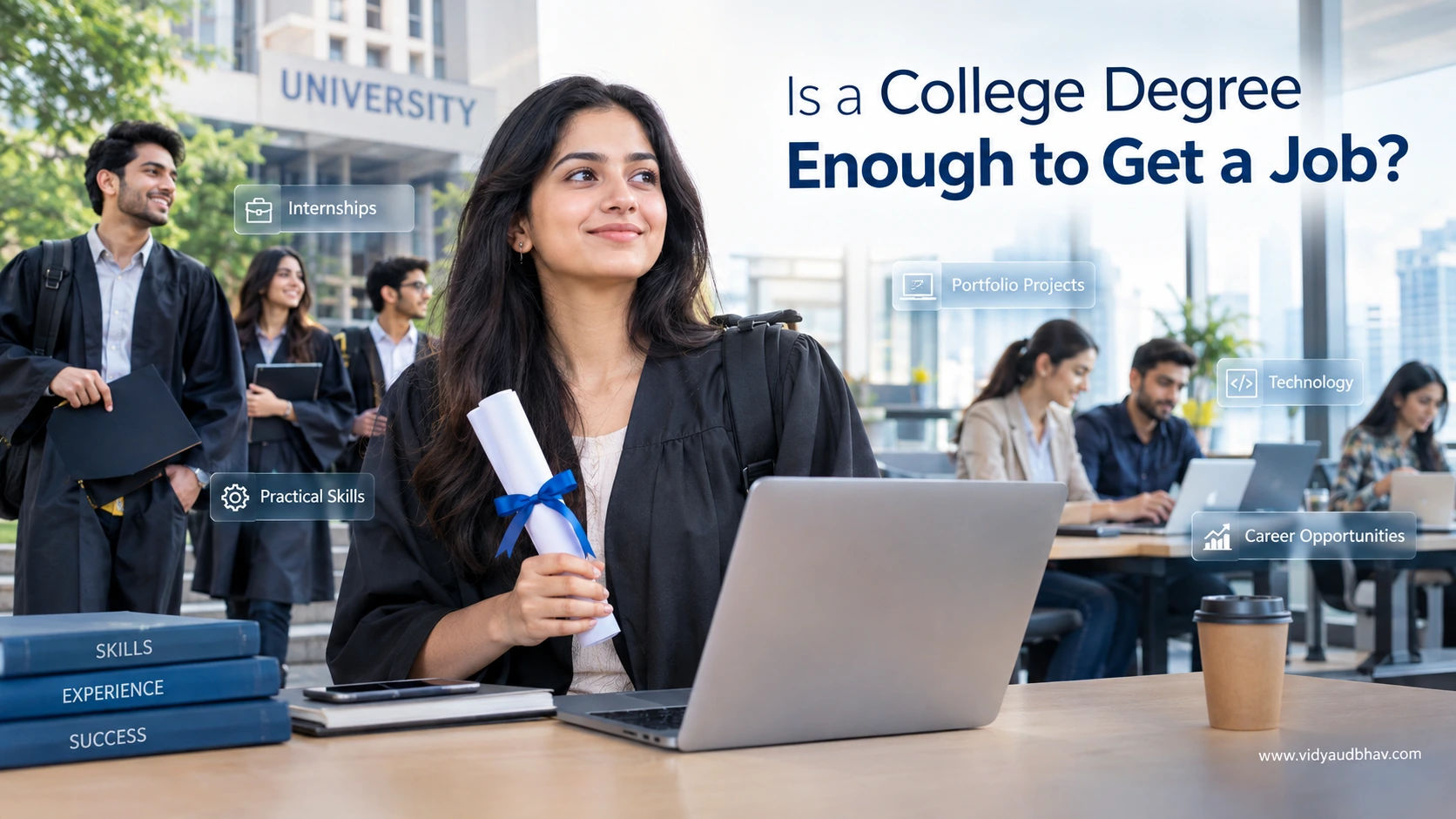
A college degree can open the door to a job, but in today’s competitive market, it does not always guarantee that you will walk through it.
Employers increasingly look beyond academic qualifications. They want candidates who can solve problems, communicate clearly, use relevant technology, adapt to change, and demonstrate what they can actually do. The World Economic Forum reports that analytical thinking remains one of the most important core skills for employers, while AI, big data, cybersecurity, technological literacy, creative thinking, and adaptability are becoming increasingly important.
So, is a college degree enough to get a job?
https://vidyaudbhav.com/blogs/i-am-confused-about-my-career-what-should-i-do
https://vidyaudbhav.com/blogs/how-to-decide-my-career
Usually, no. A degree is an important foundation, but combining it with practical skills, experience, communication ability, and evidence of your capabilities gives you a much stronger chance of getting hired.
Why a College Degree Still Matters
It would be wrong to assume that degrees no longer matter.
Many employers still use educational qualifications as an initial screening criterion, particularly for professions that require specialized knowledge or formal credentials. Even in a skills-first hiring environment, degree requirements remain common in many occupations.
A degree can provide:
- Subject knowledge
- Structured learning
- Professional credibility
- Access to internships and campus opportunities
- Networking opportunities
- Eligibility for certain professions
- A foundation for postgraduate education
For example, careers in medicine, law, teaching, engineering, research, and several regulated professions may require specific educational qualifications.
The real issue is not degree versus skills.
It is degree plus skills versus degree alone.
What Employers Look For Beyond a Degree
Here is what actually works in the modern job market: employers want evidence that you can perform the work.
The World Economic Forum found that work experience is expected to remain the most commonly used assessment method among employers between 2025 and 2030, followed by skills assessments.
This means a graduate with practical experience can often be more attractive than someone with excellent academic marks but no evidence of applying their knowledge.
Important employability skills include:
1. Technical Skills
These depend on your career.
A marketing graduate may need SEO, analytics, advertising platforms, content creation, or CRM knowledge.
A computer science graduate may need programming, databases, cloud technologies, cybersecurity, or AI-related skills.
A finance graduate may benefit from Excel, financial analysis, accounting software, and data interpretation.
2. Communication Skills
You may be technically excellent, but if you cannot explain your ideas clearly, collaborate with colleagues, or communicate during an interview, getting hired becomes harder.
3. Problem-Solving
Employers don't just want people who know information. They want people who can use information to solve real problems.
4. Adaptability
Technology changes quickly. A skill that is valuable today may evolve significantly within a few years.
The World Economic Forum expects a substantial share of workers' existing skills to change or become outdated by 2030, making continuous learning increasingly important.
5. Practical Experience
Internships, freelance projects, college projects, volunteering, apprenticeships, and personal projects can all help demonstrate capability.
Degree vs Skills: Which Is More Important?
| Academic foundation | Strong | Depends on learning |
| Eligibility for regulated careers | Often essential | Usually insufficient alone |
| Demonstrates practical ability | Limited | Stronger when supported by projects |
| Helps pass some HR filters | Often yes | Increasingly relevant |
| Industry readiness | Depends on course | Usually higher with experience |
| Long-term value | Strong foundation | Requires continuous updating |
| Best approach | Combine with skills | Combine with education |
The strongest candidate is rarely the person who has only a degree or only skills.
It is usually the person who can combine education with demonstrable ability.
How to Get a Job After College: Step-by-Step
If you already have a degree but are struggling to find employment, do not immediately assume that your degree was a mistake.
Instead, follow this process.
Step 1: Identify Your Target Career
Do not apply randomly to hundreds of jobs.
First decide what type of role you want.
For example:
BBA → Digital Marketing → Performance Marketing → Digital Marketing Specialist
or
BCA → Web Development → Front-End Developer → Full-Stack Developer
A clear direction makes skill development much easier.
If you are still confused about your career direction, you can explore this career planning guide from Vidya Udbhav.
Step 2: Compare Job Descriptions
Search for 20–30 job openings related to your desired role.
Write down the skills employers repeatedly mention.
You may discover that your degree covers only part of what companies expect.
That gap becomes your learning roadmap.
Step 3: Build Job-Ready Skills
Do not collect random certificates.
Choose skills directly connected to your target role.
For example:
Digital Marketing
- SEO
- Google Ads
- Meta Ads
- Analytics
- Content strategy
Data
- Excel
- SQL
- Data visualization
- Statistics
- AI tools
Technology
- Programming
- Git
- Databases
- Cloud
- Cybersecurity fundamentals
Step 4: Gain Practical Experience
This is where many graduates make mistakes.
They wait until they graduate to start building experience.
Instead, try to gain experience during college through internships, projects, freelancing, competitions, research, or volunteering.
Recent employer research continues to show the importance of skills-based hiring and practical experience.
Step 5: Build a Portfolio
A portfolio answers one important employer question:
“What can this candidate actually do?”
Depending on your field, your portfolio could include:
- Coding projects
- Marketing campaigns
- Graphic designs
- Research projects
- Business plans
- Financial analysis
- Writing samples
- Case studies
- Presentations
Your portfolio does not need to be complicated. It needs to be relevant and genuine.
Real-Life Example: Two Graduates, One Job
Imagine two students graduate with the same BBA degree.
Student A has good marks but no internship, portfolio, or practical experience.
Student B has average marks but completed two internships, created marketing campaigns, learned analytics, and built a small portfolio.
For a practical marketing role, Student B may have an advantage because the employer can see evidence of relevant work.
This does not mean marks are useless.
It means academic performance is only one part of employability.
Which Skills Should Students Learn?
The answer depends on the career, but several skill categories are becoming broadly valuable.
Digital and Technical Skills
AI, data, cybersecurity, technological literacy, and other digital capabilities are expected to become increasingly important globally.
Human Skills
Technology does not eliminate the need for:
- Communication
- Leadership
- Creativity
- Critical thinking
- Teamwork
- Emotional intelligence
- Adaptability
The best strategy is to combine technical knowledge with human skills.
For students deciding between different career paths, this guide on how to discover the right career based on your skills and interests can provide a useful starting point.
Do Certifications Replace a College Degree?
Usually, no.
Certifications can strengthen a profile, but their value depends on relevance and the quality of your practical knowledge.
For example, a digital marketing certification becomes more useful when you can also demonstrate:
- A real campaign
- SEO work
- Analytics reports
- Content strategy
- Advertising experience
Think of certifications as supporting evidence, not a replacement for every form of education.
Tools and Platforms Students Can Explore
The right tools depend on your field.
Beginner-friendly/free options:
- Canva
- Google Analytics
- Google Skillshop
- GitHub
- Microsoft Learn
Professional/premium options:
- Adobe Creative Cloud
- Coursera
- Udemy
- LinkedIn Learning
- HubSpot Academy
The goal is not to learn every platform. Learn the tools that employers in your chosen field actually use.
Beginner Strategy: If You Are Still in College
If you are currently studying, start before graduation.
Year 1: Explore careers and improve communication.
Year 2: Develop technical or professional skills.
Year 3: Complete internships and build projects.
Final Year: Prepare your resume, portfolio, interviews, and applications.
This approach is also consistent with the broader idea that career development should happen throughout college rather than only after graduation.
Advanced Strategy: Become a T-Shaped Professional
One useful career strategy is to become T-shaped.
The vertical part represents deep expertise in one area.
The horizontal part represents supporting skills.
For example, a digital marketer could specialize in performance marketing while also understanding:
- Content
- Analytics
- SEO
- AI tools
- Design
- Communication
This makes the professional more flexible without requiring them to become an expert in everything.
Common Mistakes to Avoid
Waiting Until Graduation
Start building experience while studying.
Collecting Certificates Without Skills
Ten certificates cannot replace one strong project.
Applying for Every Job
Target roles that match your skills and career direction.
Ignoring Communication
Interview performance matters.
Depending Completely on College Placements
Campus placement can help, but students should also develop independent job-search skills.
Choosing a Career Only for Salary
Salary matters, but career fit, growth, skills, work environment, and long-term demand matter too.
What Is the Future of Degree-Based Hiring?
The future is unlikely to be completely “degree-free.”
Instead, hiring is moving toward a combination of credentials, demonstrated skills, experience, and adaptability.
The World Economic Forum reports that 43% of surveyed employers expect university degrees to remain a requirement in some hiring contexts through 2030, while work experience and skills assessments are used more widely.
In India, the shift is also visible. The World Economic Forum reports that companies operating in India are increasingly considering skills-based hiring and broader talent pools as technology changes the workforce.
At the same time, internships are becoming an important pathway into employment, with recent Indian campus hiring research highlighting improving internship-to-offer conversion rates.
So the future is not simply:
Degree OR Skills
It is increasingly:
Degree + Skills + Experience + Adaptability
Expert Tips for Students and Graduates
If you want your degree to create real career value, remember these principles:
- Choose a career direction before randomly collecting skills.
- Study the skills appearing in current job descriptions.
- Start internships before graduation whenever possible.
- Build real projects instead of collecting certificates alone.
- Maintain a professional LinkedIn profile and portfolio.
- Improve communication and interview skills.
- Learn to work with AI rather than ignoring it.
- Keep updating your skills after graduation.
- Choose education based on career goals, not popularity alone.
- Review your career plan every year.
For help making education decisions around courses, colleges, and career direction, students can also explore Vidya Udbhav's career guidance resources.
FAQ
Is a college degree enough to get a job?
A college degree can qualify you for many jobs, but it is usually not enough by itself. Employers increasingly consider practical skills, experience, communication, problem-solving, and adaptability.
Can I get a job without a college degree?
Yes, some careers allow candidates to enter through skills, certifications, vocational education, apprenticeships, portfolios, or work experience. However, certain professions still require formal degrees or licenses.
Which skills should college students learn for jobs?
Students should choose skills based on their target career. Commonly valuable areas include technology, AI, data, communication, analytical thinking, problem-solving, and adaptability.
Do employers care more about skills than degrees?
It depends on the industry and role. Skills-based hiring is increasing, but degrees remain important for many occupations. The strongest profile usually combines relevant education with demonstrable skills and experience.
Is a degree still worth it in 2026?
Yes, but students should evaluate the degree based on career relevance, curriculum, practical exposure, cost, industry opportunities, and long-term career value rather than treating the qualification alone as a job guarantee.
What should I do if I have a degree but no job experience?
Choose a target role, identify missing skills, complete practical projects, pursue internships or entry-level opportunities, build a portfolio, improve your resume, and apply strategically.
Conclusion: A Degree Opens the Door, but Skills Help You Stay in the Room
A college degree still has value. It can provide knowledge, credibility, professional exposure, and access to opportunities that may otherwise be difficult to reach.
But the job market has changed.
Employers increasingly want people who can apply what they know.
So if you are a student, do not wait until graduation to think about employability. Build skills, gain experience, create projects, improve communication, and understand what your target industry actually needs.
The smartest question is not:
“Is my college degree enough to get a job?”
Ask instead:
“What can I add to my degree that makes me valuable to an employer?”
That shift in thinking can completely change the way you approach college, career planning, and your first job.