

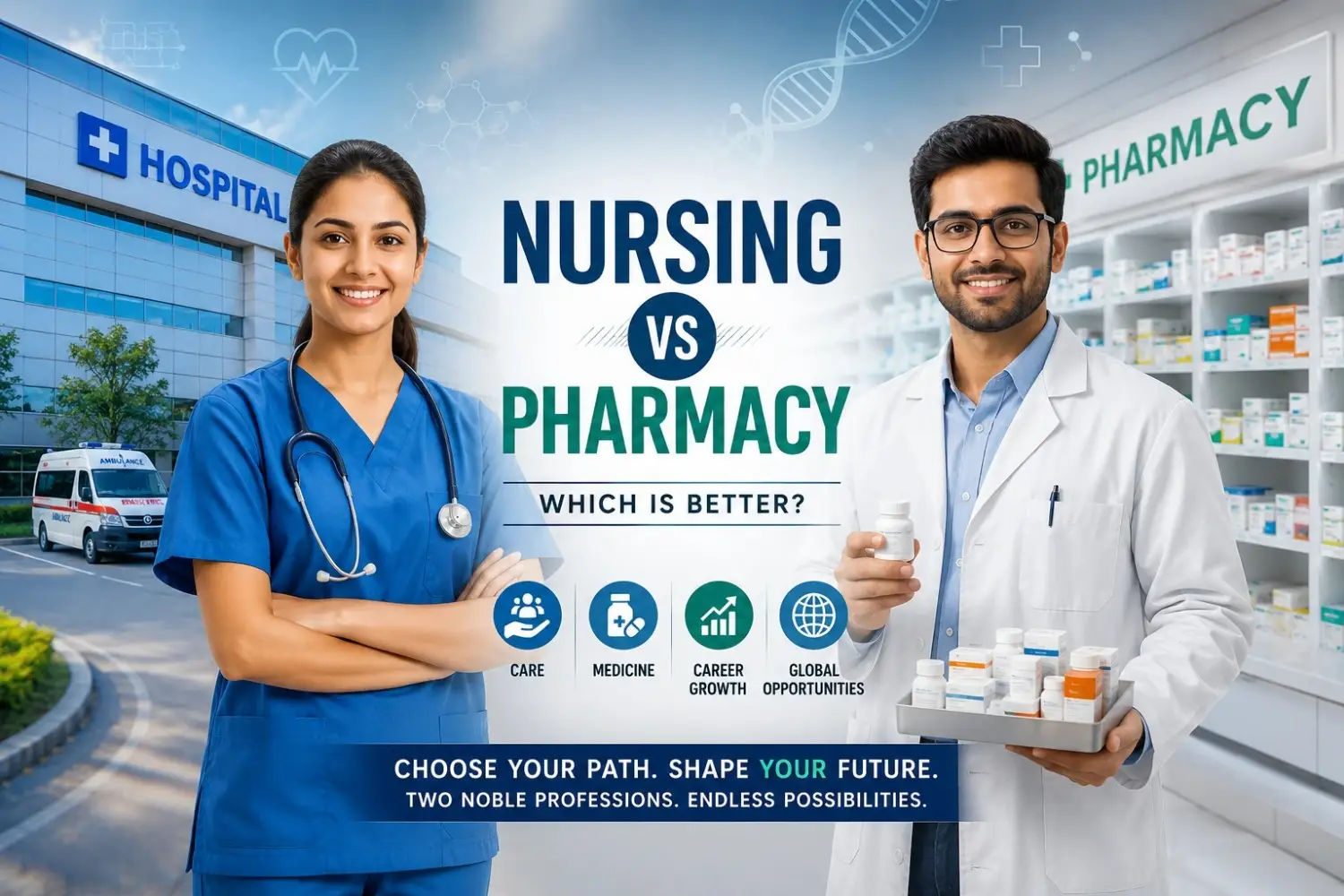
Choosing a career in healthcare is one of the most rewarding decisions you can make. However, many students find themselves confused about whether to pursue Nursing or Pharmacy, especially after completing high school.
Both professions offer excellent career opportunities, job security, and the chance to improve people's lives. The right choice depends on your interests, strengths, career goals, and preferred work environment.
If you're also exploring healthcare courses, our Medical Courses After 12th guide at Vidya Udbhav can help you explore additional career options before making a final decision.
Quick Answer
If you enjoy direct patient care, communication, and clinical work, Nursing may be the better choice.
If you're interested in medicines, research, drug development, and pharmaceutical science, Pharmacy is likely a better fit.
Neither profession is universally better—they simply suit different personalities and career aspirations.
Nursing vs Pharmacy at a Glance
| Main Focus | Patient Care | Medicines & Drug Management |
| Patient Interaction | Very High | Moderate |
| Work Environment | Hospitals, Clinics | Hospitals, Retail Pharmacies, Pharma Companies |
| Typical Degree | B.Sc Nursing | B.Pharm |
| Course Duration | 4 Years | 4 Years |
| Licensing | Required | Required |
| Higher Studies | M.Sc Nursing, NP Programs | M.Pharm, Pharm.D, MBA |
| Global Demand | Very High | High |
| Career Flexibility | Excellent | Excellent |
Understanding Nursing
Nursing is a healthcare profession focused on caring for patients before, during, and after treatment.
Nurses monitor patient health, administer medications, assist doctors, educate families, and provide emotional support throughout recovery.
One thing many beginners miss is that modern nursing goes far beyond bedside care. Nurses now specialize in critical care, emergency medicine, oncology, pediatrics, mental health, and many other advanced fields.
Understanding Pharmacy
Pharmacy focuses on medicines and their safe use.
Pharmacists ensure patients receive the correct medications, monitor drug interactions, counsel patients, and contribute to healthcare through pharmaceutical knowledge.
Beyond retail pharmacies, professionals also work in research laboratories, manufacturing companies, quality assurance, regulatory affairs, and clinical pharmacy.
Key Differences Between Nursing and Pharmacy
Nature of Work
Nursing
- Direct patient care
- Emergency response
- Monitoring vital signs
- Assisting surgeries
- Patient counseling
Pharmacy
- Dispensing medicines
- Drug formulation
- Medication safety
- Prescription review
- Pharmaceutical research
Required Skills
Nursing
- Compassion
- Communication
- Emotional intelligence
- Teamwork
- Critical thinking
- Decision-making under pressure
Pharmacy
- Scientific knowledge
- Analytical thinking
- Attention to detail
- Accuracy
- Problem-solving
- Research skills
Education Path
Nursing
Most students choose:
- B.Sc Nursing
- Post Basic B.Sc Nursing
- M.Sc Nursing
- Specialized Nursing Programs
Pharmacy
Popular options include:
- Diploma in Pharmacy (D.Pharm)
- Bachelor of Pharmacy (B.Pharm)
- Doctor of Pharmacy (Pharm.D)
- Master of Pharmacy (M.Pharm)
If you're still comparing healthcare programs, you may also find our career planning guide and medical admission guidance on Vidya Udbhav useful.
Career Opportunities
Nursing Careers
- Staff Nurse
- ICU Nurse
- Emergency Nurse
- Operation Theatre Nurse
- Community Health Nurse
- Nursing Educator
- Nurse Administrator
- Travel Nurse
Pharmacy Careers
- Clinical Pharmacist
- Hospital Pharmacist
- Retail Pharmacist
- Drug Inspector
- Medical Writer
- Quality Control Officer
- Regulatory Affairs Executive
- Pharmaceutical Research Associate
Salary Comparison
Salary varies by country, experience, specialization, and employer.
| Entry Level | Competitive | Competitive |
| Mid-Level | Higher with specialization | Higher with industry experience |
| Senior Level | Leadership and specialist roles | Management, research, and executive roles |
Internationally, both professions offer attractive salaries, particularly in countries experiencing healthcare workforce shortages.
Benefits of Choosing Nursing
- High global demand
- Strong job security
- Meaningful patient relationships
- Numerous specialization options
- Opportunities to work abroad
- Continuous career growth
Benefits of Choosing Pharmacy
- Diverse career paths
- Research opportunities
- Pharmaceutical industry growth
- Less physically demanding than nursing
- Strong earning potential
- Opportunities in healthcare innovation
Challenges to Consider
Nursing
- Shift work
- Emotional stress
- Physically demanding duties
- Emergency situations
Pharmacy
- High responsibility for medication accuracy
- Continuous learning due to new medicines
- Competitive industry positions
- Regulatory compliance
Understanding these realities early helps students make informed career decisions rather than relying solely on salary comparisons.
Real-Life Example
Imagine two students graduating from high school.
Sarah enjoys interacting with people, solving healthcare problems, and working in hospitals. Nursing gives her daily opportunities to care for patients and make a direct impact.
James enjoys chemistry, biology, and research. He prefers understanding how medicines work rather than providing bedside care. Pharmacy becomes a natural fit for his interests.
Both achieve successful careers because they chose professions aligned with their strengths.
Beginner Strategy
If you're unsure which field suits you:
- Identify your interests.
- Consider your preferred work environment.
- Research daily responsibilities.
- Talk to professionals.
- Explore internship opportunities.
- Compare long-term career goals.
You might also benefit from the student success roadmap available through career resources on Vidya Udbhav.
Advanced Career Strategy
Experienced professionals often increase career growth by:
- Pursuing higher education
- Developing leadership skills
- Gaining international certifications
- Building specialized expertise
- Staying updated with healthcare technologies
Healthcare employers increasingly value professionals who combine technical knowledge with communication and problem-solving skills.
Useful Tools for Students
Beginner-Friendly
- Google Scholar
- Microsoft Excel
- Canva
Free Resources
- PubMed
- WHO Publications
- National Health Guidelines
Premium Learning Platforms
- Coursera
- LinkedIn Learning
- Udemy
Common Mistakes to Avoid
- Choosing only based on salary
- Ignoring personal interests
- Not researching career growth
- Overlooking licensing requirements
- Assuming both professions have identical responsibilities
- Skipping practical exposure before deciding
Expert Tips
- Shadow professionals if possible.
- Compare curriculum before enrolling.
- Evaluate global demand, not just local opportunities.
- Consider work-life balance.
- Think about your long-term career satisfaction rather than short-term income.
Here is what actually works: students who align their careers with their personality and strengths generally experience higher job satisfaction and long-term success.
Future Trends
Healthcare continues to evolve rapidly.
Emerging trends include:
- AI-assisted healthcare
- Personalized medicine
- Telehealth
- Clinical pharmacy expansion
- Advanced nursing practice
- Digital health records
- Precision medicine
Professionals who embrace technology while maintaining strong patient-centered skills will remain highly valuable.
Final Advice
Both Nursing and Pharmacy are respected healthcare professions with excellent career prospects worldwide.
Choose Nursing if you enjoy patient interaction, teamwork, and clinical care.
Choose Pharmacy if you're fascinated by medicines, research, pharmaceutical sciences, and analytical work.
Rather than asking which profession is better, ask which one is better for you. The answer depends on your interests, skills, and long-term career vision.
For more career guidance, admission support, and healthcare course information, explore the career resources available on Vidya Udbhav.
Frequently Asked Questions
1. Which has better career opportunities, Nursing or Pharmacy?
Both offer strong career opportunities. Nursing has greater demand in hospitals, while Pharmacy provides broader opportunities in healthcare, research, and the pharmaceutical industry.
2. Which course is more difficult?
Both are academically challenging in different ways. Nursing emphasizes patient care and clinical practice, while Pharmacy focuses more on pharmaceutical sciences and medications.
3. Can I work abroad after completing Nursing or Pharmacy?
Yes. Many countries actively recruit qualified nurses and pharmacists, though licensing requirements vary by destination.
4. Which profession offers a higher salary?
Salary depends on specialization, experience, country, and employer. Both professions can provide excellent earning potential with experience.
5. Which is better for students who enjoy biology?
If you enjoy caring for people, Nursing may be a better fit. If you enjoy studying medicines, chemistry, and drug development, Pharmacy is often more suitable.