

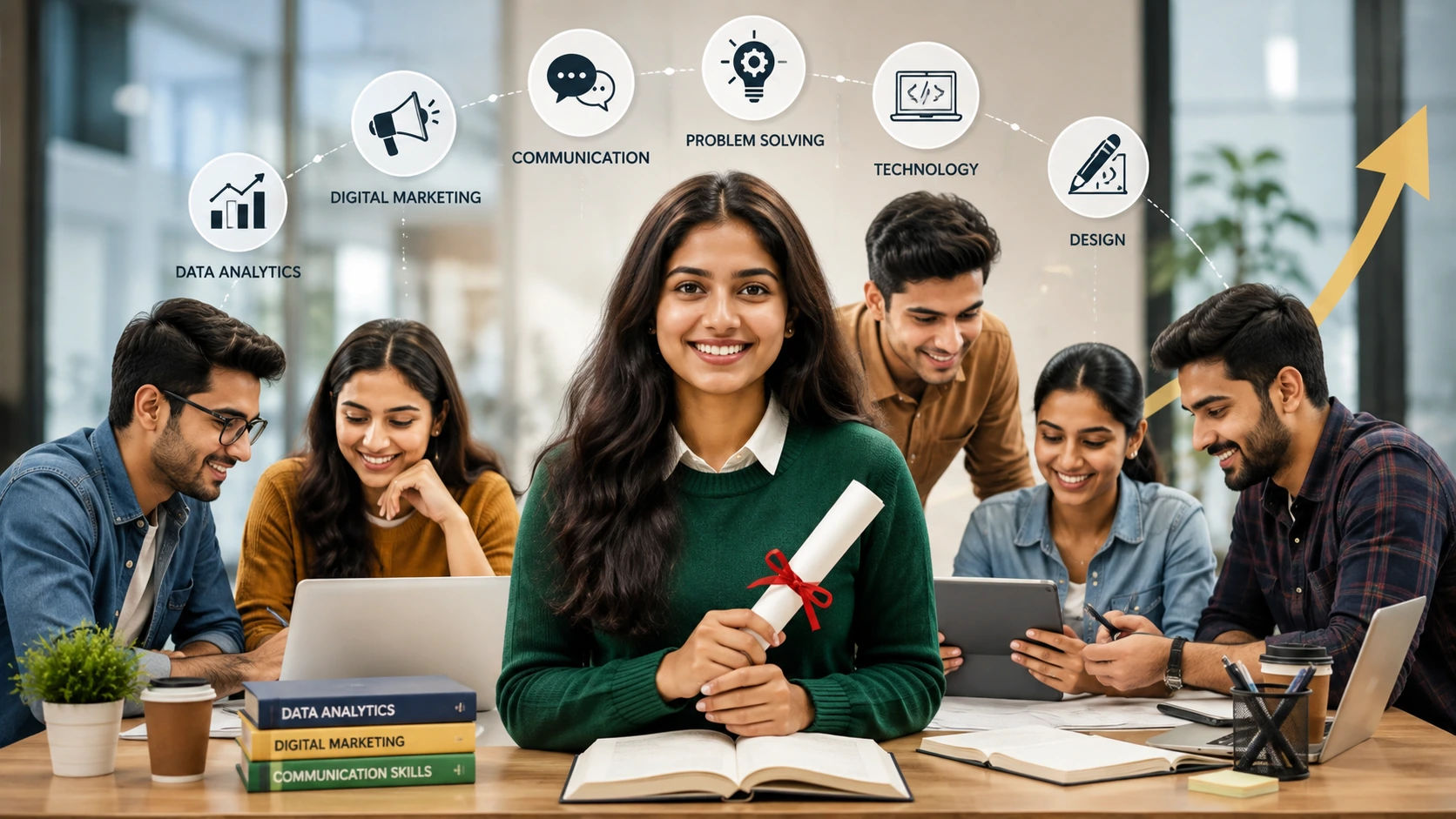
One Degree, Multiple Skills: How to Become More Employable
A degree can open the door to a career, but your skills often determine how far you can go once you enter.
Today, students and professionals are competing in a job market where academic qualifications are only one part of the equation. Employers increasingly look for people who can communicate clearly, solve problems, use digital tools, adapt to change, and apply their knowledge in practical situations.
That is why one degree with multiple complementary skills can be a powerful career strategy.
For example, a BBA graduate who understands digital marketing, data analytics, communication, and presentation can potentially demonstrate a broader professional profile than someone who has only completed the academic requirements of the degree.
The goal is not to learn everything. It is to build a skill combination that makes your degree more useful in the real world.
For students still deciding what to study, a structured career planning guide can help connect interests, education, skills, and long-term career goals.
Quick Answer: What Does “One Degree, Multiple Skills” Mean?
One degree, multiple skills means combining your primary academic qualification with several relevant technical, professional, and soft skills that improve your ability to perform in different workplace situations.
A strong skill combination usually includes:
- One core area of expertise
- One or two technical or digital skills
- Communication skills
- Problem-solving ability
- Practical experience
- Industry awareness
- A portfolio or evidence of work
This approach is also called skill stacking.
Instead of becoming average at ten unrelated things, you develop a strong primary skill and add complementary abilities around it.
Why a Degree Alone May Not Be Enough
A degree demonstrates that you have completed a structured academic program. It does not always demonstrate how effectively you can apply that knowledge.
Consider two graduates with the same degree.
One has completed only classroom assignments.
The other has completed the same degree while learning Excel, creating projects, improving communication, completing an internship, and developing a professional portfolio.
Their academic qualification may be similar, but their demonstrated capabilities are different.
This is where employability becomes important.
Employability refers to the combination of knowledge, skills, experience, behaviours, and qualities that help a person obtain, perform, and progress in employment.
Vidya Udbhav similarly emphasizes student profile building through certifications, internships, and skill-based projects as part of career preparation.
The Best Skill Combination: Core + Complementary + Human Skills
One thing many beginners miss is that employability does not come from collecting random certificates.
Your skills should support one another.
| Core skill | Finance, coding, design, teaching | Builds expertise |
| Digital skill | Excel, analytics, AI tools, CRM | Improves productivity |
| Communication | Writing, speaking, presentations | Helps you express ideas |
| Problem-solving | Research, analysis, decision-making | Helps handle real situations |
| Professional skill | Teamwork, time management, leadership | Improves workplace performance |
| Practical experience | Internship, projects, freelancing | Demonstrates ability |
For example, a graphic design student could combine:
Graphic Design + Canva + UI basics + copywriting + social media marketing.
A commerce student could develop:
Accounting + Excel + financial analysis + communication + business analytics.
The combination is more valuable when the skills naturally connect.
How to Become More Employable: Step-by-Step
1. Start With Your Degree
Your degree should remain your foundation.
A B.Tech student may build around technology. A B.Com student may develop finance or business skills. A psychology student might explore research, communication, HR, or counselling-related competencies.
Do not immediately abandon your academic specialisation because another skill is trending.
Instead, ask:
“What skills can make my degree more valuable?”
2. Add One High-Value Technical Skill
Choose one practical skill that complements your field.
Examples include:
- Data analysis
- Programming
- Digital marketing
- UI/UX
- Video editing
- Financial modelling
- Search engine optimization
- Project management
- Business analytics
You might be wondering how many skills you actually need.
For most beginners, two or three strong complementary skills are better than ten superficial ones.
3. Develop Communication Skills
Technical knowledge becomes difficult to demonstrate if you cannot explain your ideas.
Work on:
- Professional writing
- Public speaking
- Presentation skills
- Interview communication
- Email writing
- Active listening
Communication is useful across almost every industry, which makes it one of the safest skills to develop alongside a degree.
4. Turn Knowledge Into Projects
Here is what actually works: show what you can do.
Instead of writing “I know digital marketing” on your resume, create a small marketing campaign.
Instead of writing “I know web development,” build a website.
Instead of writing “I know data analytics,” create a simple dashboard and explain your findings.
Projects provide evidence of practical ability.
5. Gain Real-World Experience
Internships, freelance assignments, volunteering, college projects, competitions, and part-time work can all provide practical exposure.
Students should not wait until their final semester to think about experience.
Vidya Udbhav's guidance on building a career from college also emphasises internships, portfolios, networking, and skill development throughout the college journey.
6. Build a Professional Portfolio
A portfolio makes your skills visible.
Depending on your field, it could contain:
- Design projects
- Websites
- Research work
- Marketing campaigns
- Presentations
- Writing samples
- Data dashboards
- Business projects
- Academic projects
Your resume tells employers what you claim to know.
Your portfolio can show them.
Real-Life Example: How Skill Stacking Changes a Profile
Imagine a student pursuing a BBA.
Instead of completing only the degree, they develop:
BBA + Digital Marketing + Excel + Communication + Internship
Now imagine another student develops:
BBA + Data Analytics + Power BI + Business Communication + Business Project
Neither combination is universally “better.”
The right combination depends on the student's target career.
The important point is that the degree becomes the foundation while additional skills create professional differentiation.
Benefits of Building Multiple Skills
A well-planned skill portfolio can help you:
- Become more competitive during recruitment.
- Adapt to changing job requirements.
- Explore different career paths.
- Perform better during internships.
- Build stronger resumes
- Create better portfolios
- Improve interview confidence
- Transition between related roles
- Identify your professional strengths.
It can also reduce dependence on a single narrow job role.
Challenges You Should Expect
Skill development sounds simple, but there are common obstacles.
Trying to Learn Everything
Watching courses endlessly does not create expertise.
Choose skills based on your target career.
Collecting Certificates Without Practice
A certificate can support your profile, but practical application matters.
Ignoring Your Main Subject
Your additional skills should strengthen your degree rather than completely distract from it.
Following Every Trend
AI, analytics, coding, and other technologies may be valuable, but not every trending skill is relevant to every career.
Waiting for the Perfect Time
You do not need a perfect roadmap before starting.
Choose one useful skill and begin.
Beginner Strategy: The 90-Day Skill Plan
If you are starting from zero, use a simple three-month approach.
Month 1 – Learn
Choose one complementary skill and understand the fundamentals.
Month 2 – Practice
Complete small exercises and create two or three practical projects.
Month 3 – Demonstrate
Build a portfolio, update your resume, improve your professional profile, and start applying for internships or entry-level opportunities.
This approach is more sustainable than trying to master five skills simultaneously.
Advanced Strategy: Build a T-Shaped Skill Profile
A useful career model is the T-shaped professional.
The vertical part represents deep expertise in one field.
The horizontal part represents supporting knowledge across related areas.
For example:
Deep expertise: Digital Marketing
Supporting skills: SEO + Analytics + Content + AI Tools + Communication
This creates a professional who has specialization without becoming overly narrow.
As your experience grows, you can gradually add more depth rather than continuously chasing new skills.
Tools That Can Support Skill Development
The right tools depend on your career direction.
Beginner-Friendly Options
- Canva
- Microsoft Excel
- Google Workspace
- Notion
Digital and Technical Learning
- GitHub
- Power BI
- Google Analytics
- Figma
Professional Development
- Resume-building tools
- Project management platforms
- Online learning platforms
The tool itself is not the skill.
Knowing why and when to use it is what creates professional value.
Expert Tips to Become More Employable
Here are practical principles worth following:
- Choose skills based on your target role, not social media trends.
- Build projects while learning.
- Keep your degree as your knowledge foundation.
- Develop communication alongside technical skills.
- Get practical experience before graduation whenever possible.
- Review your skill profile every six months.
- Replace outdated skills as technology and industries evolve.
- Document your achievements instead of simply listing responsibilities.
One thing many students underestimate is career planning. Choosing the right education and then deliberately building skills around it can prevent years of unfocused learning.
Future of Employability: Skills Will Keep Evolving
The future workplace is likely to reward adaptability as much as existing knowledge.
Artificial intelligence, automation, digital collaboration, data-driven decision-making, and rapidly changing business models are transforming how people work.
That does not mean everyone needs to become a programmer.
It means professionals should become comfortable with continuous learning.
A finance professional may need stronger data skills. A marketer may need AI literacy. A designer may need to understand digital products. A business graduate may benefit from analytics and automation knowledge.
The specific skills will change.
The ability to learn and adapt will remain valuable.
Common Mistakes to Avoid
Avoid these five mistakes when building your skill profile:
- Learning unrelated skills without a career objective
- Spending more time collecting certificates than creating projects
- Ignoring communication and teamwork
- Copying another person's career path
- Waiting until graduation to develop employability
Your career does not need to look impressive on paper only. It needs to make sense as a complete story.
Degree → Skills → Projects → Experience → Portfolio → Opportunities
That progression is much stronger than simply saying, “I have a degree.”
Actionable Final Advice
Start by writing down your degree or current field.
Then answer three questions:
What job do I want?
What skills are commonly required for that job?
Which one skill can I start developing this month?
Choose one.
Learn it. Practice it. Build something with it. Get feedback. Then add the next complementary skill.
If you are still unsure about your direction, professional career counselling and career assessment can help you connect your interests, strengths, education, and career possibilities.
Conclusion
A degree gives you a foundation, but employability is built through what you can actually do with that foundation.
The smartest approach is not to become a person who knows a little about everything. Instead, become someone with strong expertise in one area and useful skills around it.
That is the real power of skill stacking.
Whether you are still choosing a course, currently in college, or preparing for your first job, start building your professional skill combination now.
Your degree may tell employers what you studied.
Your skills can show them what you can contribute.
Frequently Asked Questions
1. Can multiple skills improve employability?
Yes. Relevant complementary skills can make your profile more versatile and help demonstrate that you can handle practical workplace requirements.
2. How many skills should a student learn?
There is no fixed number. Beginners should generally focus on one core area and add two or three relevant complementary skills rather than trying to learn everything.
3. Is a degree still important for employment?
For many careers, a degree remains an important educational foundation. However, practical skills, experience, communication, and evidence of ability can significantly strengthen a graduate's profile.
4. What are the best employability skills for students?
Communication, problem-solving, digital literacy, teamwork, adaptability, analytical thinking, and practical technical skills are broadly useful across careers.
5. How can students gain experience without a full-time job?
Students can build experience through internships, academic projects, freelance work, volunteering, competitions, student organisations, and personal projects.
6. Should students learn AI skills?
AI literacy can be useful across many fields, but students should first understand their target career and then identify where AI can improve productivity or professional performance.
7. Is skill stacking useful for working professionals?
Yes. Professionals can use skill stacking to improve performance, qualify for related roles, pursue promotions, or prepare for career transitions.
8. What is the difference between skill stacking and learning random skills?
Skill stacking involves combining complementary skills that support a particular career direction. Random learning has no clear relationship to a professional goal.
9. How early should students start building employability?
Students can start as early as school or college by exploring careers, developing communication and digital skills, completing projects, and gaining practical exposure.
10. How can career counselling help with skill selection?
Career counselling can help students understand their interests, strengths, career options, educational pathways, and the skills that may support their chosen direction. Vidya Udbhav combines career assessment and mentorship with education and career planning.