

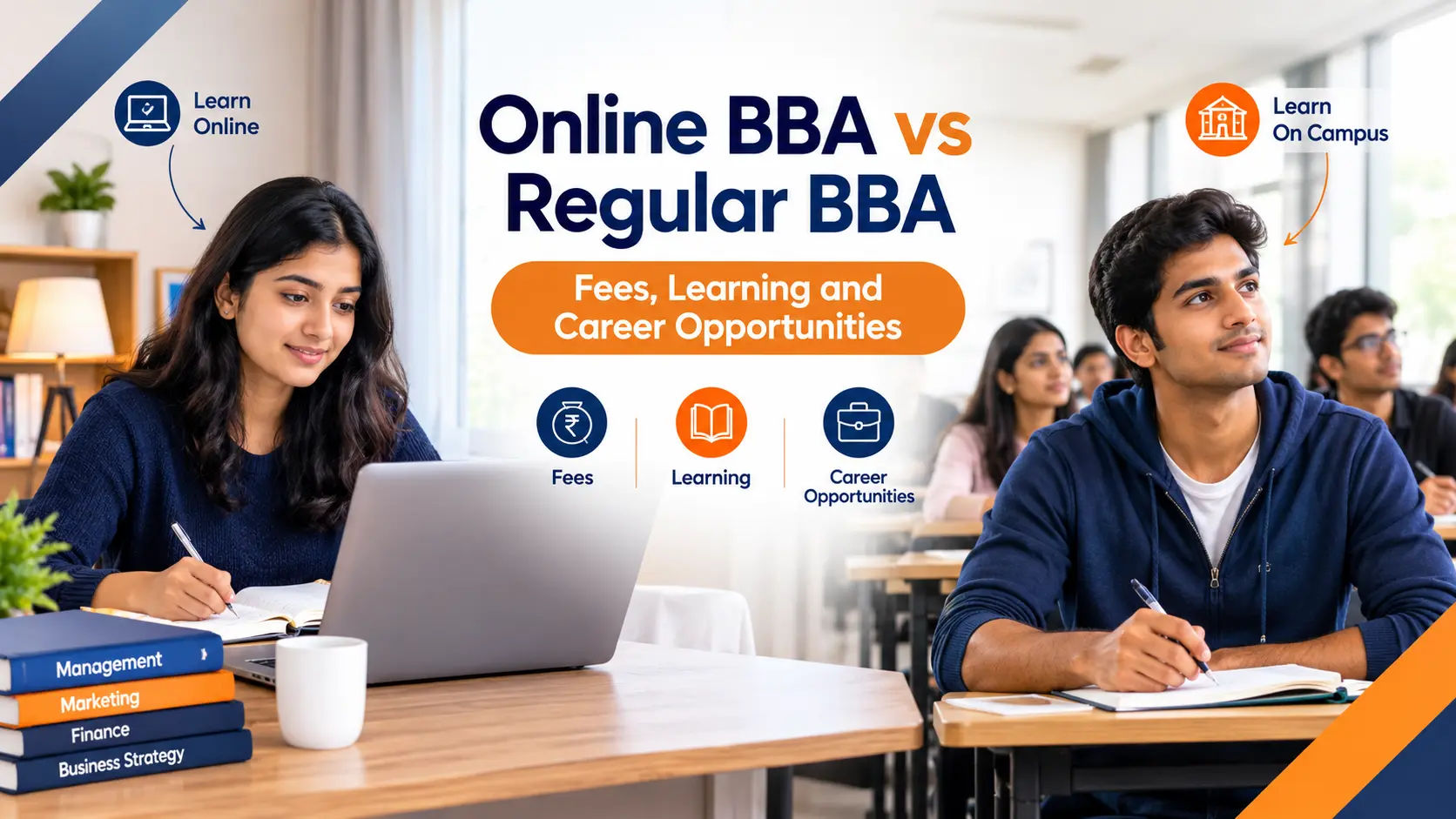
Online BBA vs Regular BBA: Fees, Learning and Career Opportunities
Choosing a Bachelor of Business Administration (BBA) is an important step for students interested in management, marketing, finance, entrepreneurship or business operations. However, deciding between an online BBA and a regular, on-campus BBA can be confusing.
Both formats can provide a foundation in business management, but they differ in teaching methods, flexibility, overall expenses, networking and access to campus facilities.
https://vidyaudbhav.com/blogs/choose-college-based-on-total-fees-living-expenses
https://vidyaudbhav.com/blogs/bba-in-digital-business-eligibility-subjects-career-scope
The right choice depends on your budget, learning preferences and career goals. If you are still exploring your options, Vidya Udbhav's career planning guide can help you connect your education choices with your long-term ambitions.
What Is the Difference Between Online BBA and Regular BBA?
An online BBA is an undergraduate business management degree delivered through digital learning platforms. Students study using online lectures, digital resources, assignments and virtual discussions.
A regular BBA is delivered primarily through in-person classes on a college campus. Students attend scheduled lectures, participate in classroom activities and may access campus-based internships, clubs and placement services.
Both formats typically cover business fundamentals, including marketing, accounting, economics, human resources, finance and management. The exact curriculum depends on the institution.
Quick answer: Which BBA is better?
An online BBA may be better for students who need flexibility, want to avoid relocation expenses or plan to gain work experience while studying. A regular BBA may suit students who prefer classroom interaction, campus life, structured schedules and face-to-face networking.
Neither format guarantees better employment outcomes. The university's recognition, course quality, practical experience and the student's skills all matter.
Online BBA vs Regular BBA: Key Differences
| Learning method | Live or recorded online classes | Face-to-face classroom teaching |
| Schedule | Often more flexible | Usually fixed |
| Tuition and living costs | Generally lower overall | Can be higher, especially with relocation |
| Faculty interaction | Virtual sessions and online support | Direct classroom interaction |
| Networking | Online communities and virtual events | Campus peers, clubs and events |
| Internships | Often requires proactive searching | Campus-based opportunities may be available |
| Placement support | May be virtual or remote | Campus recruitment may be available |
| Self-discipline | Requires strong independent learning | More external structure |
| Campus experience | Limited or unavailable | Access to campus facilities and activities |
| Suitable for | Flexible, independent learners | Students preferring structured campus learning |
The experience varies by university. Some online programmes offer regular live classes and strong career support, while some traditional colleges provide limited practical exposure.
Online BBA vs Regular BBA Fees: Which Is More Affordable?
Cost is one of the biggest factors when comparing BBA programmes. However, tuition fees alone do not show the complete financial picture.
An online BBA can reduce spending on transportation, accommodation and relocation. A regular BBA may involve additional costs for hostel facilities, food, commuting, campus activities and learning materials.
What expenses should you compare?
| Tuition | Depends on the university | Depends on the university |
| Accommodation | Usually optional | May be necessary |
| Transportation | Usually minimal | Depends on campus distance |
| Technology | Computer and internet access | May require a computer and other supplies |
| Study materials | Often digitally available | Digital and physical materials |
| Campus activities | Usually limited | May involve additional expenses |
There is no universal fee for either format. Online programmes can range from relatively inexpensive options to premium university offerings. Regular BBA tuition also varies considerably between public institutions, private colleges and premium business programmes.
Before enrolling, calculate the total programme cost for all three years, including examination fees, registration charges and any additional expenses. Also check scholarship eligibility and payment options.
A lower fee is useful only when the programme provides credible qualifications and sufficient learning support.
How Does the Learning Experience Differ?
Learning through an online BBA
Online education gives students greater control over when and where they study, although some programmes require attendance at scheduled live sessions.
Students may benefit from:
- Recorded lectures for revision.
- Digital notes, e-books and online learning platforms.
- Virtual group projects and discussions.
- Greater flexibility for internships, part-time work or other commitments.
- Opportunities to learn alongside students from different locations.
The challenge is maintaining consistency. Without regular classroom attendance, some learners postpone assignments or struggle to stay engaged.
A practical solution is to create a weekly timetable, attend live sessions whenever possible and set aside dedicated hours for revision and projects.
Learning through a regular BBA
Traditional programmes provide a more structured academic environment. Students attend lectures, interact directly with teachers and collaborate with classmates.
Depending on the college, the experience may include:
- Classroom debates and presentations.
- Business simulations and group assignments.
- Student clubs, competitions and events.
- Guest lectures and industry interactions.
- Campus recruitment and internship opportunities.
These activities can help students develop confidence, teamwork and communication skills. However, their quality depends on how actively the college supports practical learning.
Career Opportunities After an Online or Regular BBA
Both formats can prepare graduates for entry-level business roles, provided the qualification is recognised and students develop the necessary practical skills.
Common career paths include marketing, sales, human resources, finance support, business development and operations.
| Digital marketing | SEO, campaign planning, analytics | Run a sample marketing campaign |
| Human resources | Communication, recruitment, organisation | Assist with recruitment projects |
| Finance | Excel, financial analysis, accounting | Prepare sample budgets and reports |
| Sales and business development | Negotiation, presentation, CRM | Complete a sales simulation or internship |
| Operations | Planning, reporting, problem-solving | Map and improve a business process |
| Entrepreneurship | Business planning, budgeting, market research | Develop a small business plan |
These are possible career directions, not guaranteed outcomes. Job requirements vary by employer, location and industry.
Do online BBA graduates get placements?
Some online universities offer placement assistance, career counselling, interview preparation and virtual recruitment events. However, support differs considerably between institutions, and placement assistance does not mean guaranteed employment.
Regular BBA students may benefit from campus recruitment drives and direct interaction with recruiters. This can be valuable for students who want structured support when entering the job market.
Before enrolling, ask for programme-specific placement data, including the number of students placed, the types of employers involved and the roles offered.
Is an Online BBA Degree Valid and Recognised?
Degree recognition is essential when comparing online and regular education.
In India, an online BBA can be a valid qualification when offered by a university entitled to deliver the specific programme in online mode under the applicable regulations.
Before admission, verify:
- Whether the university is recognised.
- Whether the specific online BBA programme is permitted for the relevant academic session.
- Whether the course meets eligibility requirements for your intended postgraduate programme or job.
- Whether the university clearly explains its examination and assessment procedures.
Do not assume that every online course has the same recognition simply because it is advertised by a university.
For international students, recognition requirements may differ by country, employer and professional body. Check the rules in the country where you intend to work or pursue further education.
Step-by-Step Guide to Choosing the Right BBA
Making a decision becomes easier when you compare the options systematically.
Step 1: Identify your career goal
Decide whether you are interested in marketing, finance, human resources, business analytics, operations or entrepreneurship.
You do not need to choose a permanent specialisation immediately, but understanding your interests will help you evaluate the curriculum.
Step 2: Set a realistic budget
Calculate tuition, living expenses, technology costs and other charges. Decide how much you can afford without creating unnecessary financial pressure.
Step 3: Compare universities and programmes
Review recognition, faculty, course structure, assessment methods, student support and practical learning opportunities.
For further guidance, use Vidya Udbhav's college selection guide to evaluate institutions based on your professional goals.
Step 4: Evaluate internship and placement support
Ask whether internships are integrated into the programme and whether career services are available to online students.
Do not rely only on advertised salary packages. Look for transparent information about actual placement outcomes.
Step 5: Match the format to your learning style
Choose online learning if you can manage your time independently. Consider regular education if you learn better through direct interaction and a fixed daily routine.
Step 6: Build practical skills during the degree
Regardless of the format, complete projects, improve communication, learn relevant software and pursue internships. These activities help translate classroom knowledge into workplace skills.
Benefits and Challenges of Both BBA Formats
Online BBA: Benefits and drawbacks
Benefits
- Flexible learning schedule.
- Lower relocation and commuting expenses.
- Greater scope to combine education with work.
- Access to digital learning resources.
Challenges
- Requires consistent self-motivation.
- Less face-to-face networking.
- Campus facilities may be unavailable.
- Internship and placement opportunities may require independent effort.
Regular BBA: Benefits and drawbacks
Benefits
- Structured classroom learning.
- Direct faculty and peer interaction.
- Opportunities for campus activities.
- Potential access to in-person recruitment and networking.
Challenges
- Fixed attendance and class schedules.
- Potentially higher living and transportation costs.
- Less flexibility for full-time work.
- Experience depends heavily on the college's teaching quality and industry connections.
Neither option is automatically superior. The important question is whether the programme supports your learning needs and career plans.
Beginner Strategy: Make Your BBA More Career-Oriented
Students often focus only on passing examinations. A stronger approach is to build a practical portfolio alongside the degree.
During the first year, strengthen communication, Excel, presentation skills and basic business knowledge.
During the second year, explore a specialisation, complete relevant projects and seek internship opportunities.
During the final year, prepare a professional CV, practise interviews, develop industry connections and apply for suitable roles or postgraduate programmes.
For additional direction, Vidya Udbhav's career planning tips can help you organise your next steps.
Advanced Strategy: Improve Your Career Prospects
Students who want to stand out should connect business knowledge with demonstrable results.
For example, a marketing student could create a campaign plan, define an audience, prepare sample content and explain how campaign performance would be measured. A finance student could develop a budget and analyse a sample company's financial statements.
Useful tools may include Microsoft Excel, Google Sheets, Power BI, Canva, and customer relationship management platforms.
Choose tools based on your specialisation instead of collecting certificates without practical application.
Common Mistakes to Avoid
Here is where many students make mistakes when choosing a BBA:
- Selecting a programme only because it has low fees.
- Assuming all online degrees have identical recognition.
- Believing placement assistance guarantees a job.
- Ignoring the curriculum and practical projects.
- Comparing universities using advertised salary packages alone.
- Choosing a learning format without considering personal discipline.
- Waiting until graduation to gain experience.
A better decision comes from comparing the complete programme, its total cost and the opportunities it offers to develop relevant skills.
Future Trends in BBA Education
Business education increasingly combines traditional management principles with technology, data and digital communication.
Students may encounter subjects such as business analytics, e-commerce, digital marketing, financial technology, artificial intelligence in business and sustainable management.
These areas can create additional learning opportunities, but the value of any specialisation depends on the curriculum and the roles available in the student's target market.
The strongest approach is to build a solid foundation in management, communication, problem-solving and analytical thinking before specialising.
Frequently Asked Questions
1. Is an online BBA better than a regular BBA?
An online BBA may be better for students who need flexibility and lower living expenses. A regular BBA may suit those who prefer campus learning and direct networking. The better option depends on the university, learning style and career goals.
2. Which BBA format has lower fees?
Online BBA programmes generally reduce transportation and accommodation costs. However, tuition varies by university, so compare the complete cost of both options before deciding.
3. Can I get a job after completing an online BBA?
Yes, graduates of appropriately recognised online BBA programmes can apply for relevant entry-level business roles. Employment depends on the qualification, employer requirements, practical skills and experience.
4. Is an online BBA valid for an MBA?
An online BBA may meet the eligibility requirements for an MBA if the degree and awarding institution satisfy the relevant rules. Check the admission requirements of your intended MBA institution before enrolling.
5. Can I work while studying for an online BBA?
Yes. The flexible structure of many online programmes makes it easier to combine study with employment, internships or freelance work. However, you must still meet assignment and examination requirements.
6. Which BBA is better for placements?
A regular BBA may provide more direct access to campus recruitment at colleges with strong placement networks. Some online universities also offer career support. Compare actual programme-level placement records rather than assuming one format always performs better.
7. What subjects are taught in a BBA?
Common subjects include management principles, accounting, economics, marketing, finance, human resources, business communication and organisational behaviour. Electives and specialisations vary by institution.
8. Can students from any stream pursue a BBA?
Many universities accept students from different Class 12 streams, including commerce, science and humanities. Eligibility requirements, minimum marks and entrance examinations depend on the institution.
9. Does an online BBA offer the same career opportunities as a regular BBA?
Both may lead to similar career paths when the qualification is recognised, and the graduate meets employers' requirements. Internships, skills, experience and university reputation can influence opportunities.
10. How should I choose between online and regular BBA?
Compare your budget, learning preferences, university recognition, course curriculum, practical exposure, internship support and future career plans. Choose the format that best fits your circumstances and provides credible educational value.
Conclusion
The choice between an online BBA and a regular BBA is not simply about studying through a screen or attending a classroom. It is about finding an educational format that supports your finances, learning preferences and professional ambitions.
An online BBA can provide flexibility and reduce living expenses, while a regular BBA can offer structured learning, campus interaction and potential in-person recruitment opportunities.
Before enrolling, verify the university's recognition, compare total fees, examine the curriculum and investigate career support. Most importantly, use your three years to gain practical experience, develop communication skills and understand how businesses operate.
If you need help evaluating courses and colleges against your career goals, Vidya Udbhav's career guidance resources can help you make a more informed decision.
The best BBA is ultimately the one that combines credible education with practical learning and a realistic plan for your future.