

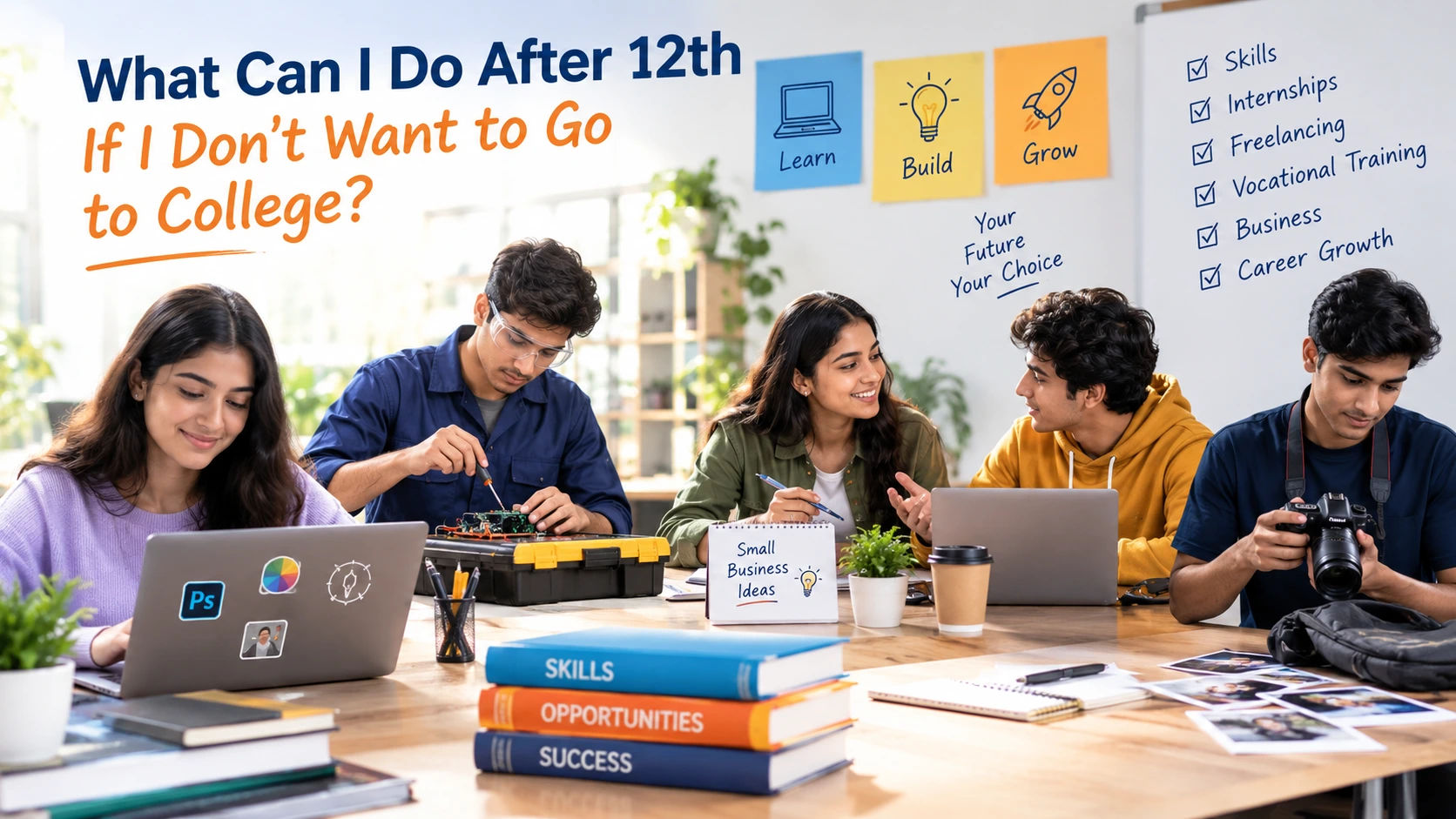
Not everyone wants to spend the next three or four years in a traditional college classroom after completing 12th. Some students want to start earning, learn a practical skill, build a business, travel, pursue creative work, prepare for a competitive career, or take time to understand what they really want.
https://vidyaudbhav.com/blogs/can-i-change-my-career-after-graduation
https://vidyaudbhav.com/blogs/how-long-does-it-take-to-become-a-lawyer
So, what can you do after 12th if you don’t want to go to college?
You have several options. You can learn job-ready skills, pursue vocational or professional training, start freelancing, take internships, build a portfolio, explore entrepreneurship, or prepare for a specific career path. The important thing is to avoid treating “not going to college” as “doing nothing.”
Your next step should still have a clear purpose.
Quick Answer: What Can I Do After 12th Without Going to College?
If you do not want to attend traditional college immediately, you can consider:
- Learning a professional or technical skill.
- Joining a vocational or certificate program.
- Starting an internship or apprenticeship.
- Freelancing in a skill-based field.
- Starting a small business.
- Learning digital skills such as marketing, design, coding or video editing.
- Preparing for government or professional examinations where applicable.
- Taking a structured gap year for skill development.
- Building a portfolio and looking for entry-level work.
- Exploring career options before committing to higher education.
The right choice depends on your interests, financial situation, abilities, location and long-term career goals.
Why Do Some Students Not Want to Go to College?
There are many legitimate reasons.
A student may not enjoy traditional classroom education. Another may want to start earning earlier. Someone else may have financial limitations or prefer practical learning over academic study.
Some students also feel pressured to choose a degree simply because their friends are doing it.
One thing many beginners miss is that avoiding college is not the same as avoiding education. Learning still matters. The difference is how, where and why you learn.
If you are still unsure about your direction, a structured [career planning guide] can help you compare your interests, strengths and possible career paths before making a major decision.
Option 1: Learn a Job-Ready Skill
One of the most practical alternatives to traditional college is skill-based learning.
Depending on your interests, you could learn:
- Graphic design
- Video editing
- Digital marketing
- Web development
- UI/UX design
- Data analytics
- Coding
- Photography
- Content creation
- Foreign languages
- Sales
- Accounting software
- Social media management
The key is not to collect certificates. It is to become capable of doing real work.
For example, someone learning graphic design should create posters, social media creatives, advertisements and brand designs rather than simply watching tutorials.
That portfolio can become evidence of their ability.
Option 2: Choose Vocational or Professional Training
Vocational education focuses more directly on practical knowledge and employment-related skills.
Depending on the country and industry, students may find training in areas such as:
| Healthcare | Medical support and allied health roles |
| Technology | IT support, coding and web development |
| Hospitality | Hotels, tourism and food services |
| Design | Graphic, fashion or digital design |
| Automotive | Vehicle service and technical work |
| Beauty & Wellness | Beauty, skincare and wellness services |
| Media | Video, photography and content |
| Business | Sales, administration and marketing |
These programs can be particularly useful for students who prefer hands-on learning.
However, always check eligibility, accreditation, course duration, practical training and employment requirements before enrolling.
Option 3: Start Freelancing
Freelancing allows you to provide a service to clients instead of working for one employer.
Popular freelance skills include:
- Graphic design
- Video editing
- Writing
- Website development
- Social media management
- Translation
- Virtual assistance
- Photography
- Animation
For example, a student interested in design could spend three months learning a design tool, another month creating sample projects and then start approaching small businesses.
You do not need hundreds of clients to begin.
Your first goal should be to build skill + portfolio + communication + reliability.
Option 4: Take an Internship or Apprenticeship
If your main goal is to gain practical experience, an internship or apprenticeship can be valuable.
Instead of spending all your time studying theory, you get exposure to how a workplace actually operates.
You may learn:
- How teams communicate
- How projects are managed
- How clients are handled
- How deadlines work
- How professional tools are used
- How problems are solved
Even a beginner internship can reveal whether you genuinely enjoy a particular career.
This becomes more important when you are considering a field based only on what you see online.
Option 5: Start a Small Business
College is not the only route to entrepreneurship.
After 12th, some students can begin small, depending on their skills and local regulations.
Examples include:
- Social media services
- Graphic design services
- Photography
- Video editing
- Online tutoring
- Handmade products
- Reselling
- Food-related businesses
- Local service businesses
- Digital products
Start small rather than investing heavily at the beginning.
Learn how customers are acquired, how pricing works, how expenses are controlled and how repeat business is generated.
A business idea is only useful when you can turn it into a sustainable process.
Option 6: Take a Structured Gap Year
A gap year can be useful if it has a plan.
It becomes risky when a student simply postpones decisions without learning anything new.
A productive gap year could look like:
Months 1–2: Explore careers and identify strengths.
Months 3–5: Learn one practical skill.
Months 6–8: Build projects and gain experience.
Months 9–10: Apply for internships or entry-level opportunities.
Months 11–12: Review progress and decide whether to continue working, pursue training or enter higher education.
If you use the year intentionally, it can become a period of exploration rather than lost time.
What Skills Should You Learn After 12th?
There is no single “best skill” for everyone.
Start with your natural interests.
If You Like Technology
Consider:
- Programming
- Web development
- Data analytics
- Cybersecurity
- Cloud technologies
- AI-related tools
If You Like Creativity
Consider:
- Graphic design
- Video editing
- Animation
- Photography
- UI/UX
- Content creation
If You Like Business
Consider:
- Digital marketing
- Sales
- E-commerce
- Customer service
- Business communication
- Financial basics
If You Like Working With People
Consider:
- Sales
- Hospitality
- Customer support
- Teaching
- Counselling-related pathways
- Event management
You can also explore this [career guide based on skills and interests] before selecting a specific field.
A Simple 90-Day Strategy for Beginners
If you have just completed 12th and feel completely confused, don't try to learn five different things at once.
Days 1–15: Explore
Research three career areas.
Write down:
- What the work involves
- Skills required
- Entry-level opportunities
- Training requirements
- Possible challenges
Days 16–45: Learn
Choose one area and study it consistently.
Use beginner-friendly courses, tutorials, books and practical exercises.
Days 46–70: Build
Create three to five real projects.
For example, a beginner in digital marketing could create a sample social media campaign.
A video editor could create short promotional videos.
A web learner could build simple websites.
Days 71–90: Test
Try to get feedback, an internship, small project or first client.
This tells you much more than simply completing another online course.
Tools and Platforms That Can Help
The right tools depend on your chosen career.
Beginner-Friendly Options
- Canva
- CapCut
- Figma
- Google Sheets
- WordPress
- Notion
Free or Freemium Learning Options
- YouTube
- Coursera
- edX
- Google Skillshop
- Microsoft Learn
Professional or Premium Options
- Adobe Creative Cloud
- LinkedIn Learning
- Udemy
- Skillshare
Do not subscribe to multiple platforms at once.
Choose one learning path, complete practical projects and evaluate your progress.
Benefits of Not Going to College Immediately
Choosing an alternative path can provide:
- Earlier practical experience
- More time for skill development
- Potentially lower education costs
- Flexibility
- Opportunity to start earning
- Exposure to real-world work
- More time to discover your interests
But these benefits are not automatic.
They depend heavily on discipline, consistency and the quality of your learning.
Challenges You Should Expect
There are also disadvantages.
Without a degree, some careers may be difficult or impossible to enter because they require formal qualifications or licensing.
You may also face:
- Limited eligibility for certain jobs
- Less structured learning
- Difficulty finding your first opportunity
- Family or social pressure
- Income uncertainty
- Competition from qualified candidates
- Lack of professional networks
Here is where many people make mistakes: they assume that a short course automatically guarantees a job.
It does not.
Employers and clients usually want evidence that you can actually perform the work.
College vs Skill-Based Path
| Learning style | Academic + practical | Usually practical |
| Duration | Often several years | Can vary widely |
| Structure | Highly structured | More self-directed |
| Cost | Can be significant | Varies |
| Degree requirement | Provides a formal degree | Usually does not |
| Career eligibility | Required for many professions | Suitable for selected careers |
| Portfolio importance | Increasingly important | Often extremely important |
| Flexibility | Moderate | Often high |
Neither path is automatically right for everyone.
The better question is: What does your target career actually require?
When College May Still Be Necessary
Some professions have formal educational or licensing requirements.
Examples can include careers in medicine, many engineering roles, law, teaching, research and other regulated professions depending on the country.
If your target profession requires a recognised degree, skipping college may close that particular route.
Before deciding, investigate the qualification requirements for the actual job you want.
If you are reconsidering college because you are confused about which course to choose, you may benefit from reading this [guide to choosing a college for your career goals].
Real-Life Example
Imagine a student named Aisha who has completed 12th and enjoys social media and design but does not want a conventional college program immediately.
Instead of spending the next year doing nothing, she creates a plan.
She learns graphic design, studies social media marketing, creates sample work for imaginary brands, helps a local business with its social media content and builds a portfolio.
After several months, she has practical experience and can decide whether to continue freelancing, seek employment, start a small agency or eventually pursue formal education.
The important part is not that she skipped college.
The important part is that she replaced an unplanned year with structured learning and real experience.
Beginner Strategy: Follow the Skill → Proof → Experience Model
A simple framework is:
Learn → Practise → Build → Show → Work → Improve
Do not stop after learning.
If you learn video editing, edit videos.
If you learn coding, build applications.
If you learn marketing, create campaigns.
If you learn design, build a portfolio.
Proof of ability is often more useful than a long list of completed tutorials.
Advanced Strategy: Build a Career, Not Just a Skill
Once you become comfortable with one skill, combine it with another.
For example:
Graphic Design + Marketing
can lead toward social media or brand work.
Coding + AI
can lead toward technology-focused projects.
Writing + SEO
can lead toward content marketing.
Video Editing + Social Media
can lead toward short-form content services.
This combination approach can make your profile more versatile.
Common Mistakes to Avoid
1. Choosing a Skill Only Because It Is Trending
Trends change quickly.
Choose something you can realistically learn and practise consistently.
2. Buying Expensive Courses Immediately
Start with free resources and understand whether you actually enjoy the subject.
3. Collecting Certificates
Five certificates do not necessarily prove practical ability.
Build projects.
4. Trying Everything
Jumping from coding to design to trading to content creation every few weeks prevents meaningful progress.
5. Expecting Immediate Income
Skill development usually takes time.
Your first objective should be competence.
6. Ignoring Communication Skills
Technical ability alone may not be enough.
Learn how to communicate with clients, colleagues and employers.
Expert Tips for Students After 12th
- Choose a career direction before choosing random courses.
- Research actual job requirements.
- Speak with professionals working in the field.
- Build projects while learning.
- Track your progress every month.
- Develop communication and digital skills.
- Avoid making decisions only because of peer pressure.
- Keep higher education open as a future option.
- Verify certifications and training providers before paying.
- Review your career plan every six to twelve months.
For more guidance, explore Vidya Udbhav's resources on [career planning for students].
Future Trends to Watch
The world of work is changing quickly.
Artificial intelligence, automation, digital commerce, cybersecurity, healthcare technology, renewable energy, data analysis and creator-driven businesses are changing how people work.
This does not mean every student needs to become an AI specialist.
It means adaptability is becoming increasingly important.
A student who can learn new tools, communicate effectively and solve real problems may have more flexibility as industries change.
Frequently Asked Questions
1. Can I get a job after 12th without going to college?
Yes, depending on the industry and job. Some entry-level roles and skill-based careers do not require a university degree, while other professions have formal education requirements.
2. What is the best career after 12th without college?
There is no universally best career. Suitable options depend on your interests, skills, location, financial situation and the qualification requirements of your target profession.
3. Can I earn money after 12th without a degree?
Yes. Freelancing, internships, apprenticeships, sales, creative services, technical work and small businesses are examples of possible routes. Income varies significantly by skill, experience and market.
4. Is it a bad idea to skip college after 12th?
Not necessarily. However, you should understand what opportunities may require a formal degree and create a structured alternative plan if you decide not to attend immediately.
5. Can I go to college later?
In many education systems, yes. Students can sometimes return to formal education after working, completing training or taking a gap period. Specific admission rules depend on the institution and country.
6. What skills can I learn after 12th?
Depending on your interests, you can learn coding, digital marketing, graphic design, video editing, web development, data analytics, sales, communication, photography, design and many other practical skills.
7. Should I take a gap year after 12th?
A gap year can be useful if you have a clear plan for learning, work experience, career exploration or preparation. An unstructured gap year may not provide the same benefits.
Final Advice
Not going to college immediately does not mean you have to stop moving forward.
Your goal should be to build something valuable: a skill, portfolio, professional network, business, qualification or meaningful work experience.
Start by asking yourself three questions:
What am I good at?
What kind of work do I actually enjoy?
What does that career require?
Then build your next step around the answers.
And remember, your decision after 12th does not have to define your entire life. Careers change. Skills evolve. People return to education, switch industries, start businesses and discover new interests.
What matters most is making a deliberate choice instead of simply following what everyone else is doing.
If you need help understanding your options, Vidya Udbhav provides career guidance and educational planning resources to help students make informed decisions about their future.