

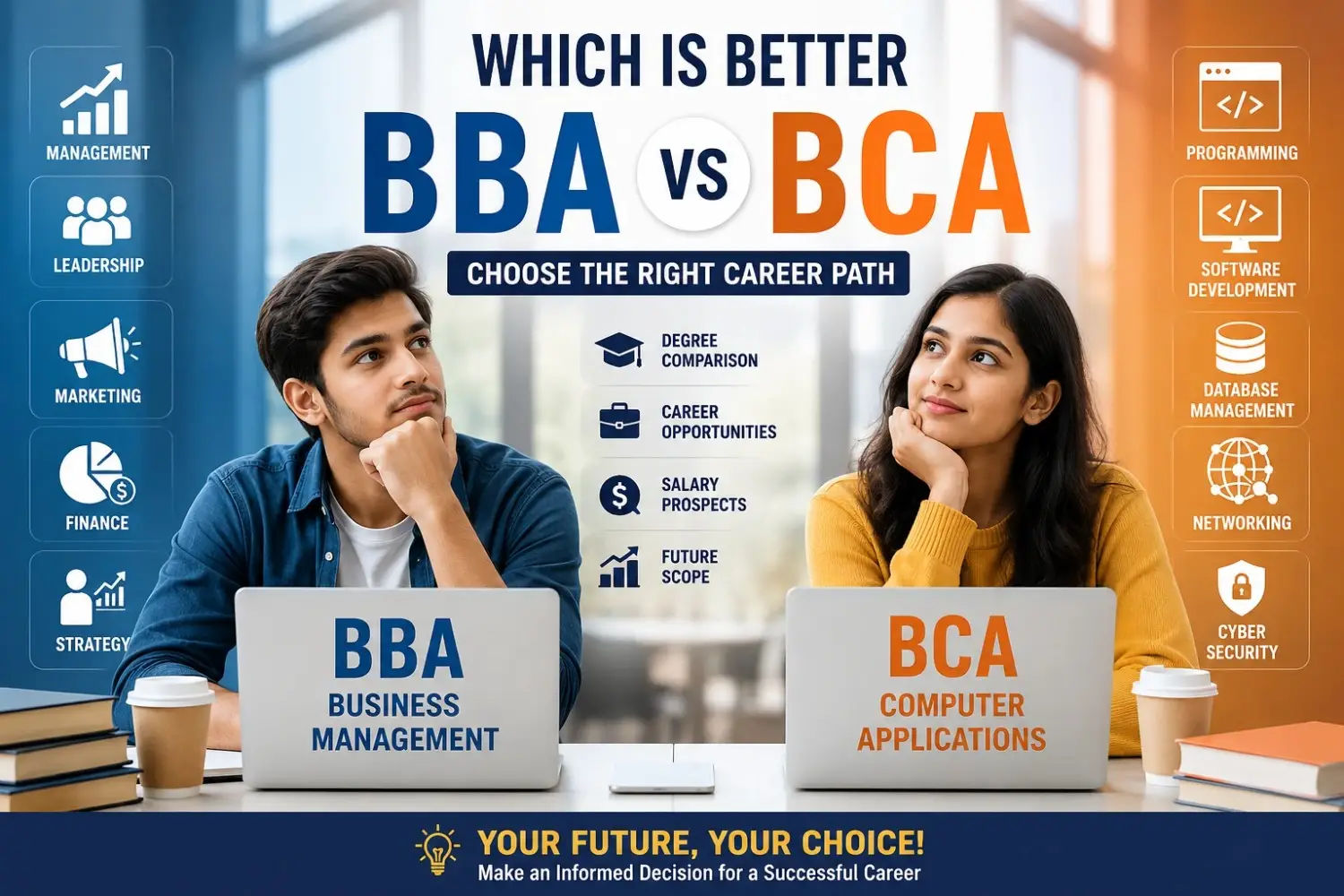
Which Is Better, BBA or BCA? Complete Career Comparison Guide
Choosing the right undergraduate course can shape your future career, earning potential, and professional growth. One question that thousands of students ask every year is: Which is better, BBA or BCA?
The answer depends on your interests, career goals, strengths, and the industry you want to enter.
Both Bachelor of Business Administration (BBA) and Bachelor of Computer Applications (BCA) are highly popular degree programs worldwide. However, they prepare students for completely different career paths.
If you are unsure which course to choose after Class 12, this detailed guide will help you consider every important aspect before making a decision.
Quick Answer: Which Is Better, BBA or BCA?
There is no universally better option.
Choose BBA if you:
- Enjoy business, management, leadership, and marketing.
- Want to work in corporate management roles.
- Plan to pursue an MBA later.
- Have strong communication and people-management skills
Choose BCA if you:
- Enjoy computers, technology, coding, and software.
- Want to enter the IT industry.
- Are interested in software development or cybersecurity
- Prefer technical and analytical work.
Your success depends more on your interest and skills than on the degree itself.
Understanding BBA and BCA
What is BBA?
Bachelor of Business Administration (BBA) is a professional undergraduate degree focused on business management and administration.
Students learn:
- Marketing
- Human Resource Management
- Finance
- Entrepreneurship
- Business Communication
- Operations Management
- Strategic Planning
The program develops leadership and managerial abilities required in modern organizations.
What is BCA?
Bachelor of Computer Applications (BCA) is an undergraduate degree focused on computer science applications and information technology.
Students learn:
- Programming Languages
- Software Development
- Database Management
- Networking
- Cloud Computing
- Web Development
- Cybersecurity Fundamentals
The course prepares students for technical careers in the digital economy.
BBA vs BCA: Complete Comparison Table
| Full Form | Bachelor of Business Administration | Bachelor of Computer Applications |
| Duration | 3 Years | 3 Years |
| Focus Area | Business & Management | Computer Applications & IT |
| Suitable For | Management Aspirants | Technology Enthusiasts |
| Core Skills | Leadership, Communication | Programming, Technical Skills |
| Higher Studies | MBA, PGDM | MCA, M.Tech, MBA |
| Industry | Corporate & Business | IT & Technology |
| Learning Style | Management-Oriented | Technical-Oriented |
| Job Roles | Manager, Analyst, Executive | Developer, Programmer, Analyst |
| Future Demand | High | Very High |
Search Intent Breakdown: Who Should Read This Guide?
This article is useful for:
- Students after Class 12
- Parents helping children choose a course.
- Career counselors
- Working professionals planning education
- Students are confused between management and technology careers.
Career Scope of BBA
One of the biggest reasons students choose BBA is its versatility.
Business professionals are required in nearly every industry.
Popular Career Options After BBA
- Business Development Executive
- Marketing Executive
- HR Executive
- Financial Analyst
- Operations Executive
- Sales Manager
- Project Coordinator
- Entrepreneur
Many students also follow a structured career growth path using a student success roadmap available through Vidya Udbhav's educational guidance resources.
Industries Hiring BBA Graduates
- Banking
- Finance
- Retail
- E-commerce
- Healthcare
- Manufacturing
- Hospitality
- Consulting
Career Scope of BCA
The technology industry continues to grow rapidly worldwide.
As digital transformation accelerates, demand for technology professionals remains strong.
Popular Career Options After BCA
- Software Developer
- Web Developer
- Application Developer
- Data Analyst
- System Administrator
- Network Engineer
- Cybersecurity Analyst
- Cloud Support Engineer
Students interested in technology careers often benefit from career planning guides available on Vidya Udbhav.
Industries Hiring BCA Graduates
- IT Services
- Software Companies
- FinTech
- Healthcare Technology
- E-commerce
- Telecommunications
- Artificial Intelligence
- Cloud Computing
Skills You Develop in BBA
BBA focuses on developing business-oriented competencies.
Key Skills
Leadership
Managing teams and projects effectively.
Communication
Presenting ideas clearly and professionally.
Decision Making
Solving business challenges.
Strategic Thinking
Understanding market trends and opportunities.
Negotiation
Handling clients, stakeholders, and business deals.
These skills remain valuable regardless of industry.
Skills You Develop in BCA
BCA focuses on technical and analytical capabilities.
Key Skills
Programming
Writing and understanding code.
Problem Solving
Developing logical solutions.
Database Management
Handling large volumes of data.
System Design
Creating scalable software systems.
Technical Analysis
Evaluating and improving technology solutions.
These skills are highly sought after in today's digital economy.
Salary Comparison: BBA vs BCA
Salary depends on location, organization, skills, internships, certifications, and experience.
Average Entry-Level Salary Comparison
| Qualification | Average Starting Salary |
| BBA | Moderate |
| BCA | Moderate to High |
| BBA + MBA | High |
| BCA + MCA | High |
| BCA + Specialized IT Skills | Very High |
In many markets, BCA graduates with strong technical skills may initially earn more than fresh BBA graduates.
However, BBA graduates pursuing MBA programs often achieve substantial long-term salary growth.
Which Course Has Better Future Scope?
This is where many students become confused.
The reality is that both fields have strong futures.
Future Scope of BBA
Growing areas include:
- Digital Marketing
- Business Analytics
- International Business
- Entrepreneurship
- Financial Management
- Product Management
Future Scope of BCA
Growing areas include:
- Artificial Intelligence
- Machine Learning
- Cloud Computing
- Cybersecurity
- Data Science
- Software Engineering
Technology-related careers are currently expanding at a very rapid pace globally.
BBA vs BCA for Higher Studies
Higher education significantly impacts long-term career growth.
After BBA
Popular options include:
- MBA
- PGDM
- International Business Programs
- Finance Specializations
- Marketing Specializations
After BCA
Popular options include:
- MCA
- MBA
- M.Tech
- Data Science Programs
- Cybersecurity Certifications
Both degrees offer excellent opportunities for further specialization.
Real-Life Example
Consider two students.
Student A
Interested in:
- Marketing
- Team leadership
- Business strategy
- Entrepreneurship
For this student, BBA is likely the better choice.
Student B
Interested in:
- Coding
- Technology
- Software creation
- Problem-solving
For this student, BCA is likely the stronger option.
The best course aligns with your interests rather than market trends alone.
Beginner Strategy for Choosing Between BBA and BCA
If you are still uncertain, ask yourself these questions:
Do you enjoy technology?
If yes, BCA may be suitable.
Do you enjoy business discussions?
If yes, BBA may be suitable.
Do you like mathematics and logic?
BCA often requires stronger analytical thinking.
Do you enjoy leadership and communication?
BBA emphasizes these areas.
One thing many beginners miss is that personal interest often predicts long-term success better than salary comparisons.
Advanced Strategy for Career Planning
Experienced career advisors often recommend evaluating three factors:
Interest
What genuinely excites you?
Aptitude
What are you naturally good at?
Market Demand
Which skills will remain valuable in the future?
The intersection of these three factors usually leads to the best career decisions.
Common Mistakes Students Make
Following Friends
Choosing a course because friends are enrolling.
Chasing Trends
Selecting a program solely because it is popular.
Ignoring Personal Strengths
Not considering interests and abilities.
Focusing Only on Salary
Career satisfaction matters too.
Lack of Research
Many students choose without understanding the course content.
A well-researched decision can prevent years of frustration.
Practical Solutions for Choosing the Right Course
Talk to Industry Professionals
Gain real-world insights.
Review Course Syllabi
Understand what you will study.
Attend Career Counseling Sessions
Professional guidance can help.
Take Aptitude Assessments
Identify your strengths objectively.
Explore Internship Preparation Resources
Practical exposure often clarifies career preferences.
Useful Tools and Platforms for Career Exploration
Beginner-Friendly
- Google Career Resources
- LinkedIn Learning
- Coursera
Intermediate
- Skillshare
- Udemy
- edX
Advanced
- Professional Certification Programs
- Industry-Specific Training Platforms
These tools can help students understand career paths before committing to a degree.
Industry Trends Shaping the Future
Trends Affecting BBA Graduates
- Digital Transformation
- Business Analytics
- Remote Team Management
- Global Business Expansion
Trends Affecting BCA Graduates
- Artificial Intelligence
- Automation
- Cybersecurity
- Cloud Infrastructure
- Data Analytics
Both fields continue evolving rapidly.
Expert Tips Before You Decide
Choose Interest Over Pressure
Long-term success requires genuine motivation.
Focus on Skill Development
Degrees open doors; skills create opportunities.
Build a Strong Portfolio
Projects and internships matter.
Develop Communication Skills
Important in both careers.
Keep Learning
Continuous learning is essential in today's economy.
Best Practices for Career Success
- Gain internship experience early.
- Build professional networks
- Learn industry-relevant software
- Earn certifications
- Stay updated with market trends.
- Participate in projects and competitions.
These practices improve employability regardless of your chosen degree.
Final Advice: Which Is Better, BBA or BCA?
If your passion lies in management, business, leadership, marketing, or entrepreneurship, BBA is likely the right choice.
If you enjoy technology, software development, computers, coding, and problem-solving, BCA is likely the better option.
There is no one-size-fits-all answer.
The best course is the one that aligns with your interests, strengths, and long-term goals.
Students can further strengthen their decision-making process through career planning guides, placement preparation strategies, and educational resources available on Vidya Udbhav.
Conclusion
The debate around which is better, BBA or BCA, does not have a universal winner.
BBA opens doors to management and business careers, while BCA provides opportunities in technology and IT.
Both degrees offer excellent growth potential, strong career opportunities, and pathways to advanced education.
Instead of asking which course is better for everyone, ask which course is better for you.
That single shift in perspective often leads to the right decision.
Frequently Asked Questions (FAQs)
1. Which has a higher salary, BBA or BCA?
Initially, BCA graduates may earn slightly more in technical roles. However, BBA graduates who pursue MBA programs can achieve very high long-term salaries.
2. Is BCA harder than BBA?
BCA is generally considered more technical because it involves programming, databases, and software development. BBA focuses more on management and business concepts.
3. Can I do an MBA after BCA?
Yes. BCA graduates are eligible for MBA programs and often move into technology management roles.
4. Which course has better future scope?
Both have strong future prospects. BCA benefits from rapid technology growth, while BBA benefits from continuous business expansion.
5. Is BBA good for entrepreneurship?
Yes. BBA teaches business management, finance, marketing, and leadership skills that are valuable for entrepreneurs.
6. Can arts students pursue BCA?
In many institutions, arts students can pursue a BCA if they meet admission requirements. Eligibility varies by institution.
7. Which is better after 12th commerce: BBA or BCA?
Commerce students interested in business generally choose BBA, while those interested in technology and IT often choose BCA.